




01. Edit your quick aphasia battery online
Type text, add images, blackout confidential details, add comments, highlights and more.

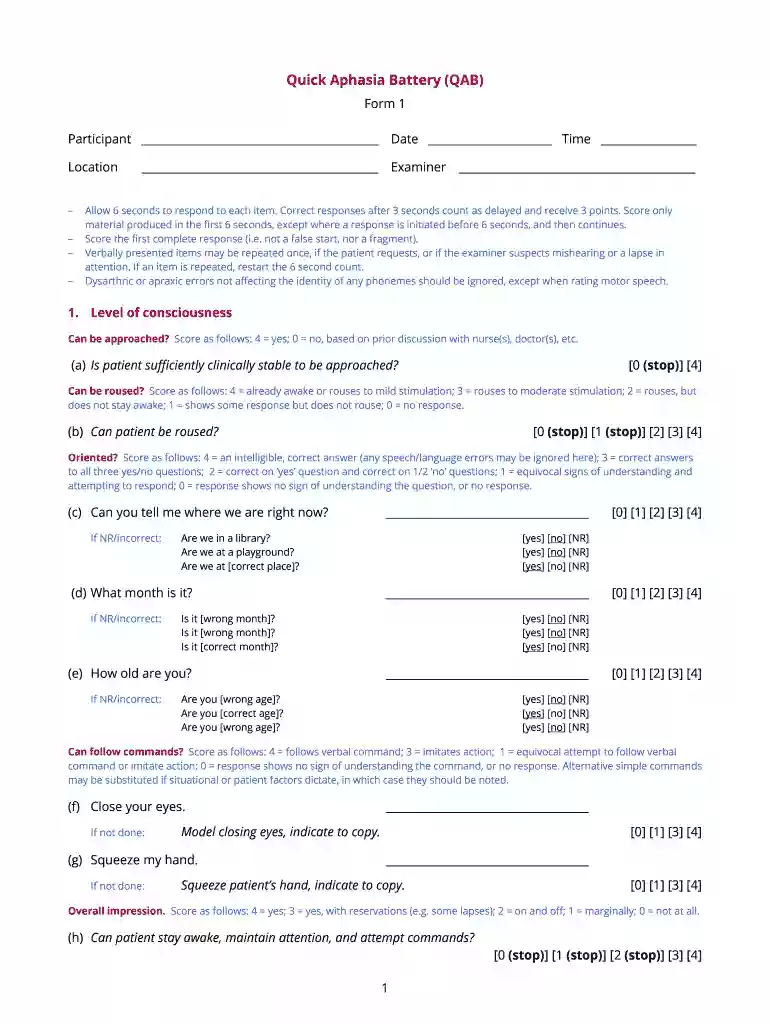
Type text, add images, blackout confidential details, add comments, highlights and more.

Draw your signature, type it, upload its image, or use your mobile device as a signature pad.

Send quick aphasia battery pdf via email, link, or fax. You can also download it, export it or print it out.
The Quick Aphasia Battery (QAB) is a structured assessment tool specifically designed to evaluate language function in individuals suspected of having aphasia. Aphasia is a communication disorder that affects a person's ability to process and produce language, often occurring due to brain injury or stroke.
The QAB comprises various sections that assess critical language skills, including:
Each section provides scoring criteria that quantify the severity of language impairments, which is essential for guiding clinical decisions and therapy planning.
Utilizing the Quick Aphasia Battery PDF effectively involves several steps to ensure accurate assessment and scoring. To begin using the PDF:
Download the QAB PDF: Retrieve the document from a reliable source, ensuring it is the most current version.
Familiarize with the sections: Review each part of the battery to understand the specific areas of language function that will be assessed.
Prepare the testing environment: Ensure that the testing setting is quiet and free from distractions to optimize the patient’s performance.
Conduct the assessment: Administer the sections consecutively, allowing the patient time to respond without pressure. Use the scoring criteria provided in the PDF to evaluate responses.
Document results: Record scores and observations directly on the PDF or in an accompanying report template for future reference.
Plan follow-up strategies: Based on the results, determine the next steps for treatment or further assessment as necessary.
This structured approach ensures that the Quick Aphasia Battery is administered effectively, leading to useful insights regarding the patient's language capabilities.
Acquiring the Quick Aphasia Battery in PDF format is straightforward. It can typically be obtained through:
Ensuring to source the PDF from authenticated professionals or organizations can guarantee that the material is up-to-date and comprehensive.
Understanding key terminology associated with the Quick Aphasia Battery is vital for effective use. Key terms include:
Acquainting oneself with these terms will enhance the application and comprehension of the QAB in both clinical and research settings.
Practical application of the Quick Aphasia Battery PDF can enhance understanding and promote better patient outcomes. Examples include:
These varied scenarios demonstrate the flexibility of the Quick Aphasia Battery in different contexts concerning aphasia assessment.
The core components of the Quick Aphasia Battery PDF encompass several essential elements that facilitate effective assessment:
These elements work together to ensure that language assessments are accurate and informative, supporting better patient care decisions.
The Quick Aphasia Battery PDF is primarily utilized by a range of professionals involved in language assessment and therapy:
These groups leverage the Quick Aphasia Battery to enhance their understanding of aphasia in clinical and academic settings.


We've got more versions of the quick aphasia battery form. Select the right quick aphasia battery version from the list and start editing it straight away!
| Versions | Form popularity | Fillable & printable |
|---|---|---|
| 2018 | 4.8 Satisfied (160 Votes) |
At DocHub, your data security is our priority. We follow HIPAA, SOC2, GDPR, and other standards, so you can work on your documents with confidence.
Mar 21, 2019 The product was originally in the Expedited Access pathway, which is now called Breakthrough, because this product meets unmet needs forRead more
QUICK APHASIA BATTERY. (QAB). An assessment of strengths and weaknesses of language function in persons with aphasia utilizing 8 subtests. REVISED HEARINGRead more
by SM Wilson 2018 Cited by 242 This paper describes a quick aphasia battery (QAB) that aims to provide a reliable and multidimensional assessment of language function in about a quarter ofRead more


