




01. Edit your id 3738 online
Type text, add images, blackout confidential details, add comments, highlights and more.

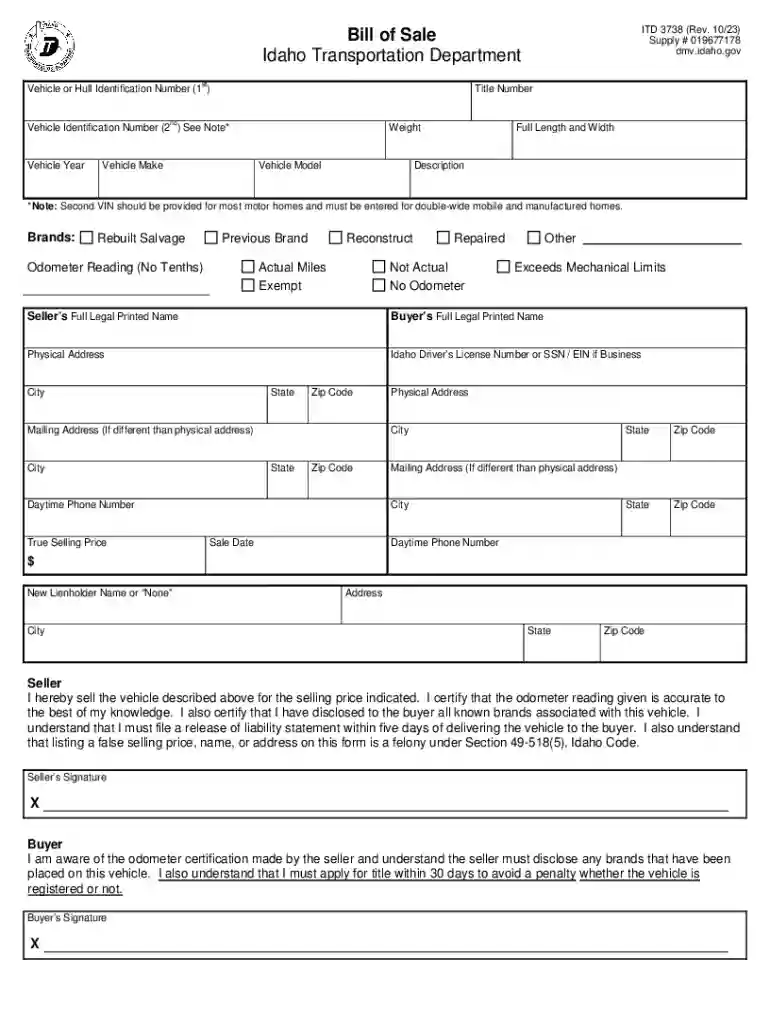
Type text, add images, blackout confidential details, add comments, highlights and more.

Draw your signature, type it, upload its image, or use your mobile device as a signature pad.

Send idaho exempt via email, link, or fax. You can also download it, export it or print it out.
A Bill of Sale is a legal document that serves as evidence of a transaction between a seller and a buyer, typically for personal property like vehicles, machinery, or livestock. This document outlines the transfer of ownership and is crucial for validating the sale, detailing both parties' agreement terms. Though commonly associated with vehicle sales, a Bill of Sale is applicable to a wide range of transactions involving personal property.
Functioning as both a receipt and proof of ownership, the Bill of Sale includes essential information such as the date of sale, description of the item, sale price, and personal details of both the seller and the buyer. By documenting these details, the Bill of Sale helps prevent potential disputes over ownership or terms of the transaction.
In most cases, the Bill of Sale is applicable in private sales where notarization is not required, serving as a mutual agreement between the parties involved. However, the necessity for specific details and the formal structure of a Bill of Sale may vary by state, especially for high-value items like vehicles where additional information might be necessary to comply with legal standards.
Using a Bill of Sale involves several crucial steps to ensure that the transaction is correctly documented and legally sound. Understanding each component of the Bill of Sale is vital to avoid potential legal challenges.
Preparation: Before drafting a Bill of Sale, gather all necessary information about the item being sold, such as a vehicle's make, model, VIN, and condition. Also, obtain contact details of both the buyer and the seller.
Drafting: Use a template that includes fields for essential details: date, buyer and seller names, item description, sale price, and any specific terms of the sale. Templates can be found online or through legal services.
Execution: Once completed, both parties should carefully review the document, ensuring all information is accurate and reflects the agreed-upon terms. Each party should sign and date the document; in some jurisdictions, notarization may be required for added validity.
Distribution: Provide each party with a copy of the signed Bill of Sale. This may be necessary for future registration processes or legal inquiries.
Storage: Safely store the original Bill of Sale. Buyers may need it to register the item or for tax purposes, while sellers may require it as proof of the transaction should disputes arise.
Completing a Bill of Sale correctly requires attention to detail and adherence to any state-specific guidelines. Below are the typical steps involved in the process:
Identify the Parties: Clearly state the full names and addresses of both the seller and the buyer. These details are crucial for record-keeping and verification.
Describe the Property: Provide a comprehensive description of the item, including relevant details like serial numbers, registration info, or distinguishing features. For vehicles, include make, model, year, and VIN.
State the Sale Price and Terms: Clearly outline the agreed sales price and any terms of payment, such as installment arrangements or deposits made.
Include Representations and Warranties: Specify any assurances regarding the property's condition. If sold "as-is," this should be explicitly stated to limit future liability for the seller.
Sign and Date: Ensure both parties sign the document along with the sale date. Notarization may be advisable or required depending on the value and type of property.
Distribute Copies: Each party should keep a signed copy. For vehicle sales, a copy may need to be provided to the DMV for registration purposes.
To ensure a Bill of Sale is comprehensive and legally binding, certain key elements should always be included:
By including these elements, the Bill of Sale can effectively support legal inquiries and clarify ownership matters.
In the U.S., a Bill of Sale functions as a crucial legal document for documenting the sale of personal property. While its primary role is to transfer ownership, it also aids compliance with state law concerning sales tax and registration, especially for vehicles.
Ownership Transfer: The Bill of Sale denotes the shift in ownership from the seller to the buyer, which is pivotal for any future legal claims or ownership disputes.
Sales Taxes: Buyers may need the document to prove the purchase price and calculate any applicable sales taxes when registering the item.
Registration and Title: Many states require a Bill of Sale to register vehicles or transfer titles, and this document thus becomes an essential part of the paperwork submitted to the DMV.
Adhering to state-specific requirements is crucial; consulting with a legal professional can help ensure compliance and avoid penalties.
Bills of Sale are utilized across various contexts but are particularly common in the following scenarios:
Private Vehicle Sales: Individuals selling or purchasing vehicles privately rely on a Bill of Sale to document the transaction and facilitate title transfers.
Business Equipment: Companies buying or selling machinery or office equipment use Bills of Sale for legitimate ownership records.
Livestock Transactions: In agricultural contexts, Bills of Sale are vital for legal ownership transfers of animals like cattle or horses.
Personal Property: Selling valuable items like boats, trailers, or luxury goods typically involves a Bill of Sale to provide proof of purchase and protection for both parties.
Using a Bill of Sale provides reassurance and clarity, making it an essential document for transactions involving high-value items or assets that require official registration.
The requirements for a valid Bill of Sale can vary significantly between states. Understanding these differences ensures compliance and avoids legal issues:
Notarization: Some states require notarization of the Bill of Sale, particularly for vehicle sales, to add a layer of authenticity and prevent fraud.
Additional Disclosures: States like California or New York may have specific disclosure requirements, such as smog certification or odometer readings for vehicles.
Template Variations: Certain states provide official templates that must be used for specific transactions, particularly vehicle registrations.
Filing with State Departments: In vehicle sales, the Bill of Sale acts as a prerequisite for DMV title filings and registrations, which may have additional paperwork requirements.
Keeping abreast of state requirements ensures that the Bill of Sale fulfills its intended purpose without legal complications.
While traditional Bills of Sale are widely used, there are alternatives and versions specific to various needs or jurisdictions:
General Bill of Sale: A versatile document for transactions involving general personal property.
Vehicle Bill of Sale: Tailored for vehicle transactions, often including state-mandated disclosures and vehicle-specific information.
Absolute Bill of Sale: Indicates that the seller agrees to the transfer without any liens or claims on the item.
Conditional Bill of Sale: States conditions that need to be fulfilled before ownership is transferred, such as completing a payment plan.
Choosing the correct version of a Bill of Sale based on the transaction type and legal requirements enhances its effectiveness and prevents future disputes.
We've got more versions of the id 3738 form. Select the right id 3738 version from the list and start editing it straight away!
At DocHub, your data security is our priority. We follow HIPAA, SOC2, GDPR, and other standards, so you can work on your documents with confidence.
in consideration of $. , do hereby sell, transfer and convey to the following vehicle: Clearly print or type all information, except signatures.Read more
A bill of sale is a written instrument that attests to a buyers purchase of property from a seller. In this way, it is similar to a receipt.Read more


