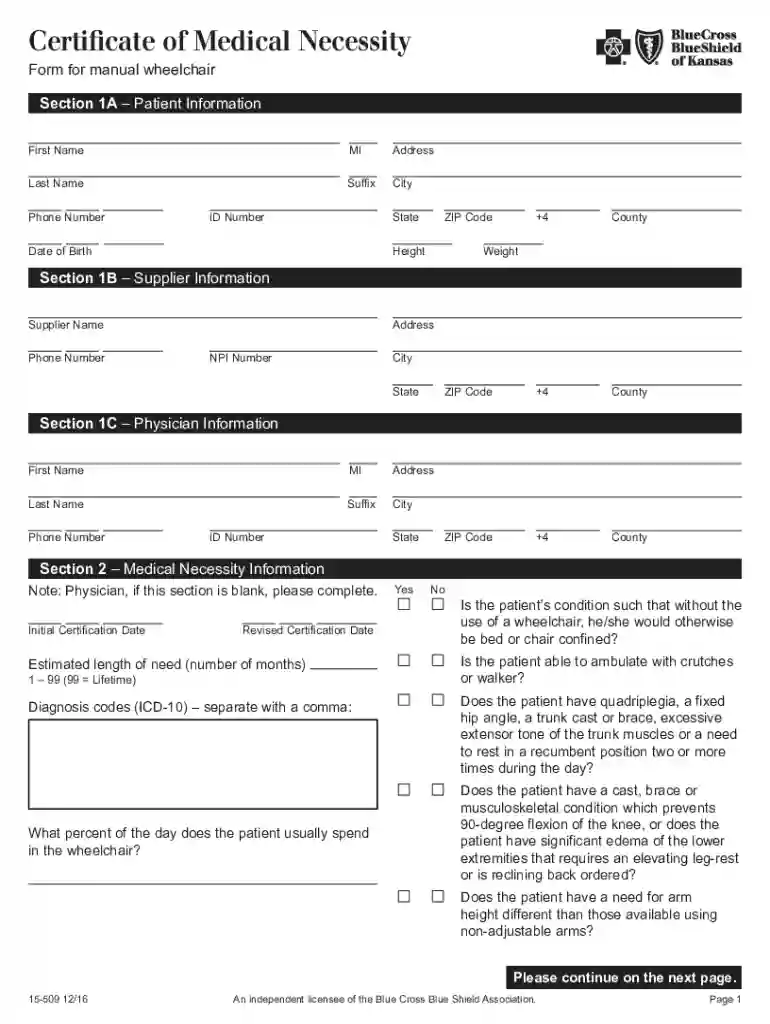
Certificate of Medical Necessity Form for manual wheelchair 2026

Get Form
Certificate of Medical Necessity Form for manual wheelchair Preview on Page 1

Here's how it works

01. Edit your form online
Type text, add images, blackout confidential details, add comments, highlights and more.

02. Sign it in a few clicks
Draw your signature, type it, upload its image, or use your mobile device as a signature pad.

03. Share your form with others
Send it via email, link, or fax. You can also download it, export it or print it out.

Definition and Meaning

A Certificate of Medical Necessity (CMN) form for a manual wheelchair is a crucial document used in the healthcare system to verify that a patient's medical condition necessitates the use of a manual wheelchair. This form addresses the clinical need by providing detailed information about the patient's medical status, mobility limitations, and specific diagnosis codes, thereby facilitating the approval process for insurance coverage. The form serves as a conduit among healthcare professionals, patients, and insurance providers, ensuring that the required medical equipment is justifiably aligned with the patient's medical condition.

How to Use the Certificate of Medical Necessity Form for a Manual Wheelchair

To use the Certificate of Medical Necessity form effectively, one must follow a structured approach:

  1. Collect Patient Information: Start by gathering all necessary personal and medical details of the patient, including name, date of birth, and contact information.
  2. Complete Medical Sections: The healthcare provider needs to meticulously fill out sections related to the patient's medical condition, diagnosis codes, and mobility limitations. This includes documenting the patient's current physical limitations and how a manual wheelchair can aid in their care.
  3. Supplier and Physician Details: Ensure that the form includes accurate information about the supplier of the wheelchair and the physician who is recommending the equipment.
  4. Review and Sign: Both the patient and the healthcare provider should thoroughly review the form for accuracy before signing. The physician's signature attests to the medical necessity of the request.
  5. Submit to Insurance: Once completed and signed, submit the form to the patient's insurance company for review and approval.

Steps to Complete the Certificate of Medical Necessity Form for a Manual Wheelchair

  1. Start with Patient Information: Input the patient's personal details in the designated section.
  2. Document Medical Necessity: The physician should clearly describe the medical justification for needing a manual wheelchair, including pertinent medical history and physical examinations.
  3. Add Diagnosis Codes: Include relevant ICD-10 diagnosis codes that support the medical need for a wheelchair.
  4. Supplier Information: Provide details about the wheelchair supplier, ensuring that they are registered and compliant with Medicare or insurance requirements.
  5. Physician Certification: The attending physician must complete their section, certifying the truthfulness and accuracy of the information.
  6. Final Check and Submission: Verify all sections for completeness and accuracy before submitting the form to the insurance company for processing.

Key Elements of the Certificate of Medical Necessity Form for a Manual Wheelchair

  • Patient Information: Includes personal details and contact information.
  • Medical Condition Section: Details the reasons for needing a manual wheelchair.
  • Physician Attestation: A declaration from the doctor affirming the necessity of the wheelchair for the patient's condition.
  • Diagnosis Codes: Uses standardized codes to establish the medical need.
  • Supplier Details: Information about where and how the wheelchair will be sourced.

Legal Use of the Certificate of Medical Necessity Form for a Manual Wheelchair

The CMN form not only serves as a justification document for insurance purposes but also fulfills legal requirements. Physicians confirm the necessity according to healthcare regulations, ensuring compliance with legal standards set by insurance providers and government bodies such as Medicare in the United States. By providing a legally binding endorsement of the patient's need for a wheelchair, the form helps patients access the required medical equipment lawfully.

Important Terms Related to the Certificate of Medical Necessity Form for a Manual Wheelchair

  • ICD-10 Codes: These are medical classification codes used to denote diagnoses and are critical for justifying the medical necessity.
  • Mobility Limitations: Refers to the documented physical challenges faced by the patient, which makes a wheelchair necessary.
  • Medicare Compliance: Ensuring the form adheres to Medicare’s guidelines or those of other insurance providers for medical equipment approval.

Examples of Using the Certificate of Medical Necessity Form for a Manual Wheelchair

Consider a patient with a chronic orthopedic condition causing difficulty in mobility. The physician completes the CMN form detailing the limitations caused by the condition and submits it to the insurance provider. Once reviewed, this supports the patient's claim for coverage of a manual wheelchair. Another scenario might involve a post-operative patient requiring temporary assistance, where the form justifies short-term use.

Who Typically Uses the Certificate of Medical Necessity Form for a Manual Wheelchair

This form is primarily used by:

  • Healthcare Providers: Physicians and medical personnel who determine and certify the need for a wheelchair.
  • Patients and Families: Individuals who need to confirm the necessity of a manual wheelchair to their insurance.
  • Insurance Companies: Entities that require the form to process and approve coverage requests for durable medical equipment.
decoration image ratings of Dochub

Eligibility Criteria

To be eligible for a manual wheelchair through insurance coverage, the patient must:

  • Have a documented medical condition that significantly impairs mobility.
  • Obtain a certification from a licensed physician who deems the wheelchair medically necessary.
  • Fulfill any specific criteria set by the insurance provider or Medicare, which may include prior authorizations or additional documentation.
decoration image
be ready to get more

Complete this form in 5 minutes or less

Get form

Got questions?

We have answers to the most popular questions from our customers. If you can't find an answer to your question, please contact us.
Contact us
I am writing on behalf of my patient, [Patient Name], to document the medical necessity to treat their [Diagnosis] with [Product Name]. This letter serves to document my patients medical history and diagnosis and to summarize my treatment rationale. Please refer to the [List any Enclosures] enclosed with this letter.
A wheelchair is medically necessary if the beneficiarys medical condition(s) and mobility limitations are such that without the use of the wheelchair, the beneficiarys ability to perform one or more mobility related activities of daily living (ADL) or instrumental activities of daily living (IADL) in or out of the
Health care services or supplies needed to diagnose or treat an illness, injury, condition, disease or its symptoms and that meet accepted standards of medicine.
Wheelchairs Scooters Medicare Part B (Medical Insurance) covers power-operated vehicles (scooters) and wheelchairs as durable medical equipment (DME) if: The doctor treating your condition submits a written order stating that you have a medical need for a wheelchair or scooter for use in your home.
A doctors attestation that a service is medically necessary is an important consideration. Your doctor or other provider may be asked to provide a Letter of Medical Necessity to your health plan as part of a certification or utilization review process.

Security and compliance

At DocHub, your data security is our priority. We follow HIPAA, SOC2, GDPR, and other standards, so you can work on your documents with confidence.

Learn more
ccpa2
pci-dss
gdpr-compliance
hipaa
soc-compliance

People also ask

A Letter of Medical Necessity (LMN) is the written explanation from the treating physician describing the medical need for services, equipment, or supplies to assist the claimant in the treatment, care, or relief of their accepted work-related illness(es).
Generally, your healthcare provider needs to include the following information in an LOMN: Your name and medical history. Your diagnosis. Reason why the product or service is needed. Duration of treatment. Date the letter was written. Their relationship to you, contact information, and signature.

Related links