




01. Edit your form online
Type text, add images, blackout confidential details, add comments, highlights and more.

Type text, add images, blackout confidential details, add comments, highlights and more.

Draw your signature, type it, upload its image, or use your mobile device as a signature pad.

Send it via email, link, or fax. You can also download it, export it or print it out.
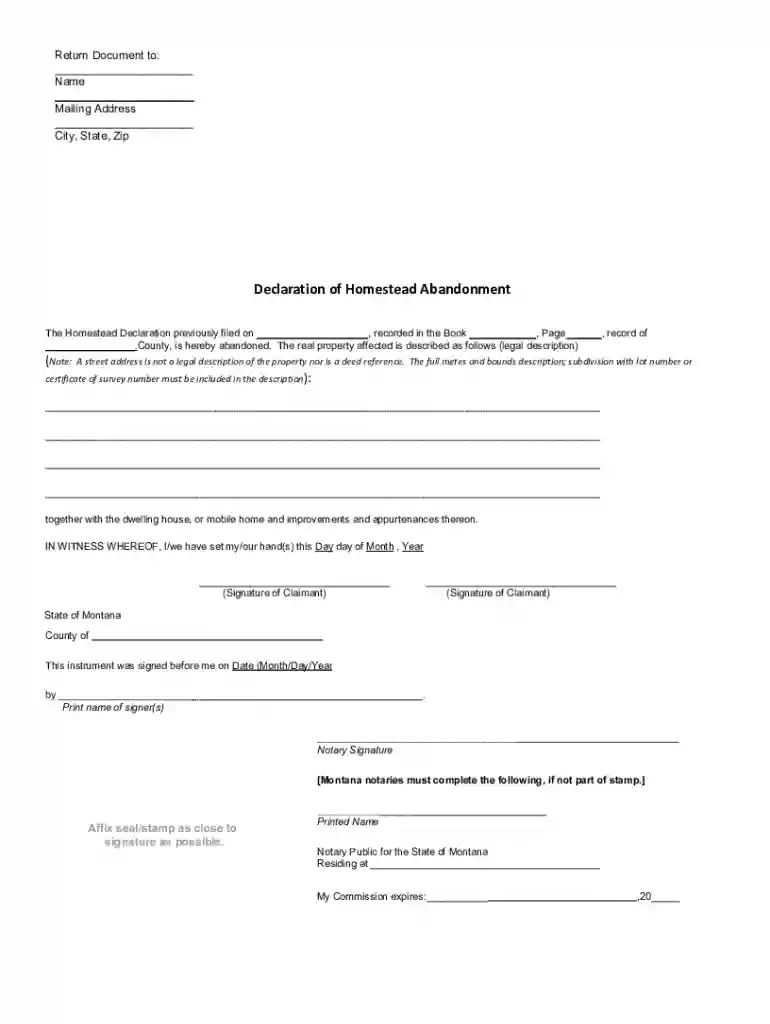
The Declaration of Homestead Abandonment in Montana is a legal document that formally signifies the renunciation of a previously declared homestead on a property. A homestead is a legal provision that protects a portion of the equity in a homeowner’s primary residence from creditors. Abandonment of this declaration typically implies that the owner no longer claims these protections on the specified property, whether due to selling the property or changing their primary residence.
When dealing with the Declaration of Homestead Abandonment, it's essential to understand key legal terms:
Filing a Declaration of Homestead Abandonment involves several precise steps:
Identify the Property: Clearly outline the legal description of the property whose homestead status you intend to abandon.
Complete the Form: Fill out the declaration form accurately, including personal details like the claimant's name and mailing address.
Sign the Document: All claimants must provide their signatures on the document.
Notary Verification: The form must be notarized, confirming the identity of the claimants and the authenticity of their signatures.
File the Form: Submit the completed form to the appropriate county recorder’s office where the property is located.
This document typically includes several crucial elements:
Utilizing this declaration is crucial in cases where:
Montana, like other states, has specific guidelines for this declaration:
Filing this document is necessary to:
Consider these scenarios:
Typical users of this form include:


To file this declaration, have the following documents ready:
We've got more versions of the Declaration of Homestead Abandonment - montana form. Select the right Declaration of Homestead Abandonment - montana version from the list and start editing it straight away!
At DocHub, your data security is our priority. We follow HIPAA, SOC2, GDPR, and other standards, so you can work on your documents with confidence.
Sample Declaration of Homestead Abandonment. The Homestead Declaration previously [Montana notaries must complete the following, if not part of stamp.]Read more
The people of the territory formed their own government and issued a declaration of independence in 1836. Homestead Bed and Breakfast Brenham, Texas
By signing a legal document known as a homestead declaration, Montanans can protect up to $350,000 in equity of their home against most unsecured debts.


