




01. Edit your form online
Type text, add images, blackout confidential details, add comments, highlights and more.

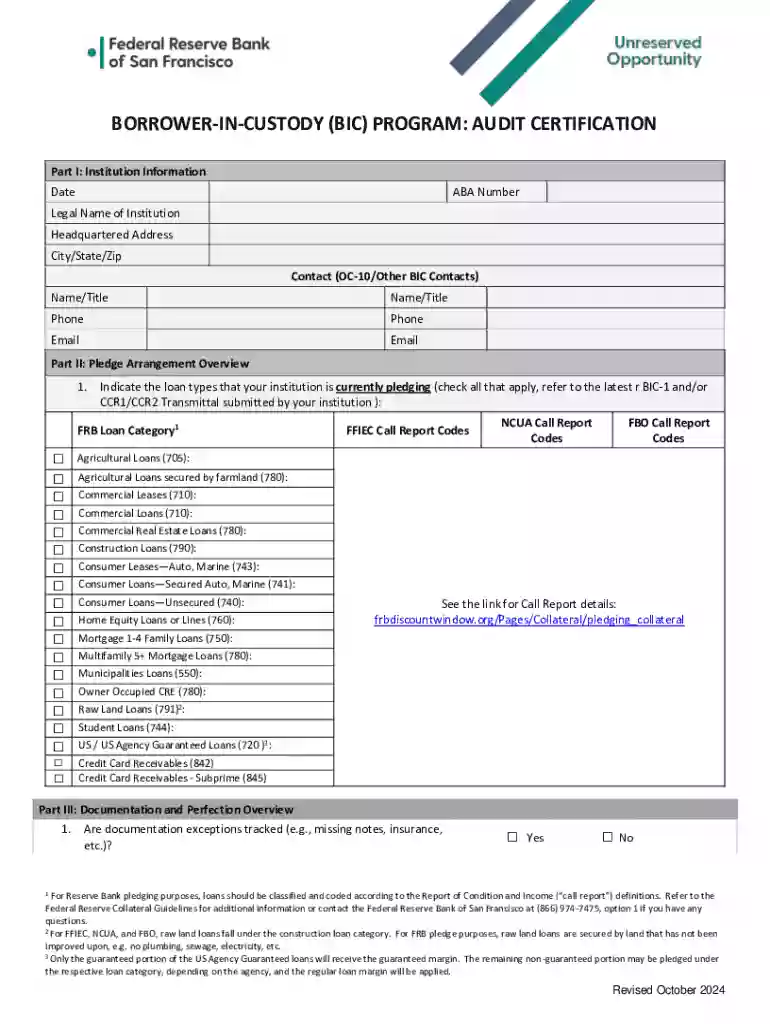
Type text, add images, blackout confidential details, add comments, highlights and more.

Draw your signature, type it, upload its image, or use your mobile device as a signature pad.

Send it via email, link, or fax. You can also download it, export it or print it out.
The "Part I: Institution Information" section serves as a foundational component in numerous administrative and compliance forms. This section is primarily designed to capture critical attributes and data about an institution, typically required for various regulatory, financial, or legal processes. Whether related to compliance with Federal Reserve guidelines, tax filings, or other institutional reporting needs, it plays a crucial role in ensuring accurate identification and assessment of the entity in question. This section typically includes basic identifiers such as institution name, address, and contact information.
Completing the "Part I: Institution Information" section requires meticulous attention to detail to ensure all necessary data accurately reflects the institution's standing.
The "Part I: Institution Information" form is utilized by a range of stakeholders across various sectors.


The "Part I: Institution Information" section must be completed in accordance with all legal stipulations and can often be subject to audits to verify compliance.
In order to accurately complete the "Part I: Institution Information" form, certain documents are typically needed:
Failure to accurately complete and submit the "Part I: Institution Information" can lead to significant consequences.
In today’s digital era, the "Part I: Institution Information" form may be submitted via digital platforms or traditional paper methods. Each has its pros and cons.
Completing the "Part I: Institution Information" section is often facilitated through various software solutions tailored to streamline the document workflow.
By thoroughly covering each aspect of the "Part I: Institution Information" form, this guide offers comprehensive insights to help users effectively navigate and complete this essential documentation accurately and efficiently.
We've got more versions of the Part I: Institution Information form. Select the right Part I: Institution Information version from the list and start editing it straight away!
At DocHub, your data security is our priority. We follow HIPAA, SOC2, GDPR, and other standards, so you can work on your documents with confidence.


Feb 13, 2025 This new designation includes any non-R1 or R2 institution that spends more than $2.5 million on research annually, accounting for 216Read more
(a) An educational agency or institution may disclose personally identifiable information from an education record to appropriate parties, including parents ofRead more


