




01. Edit your form online
Type text, add images, blackout confidential details, add comments, highlights and more.

Type text, add images, blackout confidential details, add comments, highlights and more.

Draw your signature, type it, upload its image, or use your mobile device as a signature pad.

Send it via email, link, or fax. You can also download it, export it or print it out.
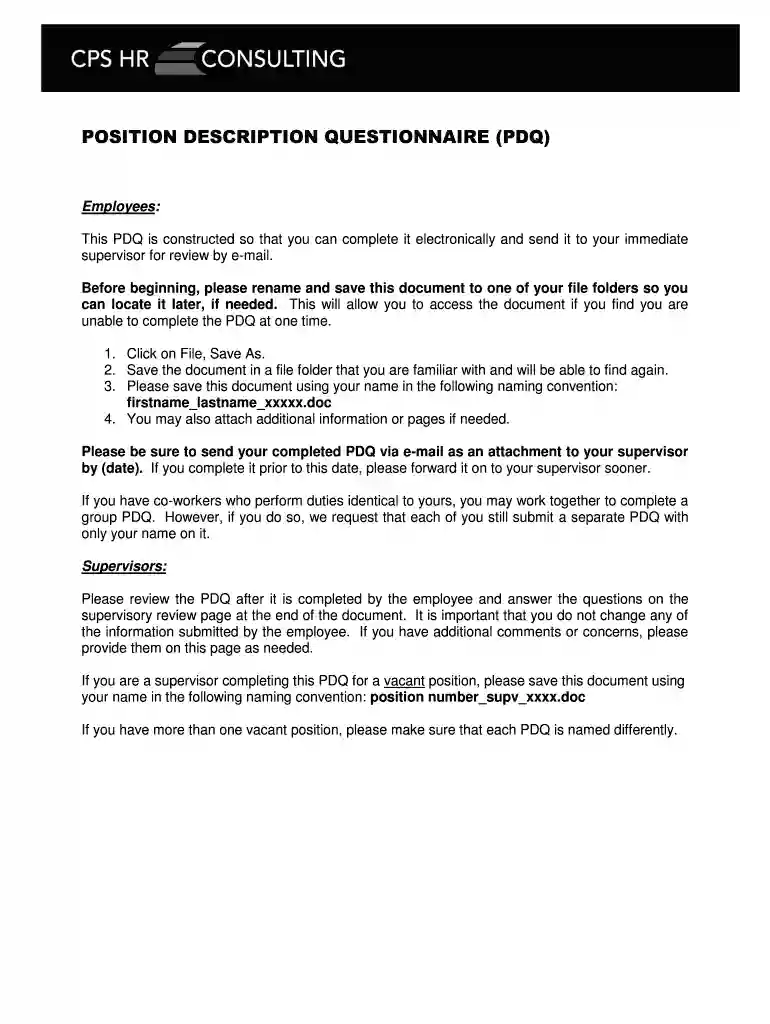
The Position Description Questionnaire (PDQ) is a comprehensive tool utilized by organizations to capture detailed information about a specific job role. The PDQ is designed to ensure accurate classification of job positions, considering elements like essential functions, responsibilities, and the impact of the role within the organization. Employees fill out the PDQ to provide a thorough overview of their duties, which helps in the evaluation and classification processes.
The PDQ is typically employed by human resources departments to gather pertinent information about a specific position. Employees are expected to provide detailed responses regarding their job functions. Below are steps to guide the use of the PDQ:
Review the PDQ Instructions: Begin by carefully reading any guidelines provided with the PDQ. These instructions will help you understand the expectations and requirements for filling out the questionnaire.
Complete Each Section Thoroughly: Ensure each segment is filled out with the necessary information. This includes details about job responsibilities, reporting structures, and any special equipment used.
Submit to Supervisors: Once completed, the PDQ should be submitted to the appropriate supervisory personnel for validation and further comments.
Filling out a PDQ requires attention to detail and clarity. Below are step-by-step instructions to complete the form:
Gather Relevant Information: Before starting, collect all necessary details related to your job role, including previous performance reviews, job-related documents, and departmental guidelines.
List Job Responsibilities: Clearly define and list primary job responsibilities. It's vital to specify both daily tasks and overarching duties that align with departmental goals.
Detail Essential Functions: These are the fundamental duties of your position. Be explicit in describing tasks that are imperative to the role and cannot be reassigned.
Highlight Supervisory Details: Include details about who you report to and any employees or teams for which you are responsible.
Submit for Review: Provide the completed PDQ to your supervisor to incorporate their inputs or necessary revisions.
The PDQ is widely used across various sectors in the United States. Key users include:
Human Resources Departments: HR teams rely on the PDQ to gain insights into job roles, which aid in the creation of accurate job descriptions and classification systems.
Employees: Those in specific roles fill out the questionnaire to provide detailed accounts of their job responsibilities and daily functions.
Managers and Supervisors: Supervisors review completed PDQs to ensure accuracy and provide additional insights into the role's requirements.


The PDQ includes several critical components, such as:
General Information: Captures basic job details including the position title, department, and supervisor's information.
Main Responsibilities: Provides an overview of the core duties and expected outputs of the role.
Essential Job Functions: Defines the tasks necessary to perform the role effectively.
Skills and Qualifications: Lists the necessary skills, education, and experience required for the position.
Supervisory and Decision-Making Authority: Details responsibilities over other staff and the level of decision-making authority.
While the PDQ offers a standard framework, state-specific regulations and best practices can vary. Organizations need to align the PDQ process with state employment laws and industry standards. This may involve adjustments in the classification criteria and compliance with local labor regulations.
The Position Description Questionnaire can be managed digitally, offering an efficient alternative to traditional paper versions. This form can be compatible with various document management platforms such as:
DocHub: Provides tools to edit, send, and sign PDQs securely online, facilitating seamless collaboration and review processes.
Google Workspace: Users can integrate PDQs into Google applications, allowing for editing and saving directly to Google Drive.
Practical scenarios that illustrate the utilization of the PDQ include:
New Position Assessment: When creating a new role, HR departments use the PDQ to detail and evaluate the position accurately.
Reclassification Efforts: If a job's responsibilities change, the PDQ is used to reassess and potentially reclassify the position.
Performance Evaluations: Supervisors might reference a PDQ during performance evaluations to ensure an employee's duties align with organizational expectations.
The PDQ assists in creating legally compliant job descriptions by outlining specific duties and requirements clearly. While the PDQ itself is not a legal document, it forms the basis for legal compliance in HR practices concerning job classification and employee responsibilities, ensuring roles align with the Fair Labor Standards Act (FLSA) and other employment laws.
At DocHub, your data security is our priority. We follow HIPAA, SOC2, GDPR, and other standards, so you can work on your documents with confidence.

A standardized PDQ serves the function of being the PDQ on file for all existing positions (unless otherwise noted) in the job class for each agency/
The purpose of the PDQ is to collect position specific information to assist in the classification of a new position and reclassification of an existingRead more


