




01. Edit your form online
Type text, add images, blackout confidential details, add comments, highlights and more.

Type text, add images, blackout confidential details, add comments, highlights and more.

Draw your signature, type it, upload its image, or use your mobile device as a signature pad.

Send it via email, link, or fax. You can also download it, export it or print it out.
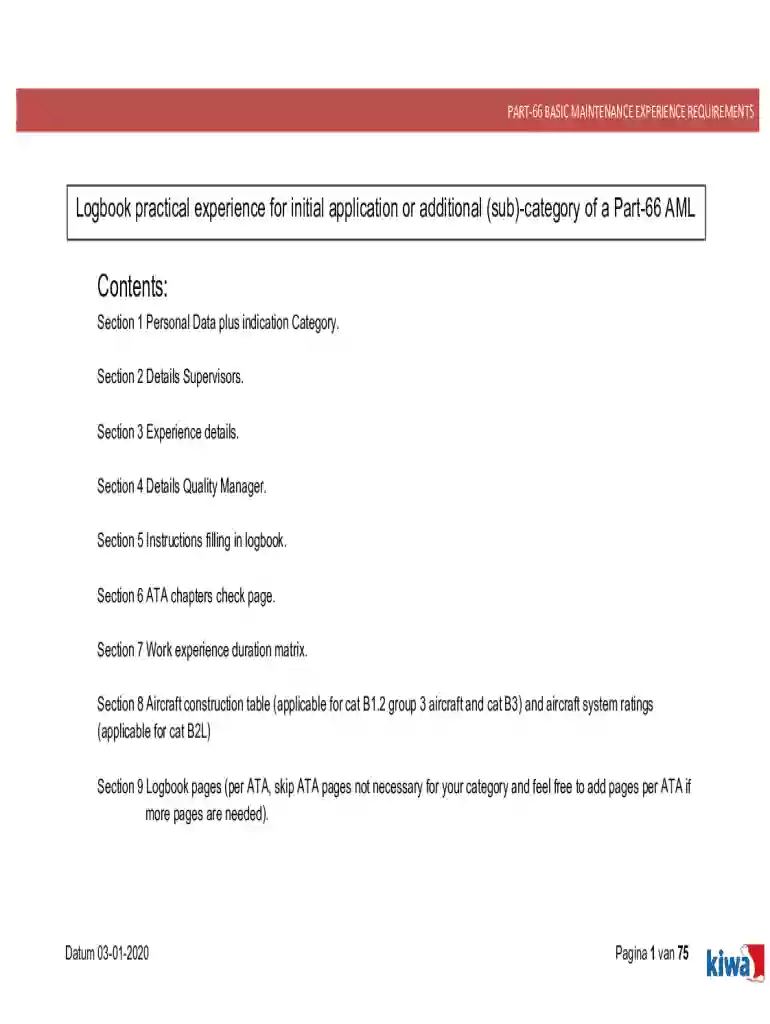
Logbook practical experience for initial application or additional purposes is a critical document for individuals seeking to obtain a Part-66 Aircraft Maintenance License (AML). This logbook acts as a structured record that documents practical work experience in the field of aircraft maintenance. It includes sections for personal data, supervisor details, and experience records. The logbook plays a vital role in verifying the hands-on experience necessary to meet licensing requirements. By accurately representing completed tasks and projects, it ensures that applicants possess the technical competencies required for certification.
The logbook is an essential tool for both applicants and evaluators. For applicants, it serves as a personal journal of professional achievements and relevant work experiences. Applicants should meticulously record each task or project, ensuring that entries are detailed enough to capture the complexity and scope of the work performed. This is crucial when specific logbook entries are examined by licensing authorities. For evaluators, the logbook verifies an applicant's practical experience, enabling them to assess whether the individual meets the necessary qualifications for obtaining or advancing their AML.
Completing the logbook requires a methodical approach to ensure that all experiences relevant to the AML application are accurately captured. Follow these steps to effectively document your experience:
Certain key elements are necessary for an effective logbook submission:
Consider these real-world scenarios to understand the diverse utility of the logbook:
The logbook is predominantly used by:


Though the Part-66 AML is an international standard, specific states in the United States may have additional requirements or variations in documenting practical experience. It is essential to consult local aviation authorities or licensing boards to understand any unique conditions or supplementary documentation needed.
The logbook not only provides practical benefits but also serves as an essential legal document:
By understanding and implementing these key aspects of the logbook, applicants can significantly enhance their chances of successfully acquiring or advancing their aircraft maintenance certification.
We've got more versions of the Logbook practical experience for initial application or form. Select the right Logbook practical experience for initial application or version from the list and start editing it straight away!
At DocHub, your data security is our priority. We follow HIPAA, SOC2, GDPR, and other standards, so you can work on your documents with confidence.

Jun 14, 2022 The first few logbooks you use may have several cross-outs and will probably be somewhat unorganized and sloppy. There is a lot to learn!
Oct 6, 2020 George Kordis Logbook has been written in digital print on the foundations of the Byzantine system of painting which has, however, beenRead more


