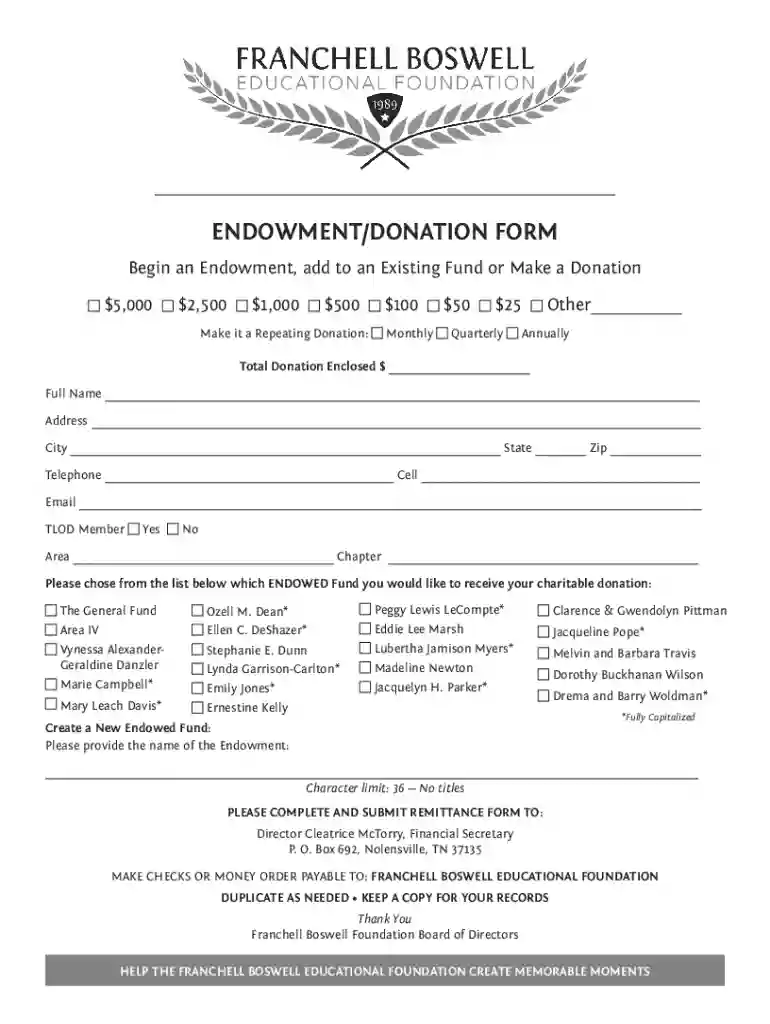
Begin an Endowment, add to an Existing Fund or Make a Donation 2026

Get Form
Begin an Endowment, add to an Existing Fund or Make a Donation Preview on Page 1

Here's how it works

01. Edit your form online
Type text, add images, blackout confidential details, add comments, highlights and more.

02. Sign it in a few clicks
Draw your signature, type it, upload its image, or use your mobile device as a signature pad.

03. Share your form with others
Send it via email, link, or fax. You can also download it, export it or print it out.

Definition and Meaning

An "Endowment, add to an Existing Fund or Make a Donation" form is utilized by individuals or organizations aiming to contribute financially to specific causes or funds. The form serves as a structured approach to managing donations, ensuring that contributors can either initiate a new endowment, augment an existing fund, or make one-time or recurring donations. By clearly defining the desired action, the form provides a transparent mechanism for financial contributions, which can support various educational, charitable, or designated fund objectives.

Steps to Complete the Form

Completing the "Begin an Endowment, add to an Existing Fund or Make a Donation" form involves several sequential steps, ensuring accuracy and proper allocation of the funds.

  1. Choose Donation Type: Indicate whether you wish to begin a new endowment, add to an existing fund, or make a standalone donation.

  2. Select the Fund: Pick the specific fund or program you want your donation to support. If establishing a new endowment, outline the purpose and objectives.

  3. Enter Personal Information: Provide your personal details, including name, contact information, and, if applicable, company affiliation.

  4. Specify the Donation Amount: Clearly state the amount you intend to contribute. If setting up a recurring donation, specify the frequency and duration.

  5. Payment Information: Enter the payment details, ensuring accuracy to facilitate seamless processing.

Key Elements of the Form

The form is designed with distinct sections that guide users through critical donation elements:

  • Purpose Section: Introduces the form's intent and the options available for contributions.
  • Personal Details: Collects essential contact information to ensure proper acknowledgment and record-keeping.
  • Fund Selection and Allocation: Allows donors to direct their funds to specific programs or causes, ensuring their contributions align with personal values.
  • Payment Details and Methods: Provides options for credit card entries, bank transfers, or alternative secure payment methods, safeguarding sensitive financial information.
  • Recurring Payment Setup (if applicable): Details for establishing ongoing donations, including frequency of contributions and preferred payment dates.

Importance of Donating

Choosing to start an endowment, contribute to an existing fund, or make a donation carries several significant benefits:

  • Impact: Donors can directly influence positive change by supporting programs and initiatives that align with their values.
  • Legacy: New endowments provide a lasting impact, funding causes perpetually based on accrued interest and investment returns.
  • Flexibility: The form offers versatile options, allowing donors to tailor their contributions in line with financial capabilities and philanthropic goals.

Who Typically Uses This Form

A diverse range of individuals and entities utilize this donation form, including:

  • Philanthropists: Individuals desiring to leave a legacy through substantial contributions.
  • Corporate Entities: Businesses looking to support community programs or corporate social responsibility initiatives.
  • Alumni and Benefactors: Graduates and supporters aiming to give back to educational foundations or alma maters.
  • Non-profit Organizations: Groups engaging in cause-centric fundraising drives.

Required Documents

Depending on the donation's scope and the fund's objectives, additional documentation may be required:

  • Proof of Identity: Government-issued ID to confirm donor identity.
  • Foundation’s Fund Guidelines: Official documentation outlining the fund’s objectives and rules.
  • Tax Compliance Forms: Necessary for donors seeking tax relief or deduction on contributions.

Legal Use and Compliance

Legal compliance is paramount when managing financial donations:

  • Adhering to US Tax Laws: Following the Internal Revenue Service (IRS) guidelines for charitable contributions.
  • Donor Privacy Protected: Secure handling of personal and financial information in line with privacy regulations.

Examples of Use

To better illustrate the form's practical use, consider a few scenarios:

  • Educational Endowment: An alumnus sets up an endowment for scholarships within a university, directly benefiting students annually.
  • Community Fundraising: A corporation donates to a local community fund dedicated to supporting small businesses.

These examples highlight how the form facilitates diverse philanthropic endeavors that cater to personalized philanthropic visions.

be ready to get more

Complete this form in 5 minutes or less

Get form

Got questions?

We have answers to the most popular questions from our customers. If you can't find an answer to your question, please contact us.
Contact us
Under this rule, a private foundation must annually distribute at least 5% of the value of its non-charitable-use assets to maintain its tax-exempt status and avoid penalties. This rule ensures that foundations actively support charitable causes instead of simply accumulating wealth.
After receiving or allocating the principal gift, you and your donors can then add to the endowment over time, growing its principal and increasing the investment income that it generates for payouts.
The 120% rule takes effect: In the second policy year when your contributions are greater than 120% of the first policy years total contributions. In any policy year when your contributions are greater than 120% of the higher of either of the previous two policy years total contributions.
They have to be maintained in perpetuity and are largely restricted. About 80% of Harvards $53.2 billion endowment is earmarked for financial aid, scholarships, faculty chairs, academic programs or other projects, according to the school. The remaining 20% is intended to sustain the institution for years to come.
Endowments are subject to a 5-year restriction period during which you can only make one withdrawal. The 5-year restriction period may be extended if you invest more over one year than 120% of your investments over either of the past two years.

Security and compliance

At DocHub, your data security is our priority. We follow HIPAA, SOC2, GDPR, and other standards, so you can work on your documents with confidence.
Learn more
ccpa2
pci-dss
gdpr-compliance
hipaa
soc-compliance
be ready to get more

Complete this form in 5 minutes or less

Get form

People also ask

An endowment is a donation which is kept invested year after year. The income generated from the investment can then be used to support further work that meets the shared aims of the donor and, in this instance, the University. In other words, endowments have a long-lasting impact.

Related links