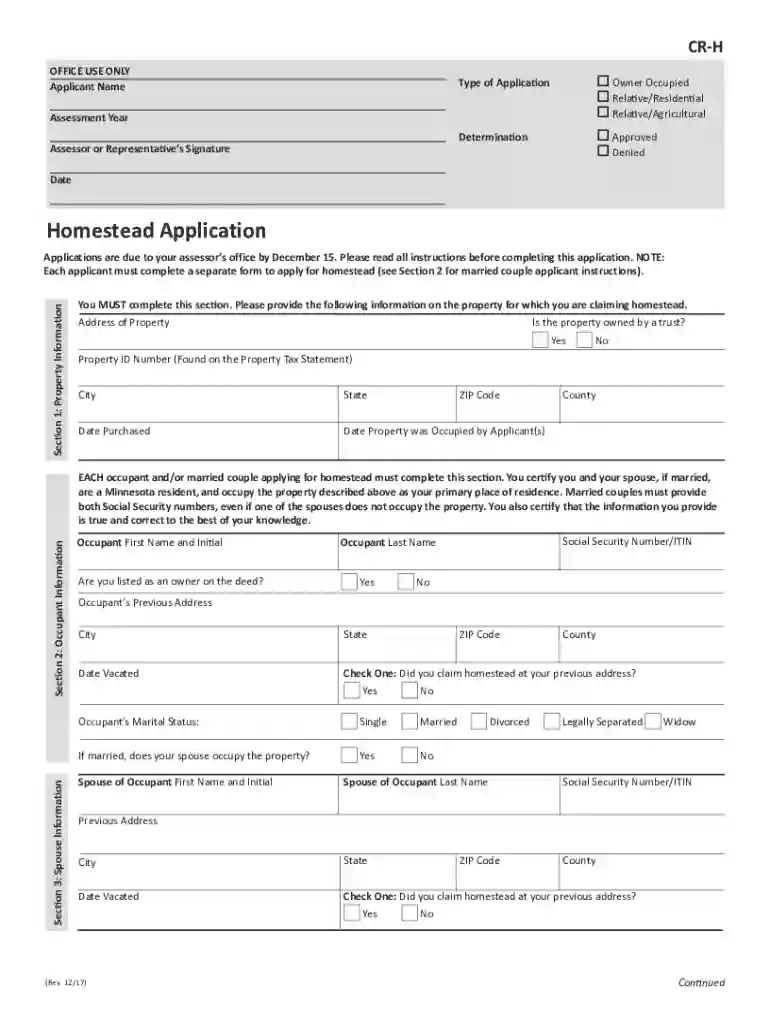
Regular Homestead Application 2026

Get Form
Regular Homestead Application Preview on Page 1

Here's how it works

01. Edit your form online
Type text, add images, blackout confidential details, add comments, highlights and more.

02. Sign it in a few clicks
Draw your signature, type it, upload its image, or use your mobile device as a signature pad.

03. Share your form with others
Send it via email, link, or fax. You can also download it, export it or print it out.

Definition & Meaning

The Regular Homestead Application is a form used by property owners in the United States, specifically in states like Minnesota, to apply for homestead status, which can provide significant tax benefits. Homestead status typically allows homeowners to reduce the cost of their property taxes on their principal residence. By declaring a property as a homestead, owners might be eligible for credits, both at state and local levels, that lower their overall property tax burden.

Importance of Declaring Homestead Status

  • Tax Reductions: Allows a reduction in the taxable value of the home.
  • Homeownership Benefits: Confirms property ownership and primary residence status, often making homeowners eligible for specific benefits.
  • Protection from Creditors: In some jurisdictions, declaring a homestead can offer a degree of protection against creditors, as it often limits the liability on an indebted homeowner’s primary residence.

How to Use the Regular Homestead Application

Using the Regular Homestead Application effectively requires a clear understanding of its purpose and requirements. The process involves gathering specific information about the property and its occupants, which is essential for the application to be considered valid.

Necessary Information for Application

  1. Property Details: Description of the property, including address and legal description.
  2. Occupant Information: Names and Social Security numbers of the owner(s) and occupants.
  3. Spouse Information: Details if applicable, even if the spouse isn't listed on the property title.

Online and Physical Form Use

  • Online Forms: Accessible through state-specific websites or PDF format for electronic filing.
  • Paper Forms: Available at county offices or through mail requests for those preferring non-digital methods.

Steps to Complete the Regular Homestead Application

Completing the Regular Homestead Application involves several critical stages:

  1. Gather Required Documentation: Including proof of residency and property ownership.
  2. Fill Out Property and Occupant Sections: Ensure accurate and honest input of all required fields.
  3. Signature and Verification: Verify all information before signing.
  4. Submission Deadline: Submit the complete application by the specific deadline to qualify for the tax year.

Section-by-Section Guidance

  • Property Section: Provide detailed descriptions, including parcel number.
  • Occupants Section: Include all residents occupying the property.
  • Additional Sections: May require additional documentation for specialized conditions or exemptions.

Eligibility Criteria

The eligibility for filing a Regular Homestead Application varies slightly from state to state but generally includes:


  • Primary Residency Requirement: The property must be the owner’s principal place of residence.
  • Ownership: Applicant must have legal ownership of the property.
  • Residency Duration: Criteria such as length of residence might apply; typically must reside for more than a certain number of months in a year.
decoration image ratings of Dochub

Common Conditions

  • Single-Family Homes: Often eligible if they serve as the primary residence.
  • Multi-Family Units and Farms: May include eligibility specifics based on unit configurations and usage.

Filing Deadlines / Important Dates

Timely submission is crucial as it directly impacts tax benefits for that fiscal year.

Key Deadlines to Remember

  • Annual Application Due Date: Typically by December 15 for states like Minnesota.
  • Renewal or Re-filing: Periodically required, usually annually, depending on state guidelines.

Consequences of Missing Deadlines

  • Missing the deadline may result in a missed opportunity for tax savings for that tax year.
  • Late applications could lead to disqualification from benefits until the next filing period.

Required Documents

Submitting a complete and accurate application usually involves attaching several documents:

  • Proof of Ownership: Deed or title showing ownership details.
  • Proof of Residency: State IDs, utility bills, or voter registration showing the address.
  • Additional Identification: May need Social Security numbers or federal tax returns for identity verification.

Document Submission Tips

  • Ensure that all documents are up-to-date and legible copies.
  • Some jurisdictions may require notarization of certain statements.

Penalties for Non-Compliance

Failure to comply with rules or providing false information can lead to significant penalties.

Common Penalties

  • Fines or Legal Repercussions: For knowingly providing false statements.
  • Revocation of Benefits: Loss of homestead status and possible retroactive tax assessments.

Preventing Non-Compliance

  • Review state laws specific to the homestead declaration.
  • Ensure thorough and honest documentation and representation of all required information.

Legal Use of the Regular Homestead Application

Filing the Regular Homestead Application has specific legal implications which vary by state.

Legal Considerations

  • Document Accuracy: Legal obligation to provide truthful information.
  • Tax Implications: Understanding how homestead status affects tax liability and benefits.

Advisory for Legal Compliance

  • Engage with legal or tax professionals to ensure all documentation meets legal standards.
  • Keep updated records to provide necessary evidence in case of audits or requests from tax authorities.
be ready to get more

Complete this form in 5 minutes or less

Get form

Got questions?

We have answers to the most popular questions from our customers. If you can't find an answer to your question, please contact us.
Contact us
Propertys parcel ID. Proof of residency, such as a copy of valid Georgia drivers license and a copy of vehicle registration. Recorded deed for new owners, if county records have not been updated. Trust document and affidavit, if the property is in a trust.
Gather What Youll Need Homeowners name. Property address. Propertys parcel ID. Proof of residency, such as a copy of valid Georgia drivers license and a copy of vehicle registration. Recorded deed for new owners, if county records have not been updated. Trust document and affidavit, if the property is in a trust.
Basic Homestead Exemption: This is available to all homeowners who occupy their property as a primary residence. It offers a $2,000 reduction in the assessed value of your home. Senior Citizens Exemption: Homeowners aged 65 and older may qualify for additional reductions based on income.
Understand the Reason for Denial Common reasons for denial can include: Incomplete Application: Missing documents or signatures can lead to an automatic denial. Eligibility Issues: Not meeting the requirements for the specific exemption, such as age, disability status, or property use.
Under the Virginia exemption system, homeowners can exempt up to $50,000 of equity in a home or other property covered by the homestead exemption.

Security and compliance

At DocHub, your data security is our priority. We follow HIPAA, SOC2, GDPR, and other standards, so you can work on your documents with confidence.

Learn more
ccpa2
pci-dss
gdpr-compliance
hipaa
soc-compliance
be ready to get more

Complete this form in 5 minutes or less

Get form

People also ask

Once youre approved for a homestead exemption, you typically dont need to reapply on an annual basis. However, you may need to notify the appropriate government agency if you move, sell or rent your house.
The Homestead Deed must be in proper legal form and should be prepared by a Virginia licensed attorney. Once the Homestead Deed is filed with the Circuit Court for the city or county where the debtor lives, and other needed steps are taken, the property generally is protected from creditors.
Overlooking Homestead Exemptions While not directly related to the protest process, failing to apply for available homestead exemptions is a common oversight that can increase your overall tax burden. Exemptions can reduce the taxable value of your home, making it less likely that your property is overvalued.

Related links