




01. Edit your form online
Type text, add images, blackout confidential details, add comments, highlights and more.

Type text, add images, blackout confidential details, add comments, highlights and more.

Draw your signature, type it, upload its image, or use your mobile device as a signature pad.

Send it via email, link, or fax. You can also download it, export it or print it out.
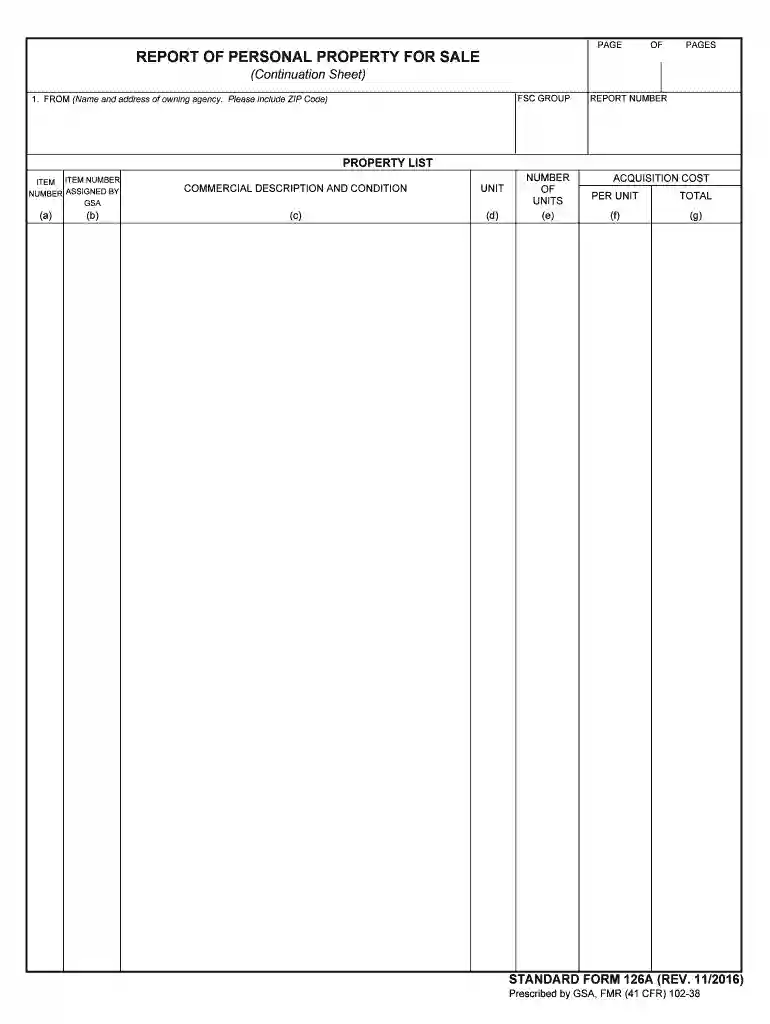
The "report of personal property for sale - GSA" is a document utilized by various agencies to manage the sale of personal property. This form is particularly structured to provide a detailed account of physical goods available for sale, facilitating transparent and efficient transactions. The report includes critical data such as agency identifiers and detailed descriptions of the items, making it a comprehensive tool for property management.
In practice, this report serves the dual purpose of both inventory management and compliance with regulatory standards. Agencies are mandated to maintain up-to-date records of all properties acquired and subsequently sold. The form's primary intent is to systematically record such activities, ensuring all transactions are compliant with federal guidelines.
To effectively use the report, agencies must first gather detailed information about the items intended for sale. The information includes unique identifiers assigned by the General Services Administration (GSA), thorough descriptions, and current conditions of the items.
It is essential to review all entries for accuracy before submission as inaccuracies can lead to compliance issues or financial discrepancies.
This form is predominantly used by federal agencies, as well as state and local government bodies tasked with managing public assets. Property managers within these agencies frequently utilize the report to maintain transparency and accountability.
Additionally, departments responsible for asset liquidation and financial compliance in public sector organizations find this report indispensable. The strict regulatory framework governing public asset sales makes it crucial for users to be adept at filling out and interpreting the form correctly.


Several critical elements must be included for the report to serve its purpose effectively:
This report is a legally mandated document requiring precise adherence to federal regulations. Misrepresentation or inaccuracies may lead to legal penalties, emphasizing the necessity for precise and honest entries.
Every report functions as a legal document verifying compliance with the sale of public goods. Federal agencies have specific guidelines dictating when and how these reports must be filed, guaranteeing that public resources undergo transparent and regulated processes when sold.
While the framework of the report is consistent nationwide, certain states might have specific requirements or additional forms that complement the report. It is crucial for agencies operating across state lines to be aware of each state's guidelines to ensure full compliance.
Certain states may mandate supplementary documentation or additional identifiers for items that cross state jurisdictions, hence the importance of consulting state-specific guidelines alongside federal mandates.
Consider a federal agency tasked with selling outdated office equipment. Using this report, the agency would:
This practical application illustrates how agencies manage asset sales, maintaining transparency and compliance by leveraging the structured format provided by the "report of personal property for sale - GSA."
We've got more versions of the report of personal property for sale - GSA form. Select the right report of personal property for sale - GSA version from the list and start editing it straight away!
| Versions | Form popularity | Fillable & printable |
|---|---|---|
| 2016 | 4.8 Satisfied (126 Votes) |
At DocHub, your data security is our priority. We follow HIPAA, SOC2, GDPR, and other standards, so you can work on your documents with confidence.


Report of Personal Property for Sale, and SF 126-A (GSA), Report of Personal Property for Sale (Continuation Sheet). is authorized for local reproduction.
OnDemand provides two methods of indexing data Document indexing is used for reports that contain logical items such as policies, and statements.


