




01. Edit your form online
Type text, add images, blackout confidential details, add comments, highlights and more.

Type text, add images, blackout confidential details, add comments, highlights and more.

Draw your signature, type it, upload its image, or use your mobile device as a signature pad.

Send it via email, link, or fax. You can also download it, export it or print it out.
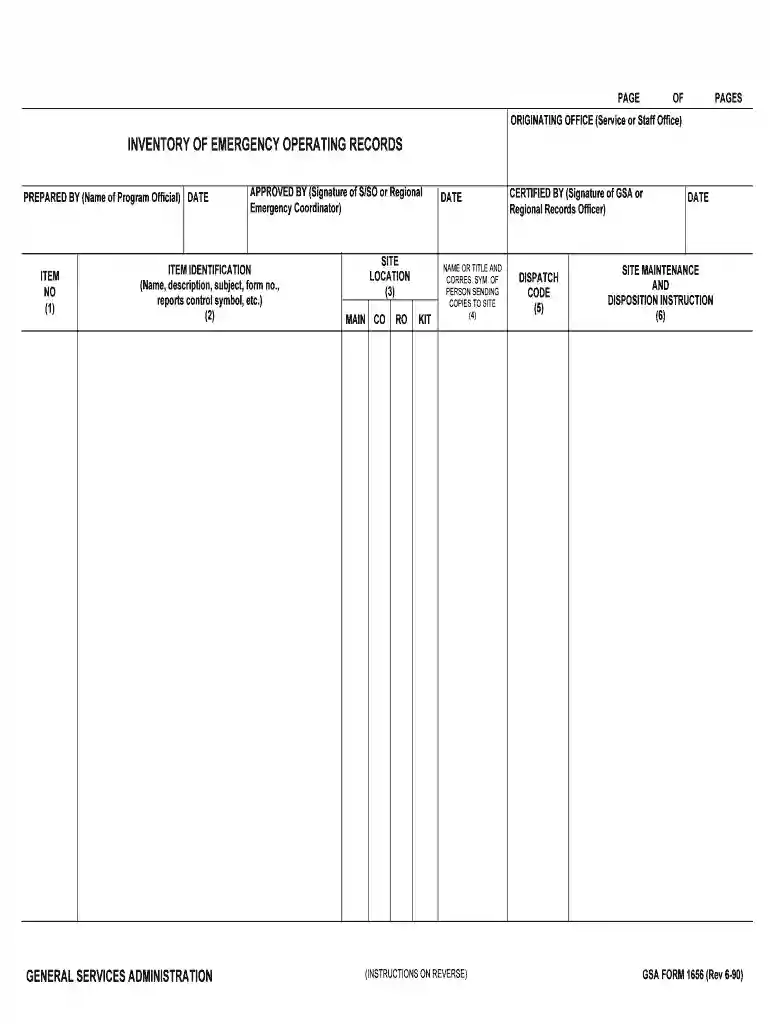
The "Inventory of Emergency Operating Records - GSA" is a critical document used in ensuring the maintenance and accessibility of essential records required for government operations during emergencies. Managed by the General Services Administration (GSA), this form catalogues documents vital for the continuity of operations, especially under unforeseen circumstances. It helps maintain an organized system where these records can be quickly and efficiently accessed when regular procedures or systems are disrupted.
Using this form involves a systematic approach to document and verify essential records. Officials in charge of managing these records must ensure that all necessary information is documented accurately.
Consider a situation where a natural disaster affects office access; having a well-documented inventory allows emergency teams to locate vital documents needed for decision-making and operations continuity.
Completing the Inventory of Emergency Operating Records - GSA involves multiple precise steps to ensure thorough documentation.
Following severe weather alerts, federal buildings use these inventories to review what documents are on-site versus those stored digitally, ensuring they have redundancy and backup access.
Understanding the fundamental elements that comprise this inventory is crucial for its correct completion and maintenance.
A healthcare bureau ensures all patient record access protocols during emergencies are documented and vetted by compliance officers, ensuring uninterrupted patient care.
The primary users of this form are various government entities and departments tasked with maintaining operational readiness during emergencies.


A regional FEMA office relies on the inventory to ensure all necessary emergency response plans and contact lists are current and readily available.
This inventory form has legal implications as it ensures federal compliance with mandates regarding record management.
During audits, this inventory is reviewed to confirm adherence to federal records management standards, ensuring no breach of process or protocol.
Compiling the inventory necessitates a range of documents to ensure all bases are covered in the event of an emergency.
Maintain an updated log of version changes and historical access to documents, ensuring full traceability and accountability in emergency situations.
We've got more versions of the inventory of emergency operating records - GSA form. Select the right inventory of emergency operating records - GSA version from the list and start editing it straight away!
| Versions | Form popularity | Fillable & printable |
|---|---|---|
| 1990 | 4.8 Satisfied (135 Votes) |
At DocHub, your data security is our priority. We follow HIPAA, SOC2, GDPR, and other standards, so you can work on your documents with confidence.
An action oriented audit plan will comprise visual inspections, as well as examination of records and emergency response tests.
Inventory of Emergency Operating Records. Information. Form Number: GSA1656; Current Revision Date: 06/1990; Authority or Regulation: Download file [PDF - 301Read more


