




01. Edit your form online
Type text, add images, blackout confidential details, add comments, highlights and more.

Type text, add images, blackout confidential details, add comments, highlights and more.

Draw your signature, type it, upload its image, or use your mobile device as a signature pad.

Send it via email, link, or fax. You can also download it, export it or print it out.
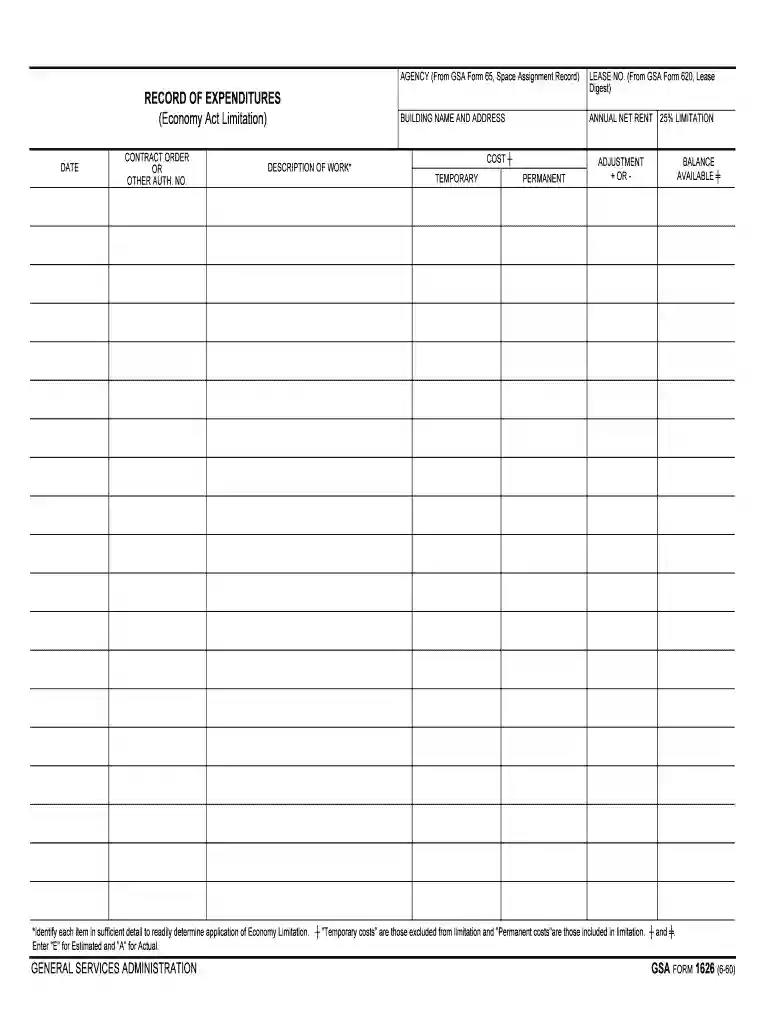
The Record of Expenditures is a comprehensive document used to track financial transactions related to specific projects or legal limitations, such as the Economy Act Limitation. This form is crucial for detailing contract orders, descriptions of work, associated agency information, lease specifics, annual net rent, and the classification of costs. The document serves as a framework for distinguishing between temporary and permanent expenses, assisting organizations in monitoring available balances and necessary adjustments. Its precise format allows for a thorough audit trail, fostering transparency and accountability in financial management.
Using the Record of Expenditures requires a systematic approach to accurately document financial activities. Professionals should ensure that each transaction is clearly defined with relevant details, including the nature of the expense, contractual obligations, and associated agency information. Important considerations include:
The structured use of this document supports efficient financial oversight and aids in maintaining compliance with legal and internal policies.
Completing the Record of Expenditures involves several crucial steps:
Following these steps ensures the document remains a reliable source of financial information.
Maintaining a Record of Expenditures is essential for several reasons:
This document is an invaluable tool for organizations striving to manage finances transparently and efficiently.
The Record of Expenditures consists of several key elements that ensure comprehensive coverage of financial records:
These elements collectively ensure that the form is effective in capturing complete financial data.
The Record of Expenditures serves an important legal function in documenting financial activities. It ensures compliance with various statutory requirements, particularly those related to the Economy Act Limitation and similar legislative frameworks. Properly maintaining this document can protect organizations from potential legal challenges by providing verifiable evidence of financial practices. Understanding the legal implications and ensuring accuracy are paramount for safeguarding against fiscal mismanagement or regulatory breaches.
Several entities rely on the Record of Expenditures, including:
Each user group applies the form to maintain fiscal discipline and accountability across various financial transactions.


To streamline the completion and management of the Record of Expenditures, utilizing compatible software solutions can be beneficial. Software options like QuickBooks and TurboTax can be instrumental in offering user-friendly interfaces for inputting and analyzing the required financial data. Benefits of these software tools include:
With the right software, maintaining an accurate and up-to-date Record of Expenditures becomes a more manageable task.
We've got more versions of the RECORD OF EXPENDITURES form. Select the right RECORD OF EXPENDITURES version from the list and start editing it straight away!
| Versions | Form popularity | Fillable & printable |
|---|---|---|
| 1960 | 4.8 Satisfied (57 Votes) |
At DocHub, your data security is our priority. We follow HIPAA, SOC2, GDPR, and other standards, so you can work on your documents with confidence.



The following are some of the types of records you should keep: Purchase and sales invoices Real estate closing statements Canceled checks or otherRead more
records documenting receipts, sales, exchanges, or other dispositions of virtual currency and the fair market value of the virtual currency.
Official budget records consist of documents used to develop initial budgets and to record changes in operating budgets.


