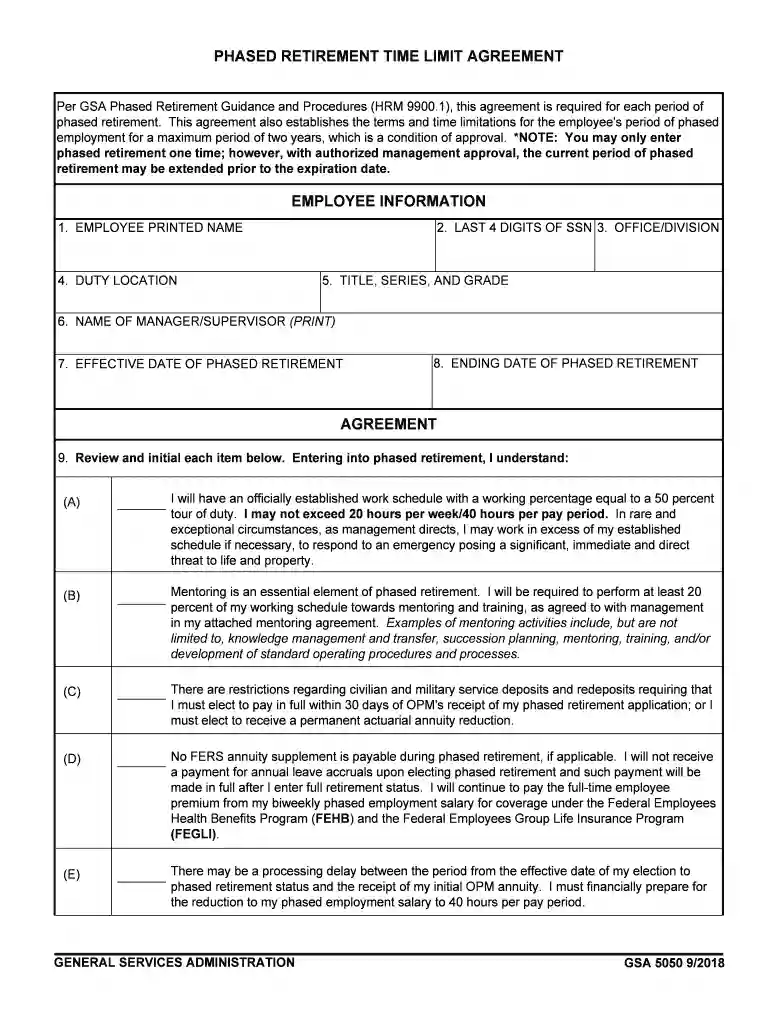
PHASED RETIREMENT TIME LIMIT AGREEMENT - GSA 2026

Get Form
PHASED RETIREMENT TIME LIMIT AGREEMENT - GSA Preview on Page 1

Here's how it works

01. Edit your form online
Type text, add images, blackout confidential details, add comments, highlights and more.

02. Sign it in a few clicks
Draw your signature, type it, upload its image, or use your mobile device as a signature pad.

03. Share your form with others
Send it via email, link, or fax. You can also download it, export it or print it out.

Definition & Purpose of the Phased Retirement Time Limit Agreement

The Phased Retirement Time Limit Agreement – GSA is a formal document designed to outline the terms of a phased retirement program for government employees, as prescribed by the U.S. General Services Administration (GSA). This agreement facilitates a gradual transition from full-time work to retirement, allowing employees to continue working part-time while beginning to draw retirement benefits. Utilized primarily within federal employment structures, it aims to balance workforce needs with personal retirement planning, thus benefiting both the organization and the employee.

Key Objectives:

  • Allow employees to balance work with retirement.
  • Retain valuable experience within the workforce.
  • Provide financial security through a combination of salary and retirement benefits.

Steps to Complete the Agreement

Completing the Phased Retirement Time Limit Agreement involves several methodical steps which ensure that both employee and employer have a clear understanding of their roles and responsibilities.

  1. Eligibility Confirmation: Begin by verifying if you qualify for phased retirement as per GSA guidelines. Typically, this involves assessing your current employment status, years of service, and potential retirement benefits.

  2. Managerial Approval: Obtain management approval. This is a critical step, where a detailed discussion about the phased retirement plan, work schedule, and transition timelines is undertaken.

  3. Documentation Preparation: Gather necessary information and documents, including prior employment records, retirement benefits statement, and personal identification.

  4. Agreement Drafting: Collaborate with your HR department to draft the agreement. Ensure all responsibilities, such as mentoring or specific part-time duties, are clearly outlined.

  5. Review and Sign: Review the full document attentively for accuracy and completeness. Both parties should understand terms before signing.

  6. Submission and Filing: Submit the signed agreement to your HR department for filing and further administrative processing.

Key Elements of the Agreement

The agreement is comprehensive and includes several essential components designed to clarify every aspect of the phased retirement process.

  • Employee Information: Personal and employment details of the individual entering phased retirement.
  • Work Schedule: An agreed part-time work schedule that accommodates the employee's transition.
  • Mentoring Requirements: Obligations related to mentoring younger employees as part of the retirement process.
  • Financial Implications: Details regarding retention of salary and phased retirement benefits.
  • Options for Full Retirement: Guidelines for eventual full retirement, including conditions to revert to full-time employment if necessary.

Legal Use and Compliance

The legality of the Phased Retirement Time Limit Agreement is anchored in the GSA guidelines and federal employment regulations. Ensuring compliance with these guidelines is crucial to avoid any potential legal disputes.

Legal Considerations:

  • Binding Nature: Once signed, the agreement is a legally enforceable document.
  • Amendments: Any changes require formal revisions and resigning by all involved parties.
  • Termination Clause: Outlines conditions under which the agreement can be terminated prematurely.

How to Use the Agreement Effectively

Understanding and effectively utilizing the agreement is essential for maximizing its benefits.

  • Strategic Planning: Approach phased retirement as part of a broader career and personal life strategy, ensuring it aligns with long-term goals.
  • Regular Check-ins: Schedule regular reviews with management to discuss progress, any required adjustments, and to ensure continued compliance.
  • Clear Communication: Maintain clear and open communication with both HR and management to ensure any issues are promptly addressed.

Who Typically Uses This Agreement

Though primarily intended for federal employees, the Phased Retirement Time Limit Agreement can be adapted to various employment situations within organizations seeking structured retirement transitions.

  • Federal Employees: Beneficiaries under the GSA policies and working within federal agencies.
  • Senior Professionals: Those looking to diminish responsibilities progressively while mentoring successors.
  • Organizations with Retirement Programs: Entities offering structured retirement plans that permit phased retirements.

Examples of Using the Agreement

Real-world scenarios highlight how the agreement fosters seamless transitions between full-time employment and retirement.

  1. Career Extension for Expert Employees: Enables senior scientists at a federal agency to mentor new recruits while transitioning smoothly towards retirement.
  2. Knowledge Transfer Program: Experienced managers utilize phased retirement to transfer crucial institutional knowledge to upcoming leaders.

Important Terms and Definitions

Understanding key terms within the agreement is important for precise application and compliance.

  • Phased Retirement: A work arrangement that allows part-time service while receiving retirement benefits.
  • Mentorship Clause: The section detailing expected guidance responsibilities of retiring employees.
  • Work Schedule Agreement: The documented part-time work arrangement mutually agreed upon by employer and employee.

By appreciating these aspects and diligently analyzing the Phased Retirement Time Limit Agreement, participants can ensure a well-managed transition from full-time service to retirement, fulfilling both personal and organizational objectives.

be ready to get more

Complete this form in 5 minutes or less

Get form

Got questions?

We have answers to the most popular questions from our customers. If you can't find an answer to your question, please contact us.
Contact us
Retire under FERS at age 62 with 5 years of service, age 60 with 20 years, or at your Minimum Retirement Age (MRA) with 30 years. You can also retire at MRA with 10 years of service, but benefits will be reduced. There are some exceptions to this rule, however. Well explore those in a moment.
At 55, youll have the required 30 years of service, but wont have docHubed your minimum retirement age, so you cant retire with benefits. If youve docHubed the minimum retirement age, and have worked for the government for more than 10 years but less than 30, you can still retire and collect some benefits.
If you were born before 1948, then you can retire at 55. If you were born in 1970 or later, you can enjoy minimum retirement at 57. And if you were born between 1948 and 1970, your minimum retirement age will be between 55 and 2 months and 56 and 10 months.
If you leave your job before the earliest retirement age of 55, you can keep your pension benefit on deposit in the plan. This is called a deferred pension.
You usually can collect these payments earlyat age 62 for Social Security and sometimes as early as age 55 with a pension. However, taking benefits early will mean that you get smaller monthly benefits for the rest of your life.

Security and compliance

At DocHub, your data security is our priority. We follow HIPAA, SOC2, GDPR, and other standards, so you can work on your documents with confidence.
Learn more
ccpa2
pci-dss
gdpr-compliance
hipaa
soc-compliance

People also ask

What is a phased retirement? Reduced hours: Employees work fewer weekly hours, gradually decreasing their hours over time. Job sharing: Employees share one full-time position, splitting responsibilities. Changing roles: Employees transition to less demanding or different roles within an organization.
Discontinued Service Retirement Because of an Involuntary Separation. A discontinued service retirement provides an immediate annuity for employees who are separated involuntarily. Discontinued service retirement has different age and service requirements than voluntary retirement (see eligibility requirement below).

Related links