




01. Edit your state tax extension online
Type text, add images, blackout confidential details, add comments, highlights and more.

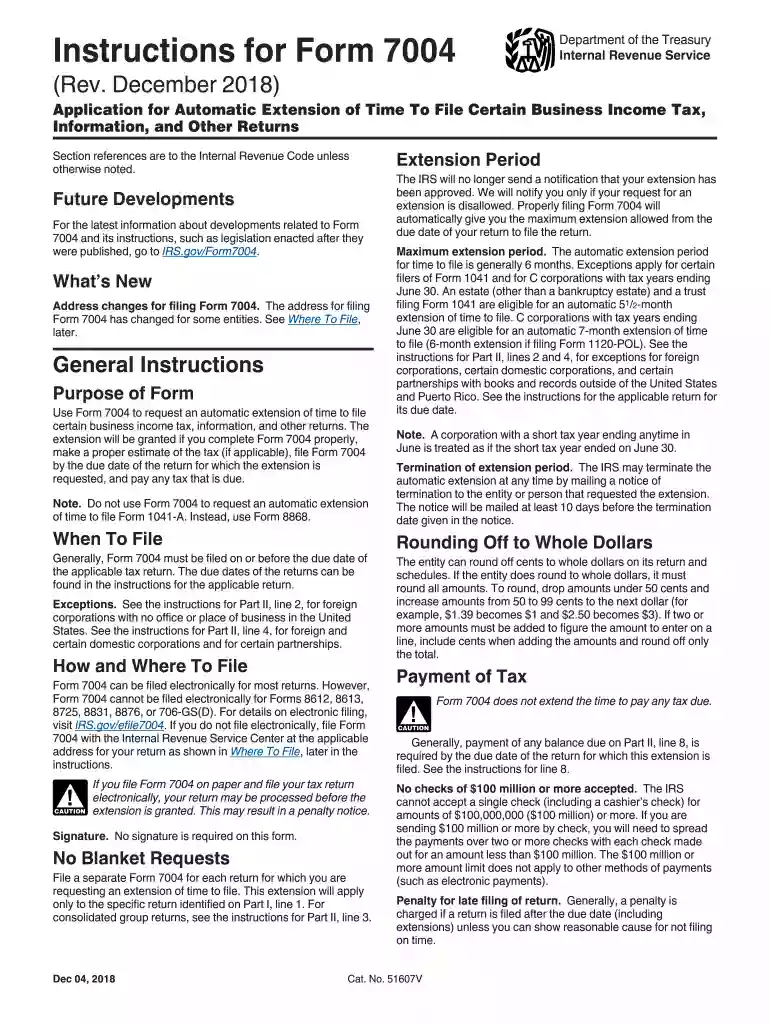
Type text, add images, blackout confidential details, add comments, highlights and more.

Draw your signature, type it, upload its image, or use your mobile device as a signature pad.

Send business tax extension via email, link, or fax. You can also download it, export it or print it out.
Form 7004 is a document used by businesses in the United States to request an automatic extension of time to file certain business income tax and information returns. Specifically, this form applies to various types of businesses, including corporations, partnerships, and certain trusts. By submitting Form 7004, businesses can secure an extension period generally ranging from five to six months, allowing them more time to prepare and submit their annual tax returns accurately. This extension does not grant a reprieve from paying any taxes owed; instead, it solely provides additional time for filing documentation.
Businesses that may file Form 7004 include corporations, S-corporations, partnerships, and some trusts, provided they meet specific IRS criteria. Eligible businesses should ensure they file Form 7004 by the original due date of their tax return to qualify for an extension. It's crucial for taxpayers to understand that the extension given applies only to the submission of tax forms, not to the payment of taxes owed. Businesses experiencing complexity in their tax documentation can particularly benefit from the extension, which affords additional time to collate and verify necessary data.


Form 7004 is predominantly used by business entities that require more time to accurately complete their tax returns. This group includes corporations, limited liability companies (LLCs) taxed as corporations, partnerships, and certain trusts. These entities often employ this form to ensure compliance while allowing time to gather comprehensive financial information, avoiding errors that could incur penalties. Additionally, organizations undergoing significant changes, such as mergers or restructuring, may require extra time for adjusting necessary financial records and tax documentation.
Determine Eligibility: Confirm that your business entity and return type qualify for an extension.
Gather Required Information: Collect all pertinent business information, including your EIN, business address, and tax year details.
Select Applicable Return Code: Choose the correct code corresponding to the return type for which you're requesting an extension. This information is essential for proper processing.
Estimate Tax Liability: Calculate any taxes owed by the original filing date. Form 7004 should be accompanied by your payment, as it does not extend the payment deadline.
Complete the Form: Fill out Form 7004 with all necessary details, ensuring accuracy to prevent processing delays.
Submit the Form: File electronically or by mail following IRS guidelines before the original return due date.
By following these steps accurately, businesses can maximize their chances of approval for an extension to file their returns.
Form 7004 includes several crucial fields that applicants must complete accurately to ensure a valid extension request. Key elements include:
Accurate completion of these fields is essential for the IRS to process the extension request successfully.
The deadline for filing Form 7004 typically coincides with the original IRS due date for filing the applicable business tax return. For example, S-corporations and partnerships generally need to file by March 15, while corporations may have a deadline of May 15. It's crucial to adhere to these deadlines to be eligible for the filing extension. Missing the deadline can result in penalties for late filing or non-compliance with IRS regulations. Businesses should mark important dates in advance to ensure timely submission of both the extension request and the final tax return.
Businesses have multiple options for submitting Form 7004. The form can be filed electronically through IRS-approved e-file providers, allowing for quicker processing and confirmation of receipt. Alternatively, businesses may choose to mail the form using the appropriate IRS office address provided in the form instructions. However, electronic filing is often recommended due to its efficiency and reliability. Regardless of the submission method, ensuring the form includes correct and complete information is essential to avoid delays or rejections in processing.
Failure to file Form 7004 by the original return deadline can result in penalties that vary depending on the type of entity and timeframe involved. For corporations, penalties for late filing can accrue monthly, based on unpaid taxes. Partnerships may face a penalty per partner for each month a return is late. To prevent these penalties, businesses are strongly encouraged to submit Form 7004 accurately and on time, alongside any payments for taxes due. Additionally, consistently failing to adhere to IRS requirements can increase scrutiny of financial practices, resulting in potential audits or additional fines.
Many businesses, from large corporations to smaller LLCs, find Form 7004 invaluable for managing tax compliance. For instance, a tech startup facing significant fiscal year-end projects may need extra time to compile financial records accurately. Completing Form 7004 affords them additional months to finalize and verify their data, avoiding possible errors. Another example includes partnerships navigating new revenue streams or investments; by using Form 7004, they ensure accuracy in reporting complex financial transactions without incurring late fees. These scenarios illustrate the utility of Form 7004 in promoting diligent compliance with IRS regulations.
The IRS provides specific guidelines dictating the admissibility and processing of Form 7004. These include requirements for correct form completion, timely filing, and accurate tax liability estimation. Following these guidelines, along with utilizing the IRS's online forms and tutorials, can streamline the extension process, ensuring businesses meet federal compliance standards. Additionally, consulting with a tax professional can aid in navigating complicated regulations, guaranteeing adherence to IRS conditions. Businesses should remain informed of updates to IRS rules, as changes may affect filing requirements or deadlines.
We've got more versions of the state tax extension form. Select the right state tax extension version from the list and start editing it straight away!
At DocHub, your data security is our priority. We follow HIPAA, SOC2, GDPR, and other standards, so you can work on your documents with confidence.
Use Form 7004 to request an automatic extension of time to file certain business income tax, information, and other returns. The extension will be granted ifRead more
(1) An application must be submitted on Form 7004, Application for Automatic Extension of Time to File Certain Business Income Tax, Information, and OtherRead more
ACIF messages contain instructions for the PSF or Infoprint Manager system programmer. Please show your system programmer these messages, because theyRead more


