PHY1600 - MicroTeaching Evaluation Form 2026

Get Form
PHY1600 - MicroTeaching Evaluation Form Preview on Page 1

Here's how it works

01. Edit your form online
Type text, add images, blackout confidential details, add comments, highlights and more.

02. Sign it in a few clicks
Draw your signature, type it, upload its image, or use your mobile device as a signature pad.

03. Share your form with others
Send it via email, link, or fax. You can also download it, export it or print it out.

Definition and Purpose of the PHY1600 - MicroTeaching Evaluation Form

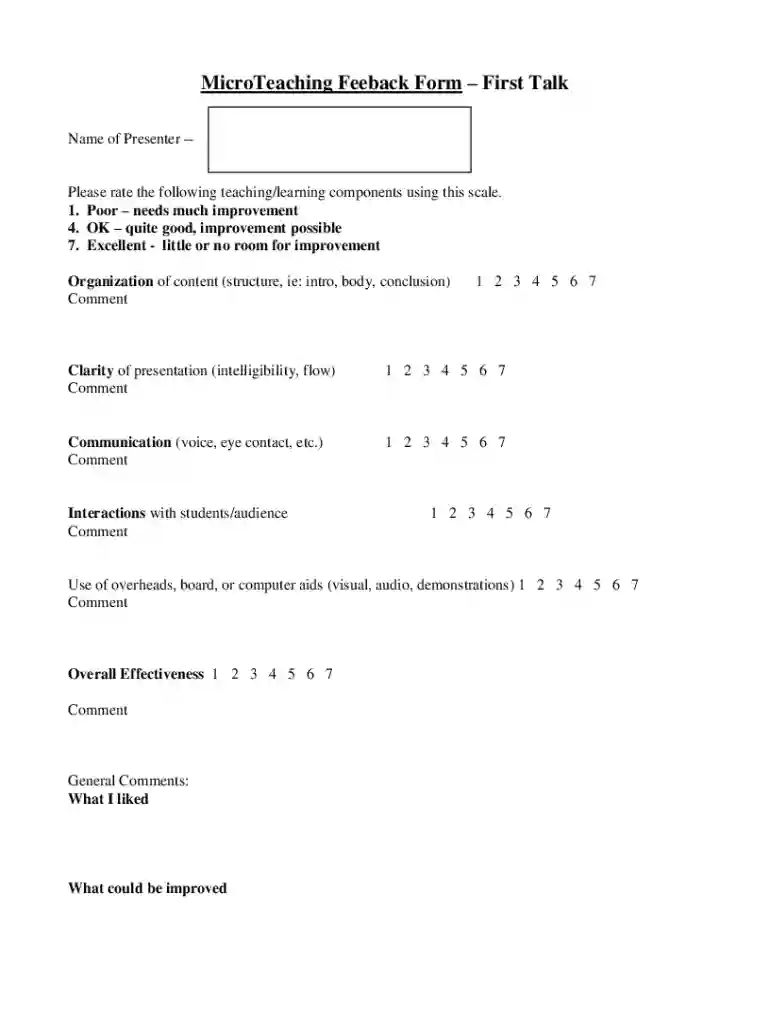
The PHY1600 - MicroTeaching Evaluation Form is designed to evaluate the effectiveness of microteaching sessions. Microteaching is a teaching practice that allows educators to refine their techniques in a controlled environment. This evaluation form includes various criteria such as the organization of the presentation, clarity of information delivered, communication skills, audience interaction, effective use of visual aids, and overall presentation effectiveness. Each aspect is assessed using a predefined rating scale that ensures consistency in feedback.

Key Components

  • Organization: Evaluates how well the teaching content is structured.
  • Clarity: Assesses how clearly the information is communicated.
  • Communication Skills: Looks at the presenter's verbal and non-verbal communication.
  • Audience Interaction: Measures how effectively the presenter engages with the audience.
  • Visual Aids: Considers the use of visuals to enhance understanding.
  • Overall Effectiveness: A holistic view of the presenter's performance.

Steps to Complete the PHY1600 - MicroTeaching Evaluation Form

Completing the PHY1600 evaluation form involves several precise steps to ensure accurate feedback for the presenter. Here's a detailed guide:

  1. Read Each Criterion Carefully: Understand what each rating category means to provide accurate feedback.
  2. Rate Each Aspect: Use the provided scale to rate aspects such as organization and clarity. Avoid middle-ground ratings to provide more actionable insights.
  3. Provide Specific Comments: Add detailed feedback in the comments section, highlighting strengths and areas for improvement.
  4. Summarize the Evaluation: Offer a brief summative comment regarding overall performance and suggestions for future development.

Tips for Accurate Feedback

  • Be Objective: Focus on the presenter's execution rather than personal preferences.
  • Use Examples: Provide concrete examples to explain each rating.
  • Stay Constructive: Feedback should be geared towards improvement rather than criticism.

How to Obtain the PHY1600 - MicroTeaching Evaluation Form

Obtaining the PHY1600 evaluation form typically involves coordination with educational institutions or organizations that integrate microteaching into their teaching development programs. Here’s how one can secure it:

  • Institutional Access: Often provided by universities or colleges as part of teaching courses or pedagogical training.
  • Online Platforms: Available through dedicated educational resources or platforms offering downloadable forms.
  • Direct Request: Contact the program coordinator or educational supervisor for a copy.

Common Access Points

  • Learning Management Systems (LMS): Forms are often integrated into platforms like Canvas or Moodle.
  • Email Distribution: Program administrators may send forms directly to participants' emails.

Key Elements of the PHY1600 - MicroTeaching Evaluation Form

The evaluation form is comprised of elements that ensure comprehensive assessment:

  • Rating Scale: Standardized to equally measure each teaching component.
  • Comments Section: Space for evaluators to provide detailed qualitative feedback.
  • Identifying Information: Sections for the evaluator's and the presenter’s details to assign and record evaluations accurately.
  • Overall Recommendations: Final section for overarching feedback and professional development advice.

Functionality Highlights

  • Consistency: Standardized elements ensure that evaluation remains uniform across different sessions and evaluators.
  • Flexibility: Allows for tailored feedback that can address specific issues the presenter faced.

Who Typically Uses the PHY1600 - MicroTeaching Evaluation Form

The PHY1600 evaluation form is primarily used by educators and teaching professionals who engage in microteaching activities. It serves a wide range of educational personnel, including:


  • Teacher Educators: To assess and guide preservice or in-service teachers.
  • Training Facilitators: Within corporate environments where communication training is provided.
  • Pedagogical Researchers: Studying teaching methods and their effectiveness.
decoration image ratings of Dochub

Target Audience

  • New Teachers: Gain practice and reflective insight into their teaching methodologies.
  • Experienced Educators: Refinement of advanced skills and techniques.
  • Educational Institutions: Higher education and training providers implement these forms to enhance their teaching programs.

Examples of Using the PHY1600 - MicroTeaching Evaluation Form

Real-world application of this evaluation form showcases its practical benefit:

  • Higher Education Scenario: During a teaching practicum, education students present a lesson where peers and instructors evaluate their performance using the form, providing feedback that verifies theoretical teaching concepts.
  • Training Workshops: In-house training sessions for corporate skills enhancement utilize the form to benchmark employee development.

Situational Adaptability

  • Method Customization: The form can be adapted depending on the subject matter or specific teaching goals.
  • Reflective Tool: As teachers review evaluations, they engage in self-reflection leading to self-initiated improvements.

Differences Between Digital and Paper Versions

While the PHY1600 evaluation form is available in both digital and paper formats, each version has its own set of advantages:

  • Digital Version: Ensures easy distribution, collection, and analysis of data. Automatic entry into digital databases facilitates comparisons across sessions and timeframes.

  • Paper Version: Offers the traditional approach, often used in environments with limited access to digital technologies.

Considerations

  • Accessibility: Choose based on evaluator access and technology proficiency.
  • Data Security: Digital forms may require additional security measures to protect participants’ data.

Legal Use and Compliance with the PHY1600 - MicroTeaching Evaluation Form

The form is a structured tool that promotes standard evaluation practices while ensuring compliance with educational standards in the U.S. context:

  • Consistency with Educational Standards: Supports accredited programs by offering a standardized feedback mechanism.
  • Data Protection Laws: Evaluators must adhere to applicable privacy laws, ensuring personal feedback is confidential and securely stored.

Compliance Measures

  • Data Handling: Information recorded must be treated in accordance with institutional data policies.
  • E-Signatures for Validity: Digital submissions may require validation through secure electronic signatures.

In summary, the PHY1600 - MicroTeaching Evaluation Form is a valuable resource for both educational institutions and individual educators looking to enhance teaching quality through constructive feedback mechanisms.

be ready to get more

Complete this form in 5 minutes or less

Get form

Got questions?

We have answers to the most popular questions from our customers. If you can't find an answer to your question, please contact us.
Contact us
A comprehensive self-evaluation form should include criteria such as accomplishments, areas of improvement, on-the-job competencies, values alignment with the company, goals for the future, and assessment of social and soft skills.
When you fill the form: Be honest and critical. Analyze your failures and mention the reasons for it. Keep the words minimal. Identify weaknesses. Mention your achievements. Link achievements to the job description and the organizations goals. Set the goals for the next review period. Resolve conflicts and grievances.
How do you write a performance evaluation? Identify core competencies. Choose a rating scale. Set an evaluation cycle. Prepare a list of questions. Share questions in advance. Have the conversation. Create a goal-setting framework. Be open to feedback.
The evaluation is designed to be a lesson, not a presentation. Successful teachers will plan on engaging students throughout the lesson through asking questions and encouraging discussion. Visual aids such as PowerPoint slides, board usage, and handouts are welcome and often appropriate, but are not required.

Security and compliance

At DocHub, your data security is our priority. We follow HIPAA, SOC2, GDPR, and other standards, so you can work on your documents with confidence.
Learn more
ccpa2
pci-dss
gdpr-compliance
hipaa
soc-compliance
be ready to get more

Complete this form in 5 minutes or less

Get form