01. Edit your form online
Type text, add images, blackout confidential details, add comments, highlights and more.

Type text, add images, blackout confidential details, add comments, highlights and more.

Draw your signature, type it, upload its image, or use your mobile device as a signature pad.

Send it via email, link, or fax. You can also download it, export it or print it out.
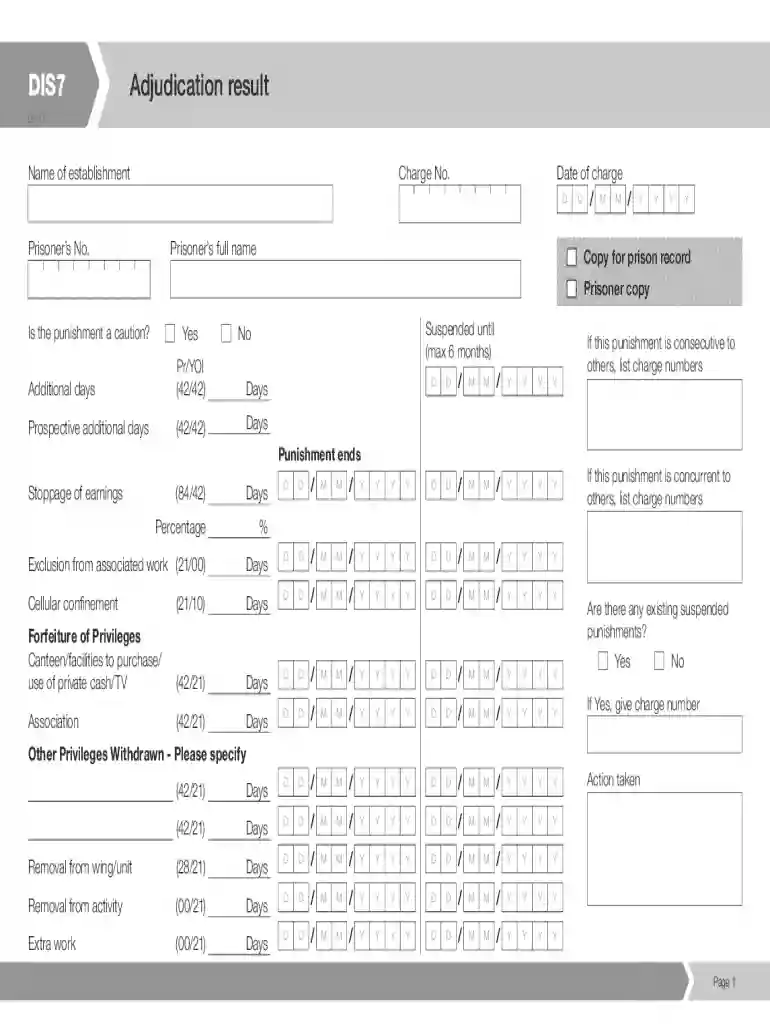
The Prison forms - DIS7 - Adjudication result Prisons, commonly referred to as the DIS7 form, is utilized within the United States prison system to document the outcomes of disciplinary adjudications for prisoners. This form serves as an official record detailing charges brought against an inmate, the adjudication process, and the resulting sanctions imposed. It captures key information about the proceedings and ensures that all parties have a clear understanding of the decisions made and their consequences. The form is critical in maintaining transparency in the disciplinary processes within prison facilities.
Filling out the DIS7 form requires a systematic approach to ensure all sections are correctly completed. Below is a step-by-step guide on how to effectively use the form:
Personal Information Section: Begin by entering the inmate's personal details, including name, identification number, and current housing information, to accurately identify the party involved in the adjudication.
Charge Description: Clearly outline the specific charges or rule violations that have led to the disciplinary action. Providing detailed descriptions helps clarify the nature and severity of the offenses.
Adjudication Outcome: Document the results of the adjudication, specifying the decisions made regarding the inmate’s guilt or innocence in relation to each charge.
Sanctions Imposed: Specify any penalties or corrective measures decided upon, such as loss of privileges, additional punishment days, or changes in work status. Clearly outline the duration and conditions of each sanction.
Review and Signatures: Ensure that the form is signed by the adjudicator, either a governor/director or district judge, and the inmate, confirming their acknowledgment of the outcome and any imposed penalties.
The process for completing the DIS7 form can be broken down into several important steps:
Gather Necessary Information: Prior to filling out the form, assemble all relevant documents, including incident reports, witness statements, and previous disciplinary records. This will inform the adjudication process and ensure accuracy.
Conduct a Hearing: A formal hearing should be conducted where the charges are presented, and the inmate has an opportunity to respond and present their defense or explanation.
Decision Making: The adjudicator should carefully consider all evidence before making a decision. This process must be fair, unbiased, and thorough.
Detailing the Outcome: Clearly and accurately record the outcome of the adjudication on the form, ensuring all sections are filled with the appropriate information and that there is no ambiguity.
Signatures and Filing: After completion, obtain the required signatures and securely file the form to maintain a transparent and accessible record.
Understanding the key elements of the DIS7 form ensures its effective use:
The DIS7 form is a legal document governed by the rules and regulations of the correctional facilities system. It is essential in upholding the legal processes surrounding inmate discipline. The form must be used in accordance with the legal standards to ensure that the rights of the inmates are preserved during adjudication proceedings.
Several scenarios demonstrate the use of the DIS7 form:
Failure to properly complete the DIS7 form or adhere to adjudication procedures can have significant consequences, including:
With advancements in technology, digital versions of the DIS7 form offer convenience and efficiency. Utilizing digital forms can streamline data entry and sharing between departments, enhance record-keeping accuracy, and facilitate easier access during audits or reviews, compared to traditional paper-based methods. However, strict protocols must be followed to maintain data security and integrity in digital formats.
We've got more versions of the Prison forms - DIS7 - Adjudication result Prisons form. Select the right Prison forms - DIS7 - Adjudication result Prisons version from the list and start editing it straight away!
| Versions | Form popularity | Fillable & printable |
|---|---|---|
| 2011 | 4.3 Satisfied (28 Votes) |
At DocHub, your data security is our priority. We follow HIPAA, SOC2, GDPR, and other standards, so you can work on your documents with confidence.