




01. Edit your form online
Type text, add images, blackout confidential details, add comments, highlights and more.

Type text, add images, blackout confidential details, add comments, highlights and more.

Draw your signature, type it, upload its image, or use your mobile device as a signature pad.

Send it via email, link, or fax. You can also download it, export it or print it out.
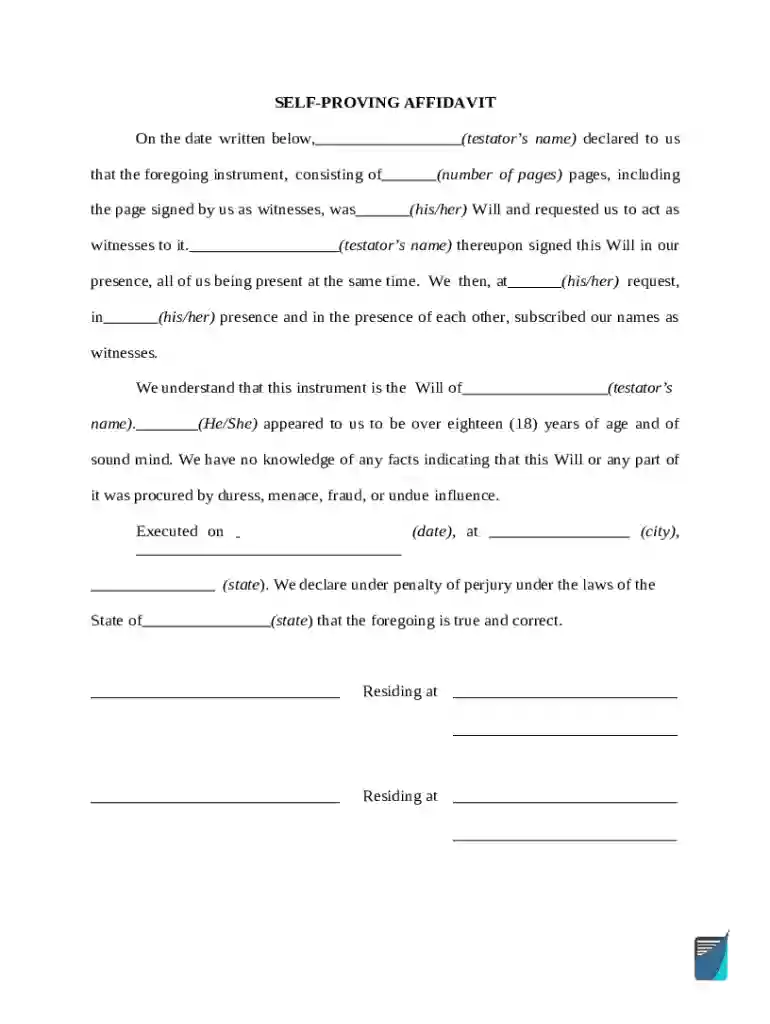
A self-proving affidavit is a legal document used primarily in the context of wills and estates within the United States. It serves to affirm the authenticity of a will without the need for the witnesses who signed it to testify in court. By attaching a self-proving affidavit, the probate court can accept the will as valid, effectively reducing administrative delays. The affidavit includes statements from the testator and witnesses confirming the testator's sound mind and voluntary execution of the will.
Using this form requires proper completion and notarization to ensure its validity. Here's a simple process for utilizing the form:
The seamless incorporation of these steps ensures the form's effectiveness in establishing a will as self-proving.
Completing the form involves several meticulous steps, which ensure its legal validity:
Attention to these details helps streamline the probate process significantly.
A comprehensive understanding of the form involves recognizing its key components:
These elements collectively establish the document’s legitimacy and avoid future legal challenges.
Its primary legal function is to simplify the probate process by eliminating the need for witness testimonies. By utilizing a self-proving affidavit, the court takes the document at face value, making probate seamless. The affidavit's legal authority rests on the ESIGN Act and various state laws, which mandate the presence and notarization of all requisite parties.
While the form serves a universal function across the United States, there are slight variations in its application among states. Key differences include:
Consult state-specific guidelines to ensure compliance and authenticity.
This form is predominantly used by:
These users rely on the form for its proven legal effectiveness and efficiency.


Understanding relevant legal terms enhances clarity and appropriate form usage:
Familiarity with these terms aids in accurately navigating the creation and use of the affidavit.
At DocHub, your data security is our priority. We follow HIPAA, SOC2, GDPR, and other standards, so you can work on your documents with confidence.
A will, at the time of its execution or at any subsequent date, may be made self-proved by the acknowledgment thereof by the testator and the affidavits of the
a person can create a self-proving will, and in most states this is accomplished by attaching two self-proving affidavits by witnesses of the wills signing.


