
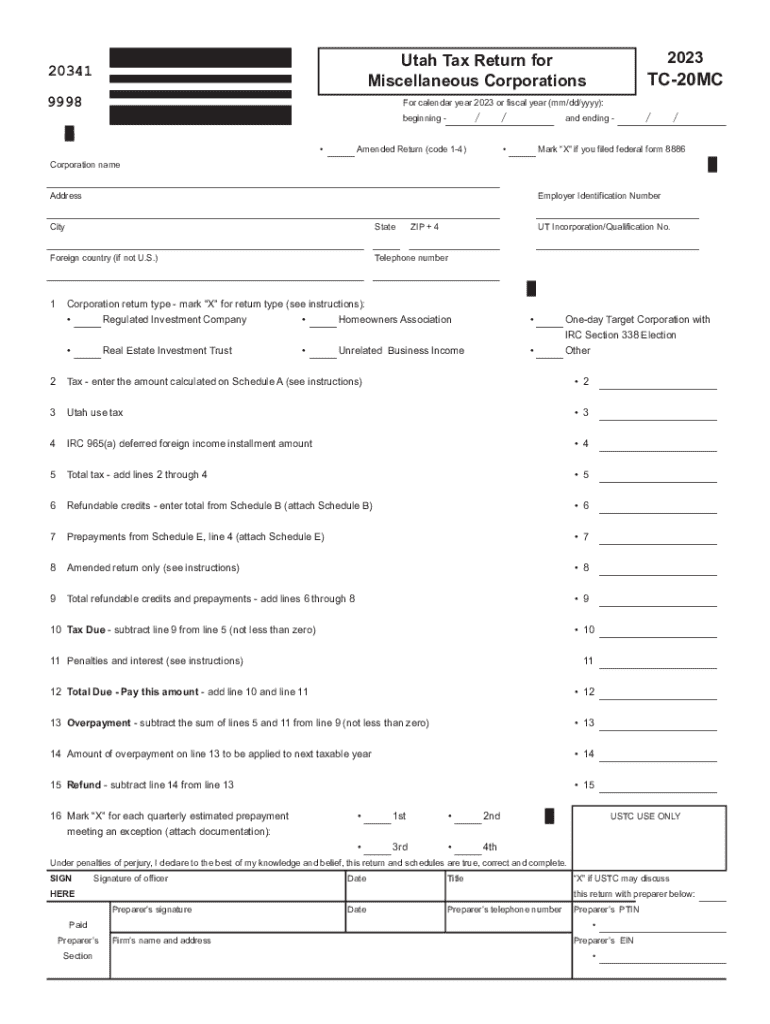







Definition & Purpose of the 2023 TC-20MC Form
The 2023 TC-20MC form, known as the Utah Tax Return for Miscellaneous Corporations, serves as a vital document for specific corporations operating within Utah. This form is designed to facilitate the reporting of financial information necessary for determining state tax liabilities. Corporations that fall under the category of “miscellaneous” generally include those that do not fit neatly into standard corporate classifications but still require formal tax reporting. The TC-20MC assists in the accurate calculation of taxes by accounting for various factors, such as income, deductions, and applicable credits.
Key Elements
- Corporation Identification: This section captures fundamental details about the corporation, including name, address, and federal employer identification number (FEIN), ensuring proper identification by the tax authorities.
- Tax Calculations: Corporations must accurately compute their tax liability based on income, expenses, and potential deductions. This includes complex calculations that must adhere to Utah state tax codes.
- Refundable Credits & Prepayments: Taxpayers can apply various credits to lower overall tax liability and report any prepayments made during the tax year to ensure they are credited appropriately.
Steps to Complete the 2023 TC-20MC Form
-
Gather Required Information: Collect all necessary financial records, including income statements, balance sheets, and any documents detailing business expenses or credits for the taxable year.
-
Complete Identification Section: Fill in firm-specific details accurately to ensure the form is tied correctly to your business.
-
Calculate Tax Liability: Use the instructions provided with the form to complete each section methodically, ensuring clarity and compliance with Utah tax laws.
-
Apply Credits and Adjustments: Carefully account for any refundable credits and report prepayments to ascertain correct tax liability and potential refunds.
-
Review and Submit: Double-check all entries for accuracy, consistency, and completeness before proceeding with the filing method of choice.
Who Typically Uses the 2023 TC-20MC Form
The TC-20MC is predominantly utilized by miscellaneous corporations operating in Utah. Such entities might include businesses that do not fit standard corporate taxation frameworks but engage in commerce or activities subject to state taxes. Common users include:
- Non-standard Corporations: Businesses that do not align with typical corporate structures.
- Out-of-State Corporations: Entities conducting business within Utah but headquartered elsewhere.
- Subsidiaries or Branches: Parts of larger corporate entities operating in Utah.


Important Terms Related to the TC-20MC Form
Taxable Income
This refers to the difference between gross income and allowable deductions. It is a critical figure in determining the total tax due by a corporation.
Apportionment Schedules
These schedules are used to allocate income to Utah for taxation purposes, especially for corporations operating both within and outside the state. They ensure that the correct portion of income is subject to Utah tax, in accordance with state laws.
Refundable Credits
Refundable credits can be claimed by corporations to reduce total tax liability. If these credits exceed the tax owed, the excess is refunded to the corporation, adding a layer of complexity to the tax return.
Legal Use and Compliance
The TC-20MC form must be filled out in compliance with Utah state tax laws, ensuring that corporations report their financials accurately and completely. Misreporting or failing to file the form can lead to serious legal consequences, including fines and penalties for non-compliance. It is imperative that corporations understand legal requirements and consult with tax professionals when necessary to ensure full compliance.
Penalties for Non-Compliance
Corporations failing to file the TC-20MC form or filing late may incur penalties. This can include interest on taxes owed, fixed monetary penalties, or more significant legal actions depending on the severity and intentionality of the non-compliance.
Required Documents and Information
Proper completion of the TC-20MC requires a range of documentation and data, including:
- Financial Statements: Year-end records detailing income, expenses, and capital changes.
- Previous Tax Returns: Reference past filed returns to ensure continuity and accuracy.
- Documentation for Credits: Specific forms or official documents supporting claims for credits or deductions.
Having these documents prepared can significantly streamline the filing process and reduce the risk of errors.
Digital vs. Paper Version
Corporations have the option to file the TC-20MC form either digitally or using paper versions. Digital submissions can be quicker and offer built-in validation checks to minimize errors, while paper submissions may be preferred by those more comfortable with non-digital forms or in need of physical records. Choosing the right method depends on the business's infrastructure and comfort level with digital technologies.
Software Compatibility
Programs like TurboTax or QuickBooks may support filing the TC-20MC form, offering step-by-step guidance and streamlined processes. Using such software can reduce errors and enhance efficiency, especially for businesses handling multiple tax forms or those unfamiliar with state-specific requirements.
Filing Deadlines / Important Dates
Corporate taxes must be filed by specific deadlines to avoid penalties. For the TC-20MC form, corporations should be aware of the April 15 deadline for tax years aligning with the calendar year. Extensions may be available, but they require timely application and are subject to approval by Utah's tax authorities.
Staying informed about these deadlines and planning tax activities in advance ensures compliance and avoids the last-minute rush that can lead to mistakes or omissions.
Examples of Corporate Scenarios Using the TC-20MC Form
Consider a tech company based in California with significant operations in Utah. The TC-20MC form allows this company to report its Utah-generated revenue and pay the appropriate state taxes. Similarly, a subsidiary manufacturing firm might use the TC-20MC to declare its obligations based on production levels and sales figures in-state, ensuring proper tax contributions to Utah.
These examples highlight the form's flexibility and crucial role in capturing diverse business scenarios under a unified tax reporting framework.




