
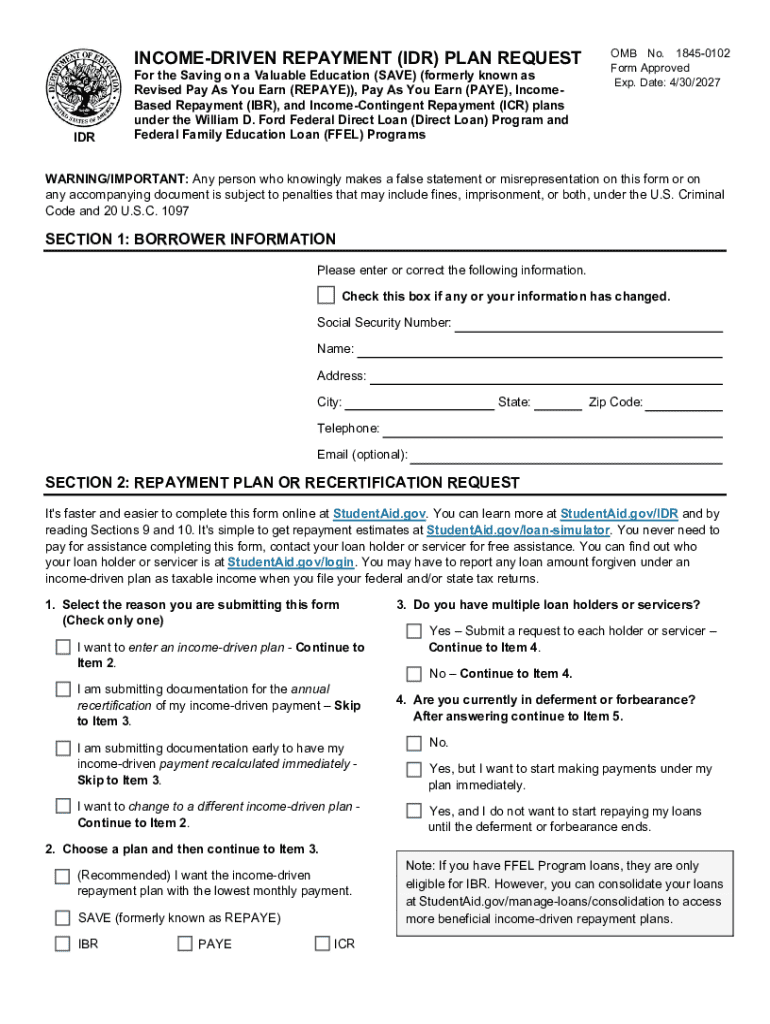







Definition & Meaning
An Income-Driven Repayment (IDR) Plan Request is a form used to apply for an income-driven repayment plan for federal student loans. These plans, including options like SAVE (Saving on a Valuable Education), PAYE (Pay As You Earn), IBR (Income-Based Repayment), and ICR (Income-Contingent Repayment), are designed to make loan payments more manageable based on a borrower's income and family size. By submitting this form, borrowers can tailor their payment plans to align with their financial capacity, potentially lowering their monthly payments and extending the repayment period.
How to Use the Income-Driven Repayment Plan Request
To effectively use the Income-Driven Repayment Plan Request form, borrowers should follow these steps:
-
Gather Required Information: Before filling out the form, ensure you have your personal and loan information ready, including your Federal Student Aid (FSA) ID, loan servicer details, and income documentation.
-
Select the Appropriate Repayment Plan: Determine which of the income-driven plans (SAVE, PAYE, IBR, or ICR) best suits your financial situation. Consider factors like current income, potential future income changes, family size, and the type of federal student loans you hold.
-
Complete the Form Accurately: Fill in the borrower information, select your preferred plan, and provide detailed income and family size information. Carefully review each section to prevent errors that could delay processing.
-
Sign and Submit the Form: Once completed, sign the form to authorize the processing of your application. Depending on your loan servicer, submit the form online through their portal or mail it as instructed. Some servicers may also accept faxes.
Important Terms Related to Income-Driven Repayment Plan Request
Understanding key terms related to the Income-Driven Repayment Plan Request can help in filling out the form accurately:
-
Adjusted Gross Income (AGI): A measure of income that includes wages, business income, and other earnings, minus certain deductions. It's crucial for calculating payment amounts under income-driven plans.
-
FSA ID: A unique identifier used to log in to U.S. Department of Education websites, necessary for accessing and submitting financial information.
-
Loan Servicer: A company assigned to handle the billing and other services related to your federal student loan. They play a role in processing IDR Plan Requests and managing your repayments.
-
Income Recertification: The annual process of submitting updated income and family size information to continue qualifying for your selected income-driven plan.
-
Outstanding Balance: The total amount you owe on your student loan, including principal and interest. This affects the calculation of your repayment terms and potential forgiveness under certain plans.
Steps to Complete the Income-Driven Repayment Plan Request
The process for completing the Income-Driven Repayment Plan Request involves several critical steps:
-
Review Eligible Plans: Understand each plan's requirements and benefits. For instance, the PAYE plan caps payments at 10% of discretionary income and is generally more beneficial for recent graduates with lower income.
-
Accurate Information Entry: Complete the borrower information section with your full name, Social Security Number, and contact information. Ensure accuracy to prevent processing delays.
-
Choose Repayment Plan: Indicate your preferred income-driven repayment plan. You may also opt for the plan with the lowest eligible payment if unsure which one to choose.
-
Provide Family Size and Income Details: Enter current family size and provide documentation or authorization for the IRS to share your tax information for income verification.
-
Authorize Tax Info Retrieval: Grant permission for the loan servicer to access your tax information, if required, to verify income and streamline application processing.
-
Submit Form: After verifying all information, submit the form following your loan servicer’s instructed method, whether online or via mail.
Required Documents
The completion of an Income-Driven Repayment Plan Request often requires specific documents to verify eligibility and calculate the repayment amount:
-
Latest Tax Return or IRS Tax Transcript: To provide a clear picture of your AGI, which influences repayment calculations.
-
Proof of Income: If your income has significantly changed since your last tax filing, additional documentation such as recent pay stubs or a letter from your employer may be needed.
-
Family Size Verification: Documentation such as birth certificates or marriage licenses might be requested to verify dependents or spouse.
Eligibility Criteria
Certain criteria must be met to qualify for an income-driven repayment plan:
-
Loan Type: Only federal student loans such as Direct Loans, FFEL Program Loans, and Parent PLUS Loans (consolidated) are eligible.
-
Income Level: The plan requires an income level that justifies a reduction in your repayment amount. This is often determined relative to the federal poverty guideline for your family size.
-
Discretionary Income: This is calculated based on your AGI minus a percentage of the federal poverty guideline and is critical in determining your eligibility for plans like PAYE and IBR.


Penalties for Non-Compliance
Failing to comply with the terms of the Income-Driven Repayment Plan can result in several consequences:
-
Default Risk: Missing payments can lead to default, severely affecting credit scores and access to future financial aid.
-
Interest Accumulation: Payments less than the interest amount can cause unpaid interest to be capitalized, increasing the total loan balance.
-
Eligibility Cancellation: Failure to recertify income and family size annually may result in a shift back to a higher standard repayment amount.
Legal Use of the Income-Driven Repayment Plan Request
This form is legally binding and must be used within the U.S. legal framework for educational lending:
-
Adherence to ESIGN Act: Electronic submissions require acknowledgement of the ESIGN Act that recognizes digital applications as legally valid.
-
Fraud Prevention: Providing false information is subject to legal penalties, including financial penalties and disqualification from future federal aid.
-
Authorization for Data Use: The form authorizes the use of personal and financial data strictly for the purpose of determining repayment amounts and eligibility.




