




01. Edit your non permit confined space form online
Type text, add images, blackout confidential details, add comments, highlights and more.

Type text, add images, blackout confidential details, add comments, highlights and more.

Draw your signature, type it, upload its image, or use your mobile device as a signature pad.

Send non permit confined space form via email, link, or fax. You can also download it, export it or print it out.
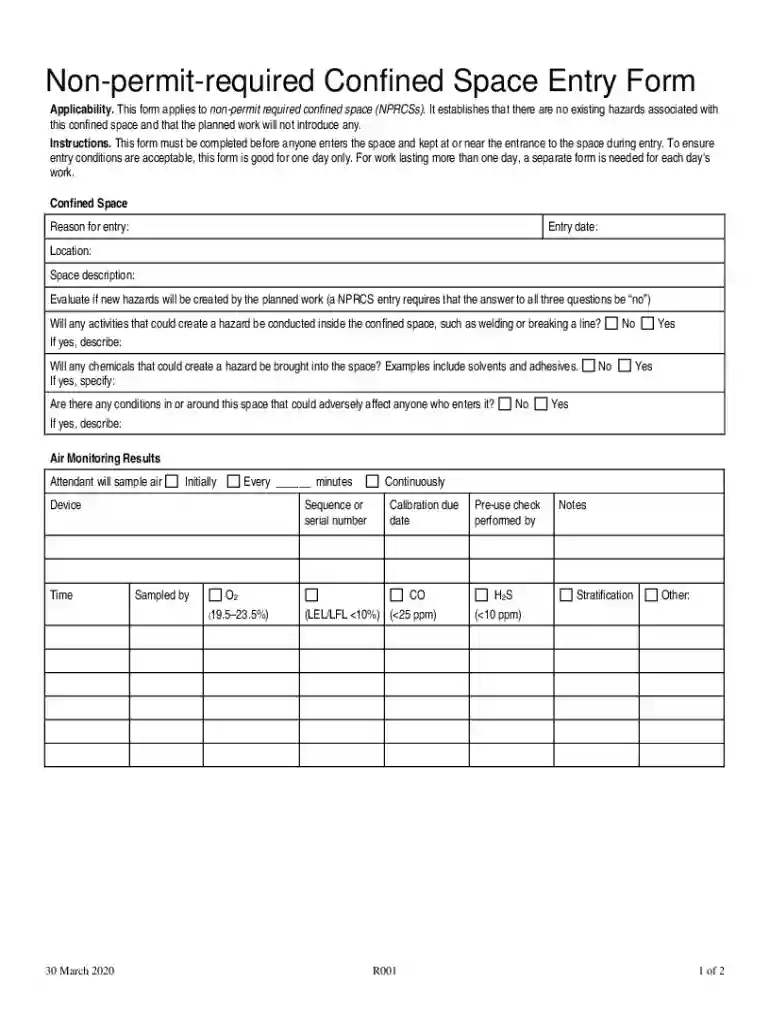
The Non-permit-required Confined Space Entry Form is crucial for ensuring safety in workplace environments that feature confined spaces. These confined spaces can include tanks, vessels, silos, vaults, and pits that are not designed for continuous employee occupancy. This form serves a dual function: verifying that these spaces are free from hazardous conditions and maintaining a record of entities entering the space. It must be completed each time there is an entry and serves as a guide for evaluating potential dangers.
Confined spaces do not typically have the hazards that naturally necessitate a permit-required confined space classification. However, the form ensures that steps are taken to confirm the safety of the area. The procedural aspect of this form underscores its importance in workplace safety, providing a framework for employees and supervisors to follow.
Using the Non-permit-required Confined Space Entry Form involves several steps. First and foremost, a detailed inspection of the confined space must be undertaken. The form will guide this inspection, helping to evaluate risks associated with specific conditions or materials. Key elements you can expect to document include:
This step-by-step record-keeping is crucial. The form must be retained at the entry point to the confined space while work is being conducted, ensuring it is accessible for any required checks or approvals. Each entry and exit must be meticulously logged to maintain an accurate and reliable operational record.
Completing the form involves several detailed actions:
Initial Evaluation: Assess the confined space for any hazardous conditions. This is the first step before filling out the form.
Air Monitoring: Use appropriate equipment to record air quality and ensure no hazardous gases are present. Document these results speculatively on the form.
Identification of Personnel: Log the names, times, and purposes of all individuals entering and exiting the confined space.
Supervisor Confirmation: Obtain a sign-off from a supervisor confirming the space is safe for entry.
The form is not just a bureaucratic requirement but a critical component of workplace safety practices. Each step aligns with broader occupational safety mandates to reduce risks associated with confined space work environments.
The Non-permit Confined Space Form encompasses various elements that ensure comprehensive evaluation and documentation:
The form is designed with ease of use in mind, featuring a systematic arrangement that aids in quick yet thorough completion.
In the United States, the utilization of the Non-permit-required Confined Space Entry Form aligns with OSHA regulations for maintaining workplace safety. It is indispensable for industries that may involve work in confined spaces, absolving potential liabilities by ensuring all safety precautions have been documented.
Non-compliance with these regulations could result in hefty fines, legal actions, or increased liability exposure during incidents. By adhering to these requirements, companies protect themselves and their employees, achieving legal and regulatory peace of mind.
The form is integral in various industries, predominantly used by safety managers, supervisors, and workers who engage in:
It is primarily the responsibility of the safety manager to complete and maintain these records, ensuring all entries into a non-permit-required confined space are accounted for efficiently and accurately.


While the OSHA regulations are federally mandated, states may impose additional requirements or best practices when it comes to confined spaces. Some states have programs mirroring the federal guidelines, while others might introduce stricter localized rulings.
For example, states like California might have heightened air quality sampling requirements or more detailed logging needs. It is crucial for companies operating across several states to fully understand and comply with any state-specific variations.
Familiarity with specific terms enhances understanding and execution of the form:
Clarifying these terms assists users in accurately completing and interpreting the form, ensuring they can effectively communicate safety measures and meet compliance requirements.
In practice, efficient use of the form could involve scenarios such as maintenance teams entering a storage tank. Before entry, the team would document readings and inspections to demonstrate compliance with air quality and safety standards, recording all participants’ times in and out.
Another instance may be a utility repair requiring entrance into a vault. The form would guide pre-inspection measures and log each stage and personnel action involved in the repair process.
These examples reflect the form’s versatility and crucial role in maintaining safety standards across various industries and tasks.
We've got more versions of the non permit confined space form form. Select the right non permit confined space form version from the list and start editing it straight away!
| Versions | Form popularity | Fillable & printable |
|---|---|---|
| 2020 | 4.6 Satisfied (23 Votes) |
At DocHub, your data security is our priority. We follow HIPAA, SOC2, GDPR, and other standards, so you can work on your documents with confidence.
If NO, the space is a non-permit confined space. No action is necessary for non-permit confined spaces. Retain this form in site files for the confined space
Jun 2, 2015 This document presents current technical recommendations of the U.S. Environmental Protection Agency (EPA) based on our current understanding
This form applies to spaces that are listed as a non-permit required confined space (NPRCS) in the confined space inventory.


