




01. Edit your form online
Type text, add images, blackout confidential details, add comments, highlights and more.

Type text, add images, blackout confidential details, add comments, highlights and more.

Draw your signature, type it, upload its image, or use your mobile device as a signature pad.

Send it via email, link, or fax. You can also download it, export it or print it out.
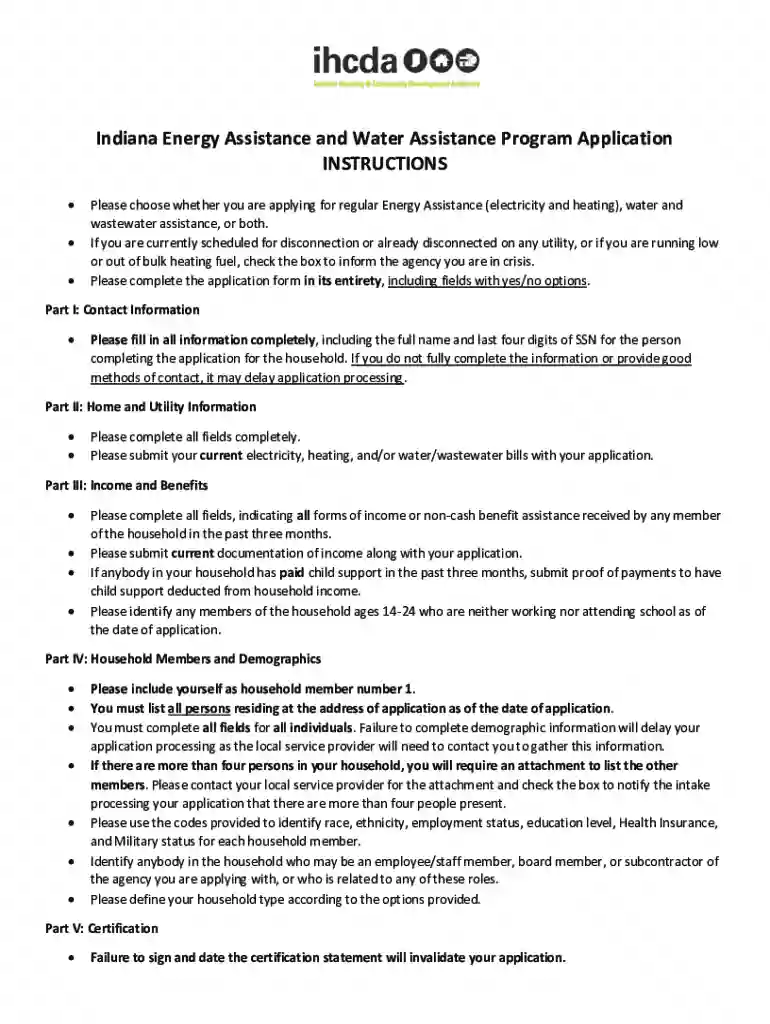
The Indiana Energy Assistance Program (EAP) application is a formal document used by individuals and households in Indiana to apply for financial assistance with their utility bills. This program is designed to support low-income households by ensuring they have uninterrupted access to essential services such as electricity and heating. The application gathers critical information about the applicant’s household, including demographics, income, and utility service providers, to evaluate eligibility for assistance.
Applicants must complete the application with detailed and accurate information to be considered for the program. The form also includes sections for applicants to certify the accuracy of the information provided. Crucially, applications must be submitted to a local service provider by a specified deadline to qualify for assistance. The EAP can be a lifeline for many families, offering support during extreme weather conditions when utility bills can become particularly burdensome.
To accurately complete the Indiana EAP application, several documents are required to verify both household identity and financial status. Applicants should prepare the following documentation:
The completeness and accuracy of these documents are essential in preventing processing delays and ensuring timely approval of applications.
Completing the Indiana EAP application requires attention to detail and an understanding of the information necessary for each section. Here are the steps to guide applicants:
Applicants should double-check the completed form to avoid errors or omissions that could delay processing.
Eligibility for the Indiana EAP is based primarily on household income and size. Specific criteria include:
Confirmation of eligibility can sometimes involve an interview or additional documentation.


The Indiana EAP application can be obtained through multiple channels:
Sources must be verified as official to ensure the form's validity.
Applicants can submit their completed EAP applications using several methods:
Each method has specific guidelines and deadlines that need to be adhered to closely.
Once submitted, applications undergo a review process. The timeline for approval can vary:
Awareness of this process can help manage expectations and reduce anxiety associated with waiting periods.
Using the Indiana EAP application involves legal responsibilities:
Understanding these legal expectations helps applicants engage with the program correctly and responsibly.
We've got more versions of the Indiana energy assistance program application form. Select the right Indiana energy assistance program application version from the list and start editing it straight away!
At DocHub, your data security is our priority. We follow HIPAA, SOC2, GDPR, and other standards, so you can work on your documents with confidence.
Sep 29, 2019 Applications for LIHEAP assistance in Champaign County require an in-person visit. Those can be done Monday through Fridays from 8 A.M. to 4:30
When can I apply for EAP? The Energy Assistance Program application is currently closed and will reopen Fall of 2026. How long will it take to receiveRead more


