




01. Edit your form 8493 online
Type text, add images, blackout confidential details, add comments, highlights and more.

Type text, add images, blackout confidential details, add comments, highlights and more.

Draw your signature, type it, upload its image, or use your mobile device as a signature pad.

Send it via email, link, or fax. You can also download it, export it or print it out.
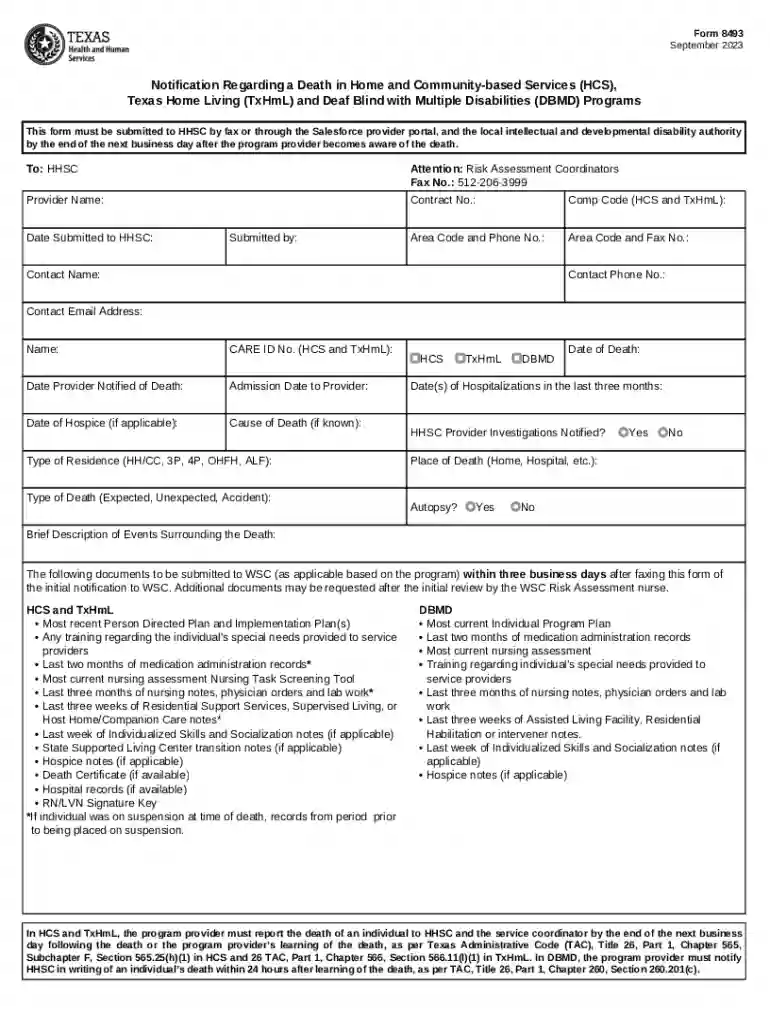
Form 8493 is a critical notification tool used primarily to report deaths within the Home and Community-based Services (HCS), Texas Home Living (TxHmL), and Deaf Blind with Multiple Disabilities (DBMD) programs in Texas. The form is mandated to ensure that the required information is promptly communicated to the Health and Human Services Commission (HHSC) and local authorities. This includes details about the deceased individual, such as their identity, place of residence, and circumstances surrounding their death.
Using Form 8493 involves several key steps. Providers must complete the form upon becoming aware of a death within HCS, TxHmL, or DBMD programs. A completed form includes necessary details about the incident and must be submitted within specified timeframes to ensure compliance with Texas state regulations.
To obtain Form 8493, you can access it through state health department websites or contact relevant agencies directly. Authorized organizations often provide both digital and physical copies, making it convenient for different preferences.
Primarily, service providers, caregivers, and program administrators associated with the HCS, TxHmL, and DBMD programs are the typical users of Form 8493. They are responsible for ensuring timely reporting of any death within their jurisdiction to comply with legal obligations.
Form 8493 includes several essential components that must be completed accurately:
Understanding several key terms can aid in the correct completion and submission of Form 8493:
The legal framework surrounding Form 8493 necessitates that all information provided is true and accurate to the best of the provider’s knowledge. Failure to comply with submission regulations may lead to penalties or sanctions.
Particular rules apply to the use of Form 8493 within Texas, impacting how and when the form must be submitted. Providers must stay updated with any amendments to state laws and guidelines to ensure continuous compliance.
Alongside Form 8493, providers must submit additional supporting documents, such as medical reports or death certificates, to corroborate the information. These documents help verify the details and provide a comprehensive context for the recorded death.
Adherence to stipulated filing deadlines is crucial. Providers must submit the form within specified days following the death, varying slightly based on the program involved and specific state regulations. These deadlines are designed to ensure prompt and efficient processing of the form.
By comprehensively addressing each of these sections, users can ensure they meet all necessary requirements for using Form 8493 effectively, while complying with both the practical and legal obligations dictated by Texas state law.
We've got more versions of the form 8493 form. Select the right form 8493 version from the list and start editing it straight away!
At DocHub, your data security is our priority. We follow HIPAA, SOC2, GDPR, and other standards, so you can work on your documents with confidence.
Dec 23, 2022 TEXAS DEPARTMENT OF HOUSING AND COMMUNITY AFFAIRS ADMINISTRATION. Texas Commission of Licensing and Regulation
Form 8493, Notification Regarding a Death in HCS, Click here for instructions on opening this form. Effective Date 9/2023 8493.pdf. Texas Health and Human


