




01. Edit your form online
Type text, add images, blackout confidential details, add comments, highlights and more.

Type text, add images, blackout confidential details, add comments, highlights and more.

Draw your signature, type it, upload its image, or use your mobile device as a signature pad.

Send it via email, link, or fax. You can also download it, export it or print it out.
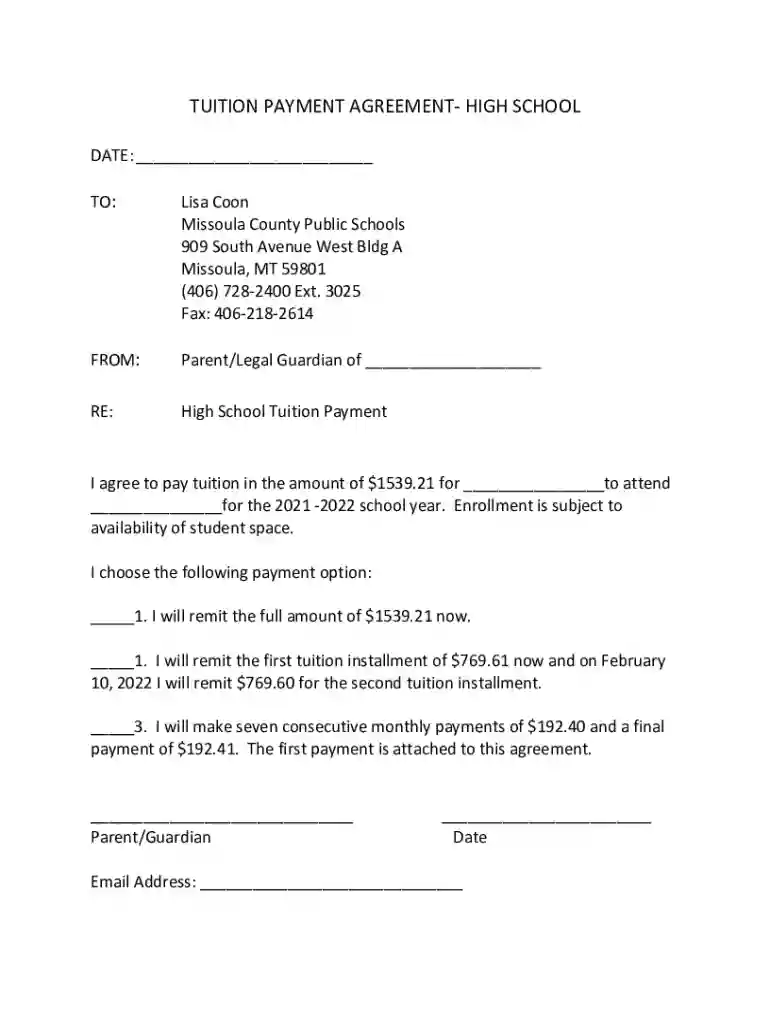
A Tuition Payment Agreement - High School is a legally binding contract between a high school and a student’s parent or guardian. It specifies the terms under which tuition fees will be paid for the academic year. Primarily used in private schools, this document aims to clarify payment obligations, including the total amount, installment options, and due dates, ensuring both parties are clear on their financial responsibilities. By establishing such agreements, schools and families can prevent misunderstandings and disputes related to tuition payments.
The main components of the Tuition Payment Agreement include:
These elements form the agreement's backbone, delineating expectations clearly to foster trust and commitment from both parties.
To effectively use the Tuition Payment Agreement, parents and guardians must first understand the terms before acknowledgment and signing.
Following these steps ensures that both the school and families have a mutual understanding of the financial structure for the academic year.
Completing the Tuition Payment Agreement involves several critical steps to ensure accuracy and compliance.
This comprehensive approach simplifies the agreement's completion, ensuring all necessary steps are addressed accurately.
Understanding specific terminology within the agreement is vital for compliance and smooth transactions.
Familiarity with these terms enhances understanding and compliance with the tuition payment process.
The Tuition Payment Agreement is utilized primarily by private high schools and families opting for private education.


Both parties rely on this agreement for clarity in educational financial transactions.
Utilizing the Tuition Payment Agreement involves understanding its legal implications, ensuring all parties adhere to the contract's terms faithfully.
Understanding these legal aspects ensures that the agreement is used correctly and maintains its integrity as a financial safeguard.
Tuition Payment Agreements can be submitted in various formats, providing flexibility and convenience to families and school administrators.
These methods cater to different preferences, ensuring that submission can be completed with convenience and assurance.
We've got more versions of the TUITION PAYMENT AGREEMENT-HIGH SCHOOL form. Select the right TUITION PAYMENT AGREEMENT-HIGH SCHOOL version from the list and start editing it straight away!
At DocHub, your data security is our priority. We follow HIPAA, SOC2, GDPR, and other standards, so you can work on your documents with confidence.


