




01. Edit your repossession application form online
Type text, add images, blackout confidential details, add comments, highlights and more.

Type text, add images, blackout confidential details, add comments, highlights and more.

Draw your signature, type it, upload its image, or use your mobile device as a signature pad.

Send it via email, link, or fax. You can also download it, export it or print it out.
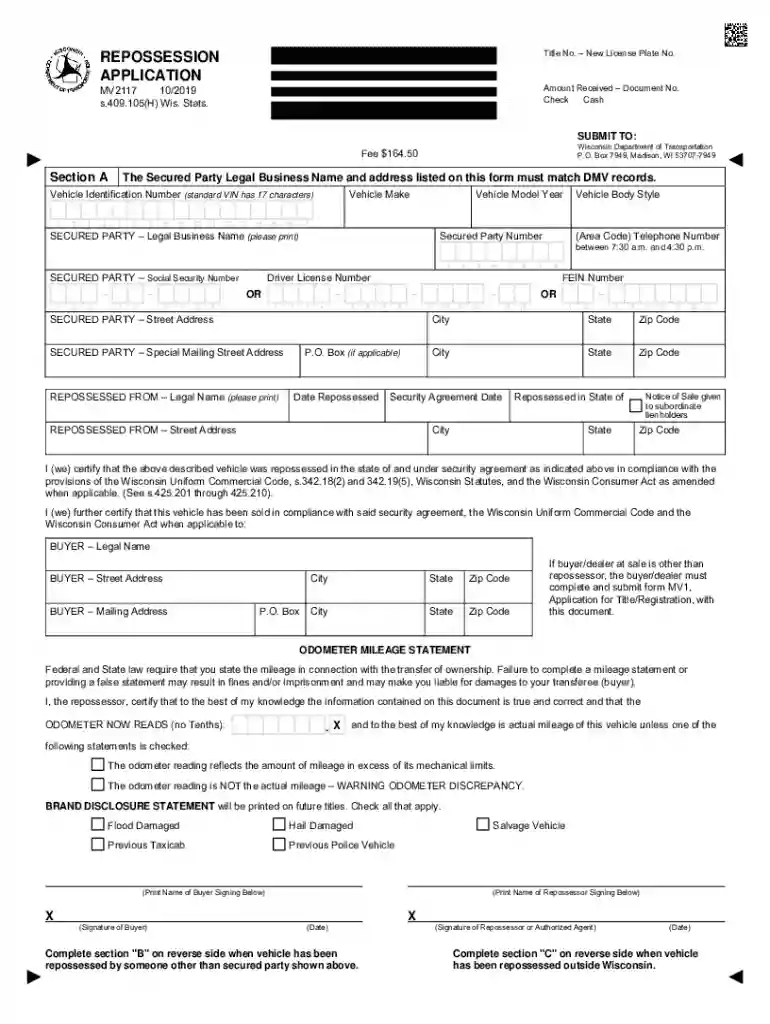
A repossession application is a formal request submitted to the Wisconsin Department of Transportation for the legal recovery of a vehicle by a secured party. This document is essential for financial institutions or lenders seeking to repossess property from borrowers who have defaulted on payments. It ensures that the repossession process adheres to state regulations, protecting both the lender and borrower from potential legal disputes. Utilizing the repossession application is crucial for maintaining order in transactions involving secured loans, where a vehicle serves as collateral. By providing a clear, legal framework for repossession, the application safeguards all involved parties.
To effectively use the repossession application, begin by gathering all necessary details about both the secured party and the borrower. This includes the names, addresses, and contact information of all involved parties. Completion of the section detailing the vehicle is paramount, as it requires the vehicle identification number (VIN), make, model, and year. Additionally, include the odometer mileage to meet regulatory requirements accurately. After filling in these sections, focus on the repossessor's statement, which must clearly justify the grounds for repossession. To finalize the application, ensure the appropriate fee is enclosed and all information is thoroughly reviewed for accuracy.
Secure Party Information: Fill in details about the lender or financial institution initiating the repossession. Include a contact address for correspondence.
Vehicle Identification: Enter the vehicle's VIN, make, model, and year. This ensures clarity about which asset is subject to repossession.
Odometer Mileage Statement: Record the current odometer reading to comply with legal standards.
Repossession Justification: Provide an assertive repossessor's statement explaining the borrower’s default and justifying the repossession.
Application Fee Payment: Attach the payment of $164.50, the required fee for processing the application, in the preferred method as specified by the Department.
Review the form for accuracy and completeness before submission to avoid processing delays or rejections.
The repossession application must be used within the frameworks defined by Wisconsin state law. It aims to prevent unlawful seizure of property and ensures that all repossessions are lawful and justified. Submitting a repossession application is mandatory before a repossession can proceed legally. Any deviation from the lawful process could result in legal repercussions for the lending institution or individual, including potential fines or dismissal of the repossession case.
In Wisconsin, the repossession process is governed by specific regulations that must be followed meticulously. The state mandates the submission of a repossession application as part of its process to ensure lawful repossession. Wisconsin requires that borrowers be notified of a pending repossession, providing them with a chance to rectify the loan default. The state specifies the invitation for the borrower to redeem the vehicle before final sale or auction.
Let's consider a financial institution that has provided a car loan to a borrower. If the borrower defaults on payments, the lender can file a repossession application. By ensuring all documentation is in place, including proof of default and the loan agreement, the lender can legally request repossession through the Wisconsin Department of Transportation. Another example is a smaller auto dealership recovering a leased vehicle whose lessee has failed to make payments.
The primary users of a repossession application are financial institutions, such as banks and credit unions, and individual lenders who have issued secured loans. Vehicle dealerships engaged in financing arrangements may also frequently use this application. In addition, asset recovery agencies or legal representatives involved in debt collection processes may require the application to ensure their actions are within legal parameters, emphasizing the importance of this document in financial and loan-related operations.


We've got more versions of the repossession application form form. Select the right repossession application form version from the list and start editing it straight away!
At DocHub, your data security is our priority. We follow HIPAA, SOC2, GDPR, and other standards, so you can work on your documents with confidence.
Application for Title to a Repossessed Vehicle. Each applicant for title to a vehicle purchased after repossession shall furnish the following to the bureau: (
If you have a purchaser for the vehicle, the purchaser must complete Application for Title/Registration form MV1 and submit it along with the MV2117 and properRead more


