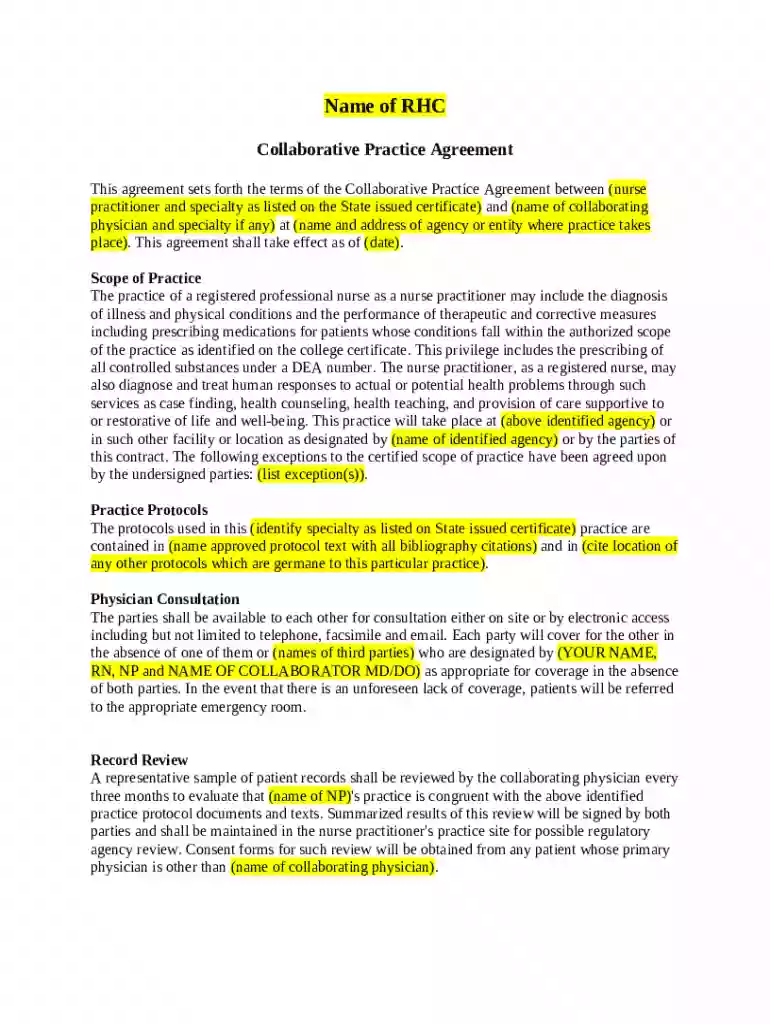
Np-sample-collaborative-agreement 2026

Get Form
np-sample-collaborative-agreement Preview on Page 1

Here's how it works

01. Edit your form online
Type text, add images, blackout confidential details, add comments, highlights and more.

02. Sign it in a few clicks
Draw your signature, type it, upload its image, or use your mobile device as a signature pad.

03. Share your form with others
Send it via email, link, or fax. You can also download it, export it or print it out.

Definition & Meaning

A "np-sample-collaborative-agreement" refers to a legally binding document outlining the professional relationship between a nurse practitioner (NP) and a collaborating physician. This agreement specifies the scope of practice, roles, and responsibilities of both medical professionals in patient care. The document ensures clear communication and understanding between the involved parties, providing guidelines for protocols, consultation methods, and resolution of disagreements. By defining these elements, it helps maintain a high standard of care and safety for patients.

How to Use the np-sample-collaborative-agreement

Using the np-sample-collaborative-agreement involves several key steps. Initially, both the nurse practitioner and the collaborating physician need to thoroughly review the agreement to understand its terms and obligations. They should discuss the document's contents to ensure alignment in expectations and interpretations. After this review, both parties should formally agree to the terms by signing the document, establishing a clear framework for their professional collaboration.

  • Review Terms: Carefully read through the agreement, noting specific protocols and guidelines.
  • Discuss Expectations: Engage in a dialogue with the collaborating physician to set clear expectations.
  • Formal Agreement: Sign the document to confirm mutual understanding and acceptance of all terms.

Key Elements of the np-sample-collaborative-agreement

The np-sample-collaborative-agreement includes several essential elements to facilitate effective collaboration between the nurse practitioner and the physician. Each component serves a specific purpose in defining the partnership and ensuring compliance with legal standards.

  • Scope of Practice: Outlines the clinical activities and procedures the nurse practitioner is authorized to perform.
  • Protocols and Guidelines: Provides detailed instructions for healthcare procedures and interventions.
  • Consultation Methods: Describes how the nurse practitioner and physician will communicate and consult with each other.
  • Record Review: Establishes procedures for periodic review of patient records.
  • Dispute Resolution: Includes methods for resolving disagreements between the parties.
  • Amendment Procedures: Details how changes to the agreement will be managed.

Important Terms Related to np-sample-collaborative-agreement

Understanding the technical language within the np-sample-collaborative-agreement is crucial for all parties. Here are some significant terms typically found within the agreement:

  • Collaborative Practice: A working partnership between two healthcare providers aimed at improving patient outcomes.
  • Delegated Authority: The power granted to the nurse practitioner to perform certain medical acts.
  • Clinical Protocols: Standardized procedures and guidelines for managing specific medical conditions.
  • Consultative Role: The responsibilities of the collaborating physician in advising and guiding the nurse practitioner.

Who Typically Uses the np-sample-collaborative-agreement

The np-sample-collaborative-agreement is primarily used by nurse practitioners and collaborating physicians who work together in medical settings. These professionals may operate in various healthcare environments such as hospitals, private practices, or community health settings. In states that require collaborative agreements, nurse practitioners use this document to define legal practice boundaries and ensure compliance with state regulations.


decoration image ratings of Dochub

State-Specific Rules for the np-sample-collaborative-agreement

State laws govern the requirements for collaborative agreements between nurse practitioners and physicians. These regulations can vary significantly, affecting the terms and necessity of such agreements. It's crucial for parties involved to be familiar with their specific state regulations to ensure legal compliance.

  • State Licensure Requirements: Some states require collaborative agreements while others do not.
  • Scope of Collaborative Practice: Certain states have more restrictive or expansive scopes of practice for nurse practitioners.
  • Supervisory Arrangements: Varying degrees of supervisory responsibility might be mandated by the state.

Steps to Complete the np-sample-collaborative-agreement

Completing the np-sample-collaborative-agreement involves several straightforward steps. Each party must ensure that the agreement is tailored to their unique professional arrangement:

  1. Draft Agreement: Prepare a draft that includes all necessary components as per state laws.
  2. Consult Legal Counsel: Have the draft reviewed by legal experts specializing in healthcare law.
  3. Collaborative Discussion: Both parties should meet to discuss and adjust the draft as needed.
  4. Final Review: Conduct a final review to ensure all terms are clear and comprehensive.
  5. Sign Agreement: Both parties sign the document to formalize the agreement.

Examples of Using the np-sample-collaborative-agreement

Real-world scenarios illustrate the utility of the np-sample-collaborative-agreement:

  • Hospital Settings: Often used in hospitals where NPs work in teams with physicians to manage patient care.
  • Private Practices: Aids in delineating roles in private practice settings, ensuring NPs can offer care within legal bounds.
  • Community Health Clinics: Supports effective collaboration in community clinics serving diverse patient populations.

Legal Use of the np-sample-collaborative-agreement

The np-sample-collaborative-agreement serves a critical role in ensuring compliance with healthcare regulations. Legal use includes establishing clear practice boundaries and protecting both parties legally. This agreement can help avoid potential litigations by detailing agreed-upon practices and maintaining the quality of patient care.

  • Regulatory Compliance: Ensures adherence to state-specific regulations regarding advanced practice nurses.
  • Professional Liability Protection: Shields both parties from legal disputes by clarifying responsibilities.
  • Patient Safety Assurance: Contributes to maintaining the high standard of care expected in medical practice settings.

By understanding and utilizing these essential sections of the np-sample-collaborative-agreement, healthcare professionals can ensure their practice meets legal requirements while fostering a collaborative, efficient work environment.

be ready to get more

Complete this form in 5 minutes or less

Get form

Got questions?

We have answers to the most popular questions from our customers. If you can't find an answer to your question, please contact us.
Contact us
The collaboration agreement needs to define what is expected of each party. Each partys role should be defined, as should each partys responsibilities. Go into as much detail as possible to define the duties and obligations expected of each party.
A practice agreement, sometimes called a delegation agreement, outlines in a general way the patient problems and procedures that the physician authorizes the PA to address or perform. The agreement should be reviewed and updated periodically, as the physician-PA team evolves in the way it delivers care.
In California, the collaborative practice agreement between a Nurse Practitioner (NP) and a physician must include standardized procedures, which are agreements on the scope of practice and protocols for patient care. These procedures are crucial for NPs to legally collaborate with physicians within the state.
Here are some essentials of a business collaboration agreement template: Parties: Details of all involved parties. Purpose: A description of the project and objectives. Duration: The start date and end date of the partnership agreement. Contributions: The resources, assets, or funding each party will provide.
Here are the typical sections to include in a collaborating physician contract. Section #1: Scope of Practice. Section #2: Practice Protocols. Section #3: Physician Consultation. Section #4: Record Review. Section #5: Resolution of Disagreements. Section #6: Alteration of Agreement. Section #7: Compensation.

Security and compliance

At DocHub, your data security is our priority. We follow HIPAA, SOC2, GDPR, and other standards, so you can work on your documents with confidence.

Learn more
ccpa2
pci-dss
gdpr-compliance
hipaa
soc-compliance
be ready to get more

Complete this form in 5 minutes or less

Get form