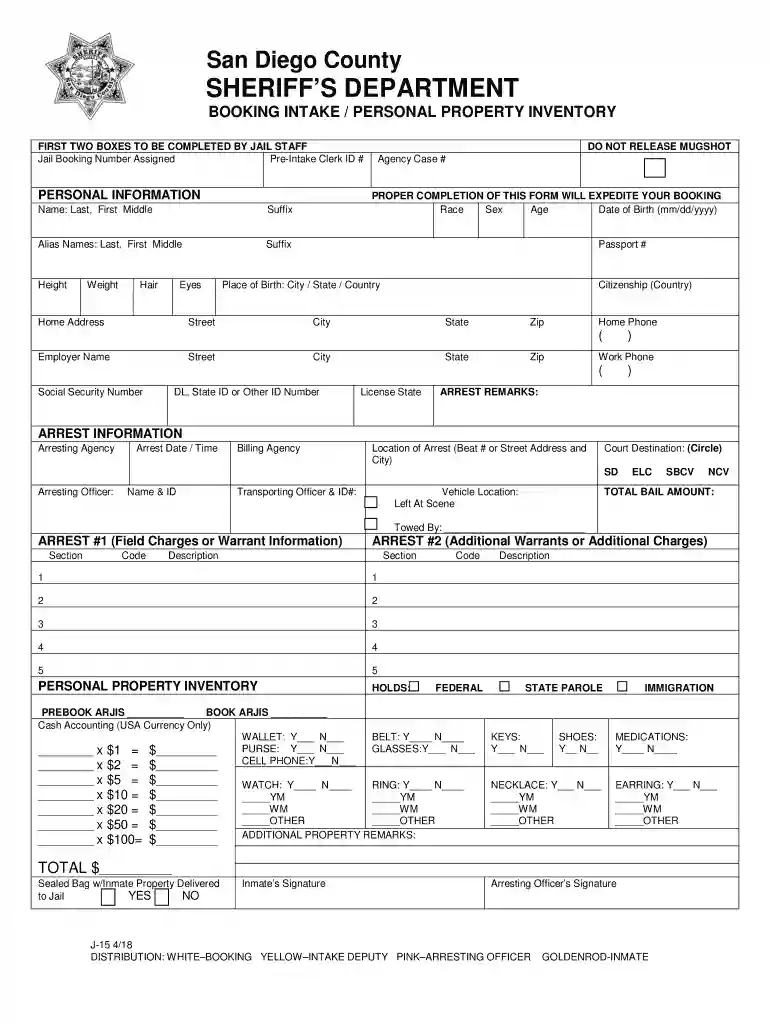
BOOKING INTAKE PERSONAL PROPERTY INVENTORY 2026

Get Form
BOOKING INTAKE PERSONAL PROPERTY INVENTORY Preview on Page 1

Here's how it works

01. Edit your form online
Type text, add images, blackout confidential details, add comments, highlights and more.

02. Sign it in a few clicks
Draw your signature, type it, upload its image, or use your mobile device as a signature pad.

03. Share your form with others
Send it via email, link, or fax. You can also download it, export it or print it out.

Definition and Meaning of Booking Intake Personal Property Inventory

The Booking Intake Personal Property Inventory form is an essential document utilized in the booking process during arrests. This form helps law enforcement agencies systematically document an individual's personal property at the time of booking. Typically managed by departments such as the San Diego County Sheriff's Department, its primary purpose is to ensure a comprehensive record of all personal items accompanying an individual into custody remains accessible and secure. By capturing details like personal effects, identification items, and personal valuables, the form aids in both property management and in preventing claims of misplaced or lost items.

How to Use the Booking Intake Personal Property Inventory Form

Utilizing the Booking Intake Personal Property Inventory form involves a series of methodical steps to ensure accuracy and thoroughness. First, law enforcement officials must gather all items in possession of the person being booked. These items are logged into the form, detailing descriptions, conditions, and quantities. Special attention should be given to high-value items, ensuring they are accurately described to protect both the property owner and the custodial department. The form may have sections allocated for signatures from both the booking officer and the individual, serving as an acknowledgment of the items logged.

Detailed Process Steps

  1. Gather Personal Property: Start by collecting all items the individual has on their person.
  2. Itemize and Record: Accurately note each item’s condition and quantity in the form.
  3. Verification and Signature: Both the booking officer and the individual must verify and sign the completed inventory list to confirm its accuracy and completeness.

Steps to Complete the Booking Intake Personal Property Inventory

Completing the Booking Intake Personal Property Inventory requires adherence to a structured process to ensure each item is properly accounted for. Follow these steps for efficient form completion:

  1. Initial Property Collection: Carefully collect all personal property from the individual during the booking process to avoid omissions.
  2. Classification of Items: Sort items into categories such as clothing, electronic devices, accessories, and personal identifiers.
  3. Documentation Process: For each item, document its description, make, model, color, and any distinguishing marks that can aid in identification.
  4. Verification Procedures: Conduct a double-check by a second officer to verify the completeness and accuracy of the inventory list.
  5. Signature Capture: Obtain signatures from both the officer conducting the intake and the individual being booked to authenticate the inventory.

Key Elements of the Booking Intake Personal Property Inventory

Several elements are critical to ensure the Booking Intake Personal Property Inventory fulfills its purpose effectively:

  • Detailed Item Descriptions: Every item should have a detailed description including make and model where applicable.
  • Valuation Estimates: High-value items may include estimated value; this assists in addressing potential claims.
  • Photographic Evidence: Attaching photographs of key items can serve as an additional level of detail and evidence.
  • Secure Custody Notations: Mark items that are to be held in secure storage differently to maintain inventory integrity.

Who Typically Uses the Booking Intake Personal Property Inventory

The primary users of the Booking Intake Personal Property Inventory form are law enforcement officials and departments involved in the arrest booking process. These individuals are responsible for capturing an unbiased inventory of personal items, which can include:


  • Police Officers: Those involved directly in arrests and responsible for property documentation.
  • Custodial Staff: Personnel responsible for managing and securing collected items.
  • Legal Professionals: Attorneys and legal staff may reference the form for claims or disputes regarding property.
decoration image ratings of Dochub

Legal Use of the Booking Intake Personal Property Inventory

Legally, the Booking Intake Personal Property Inventory acts as a safeguard for both the arrestees and law enforcement agencies. It ensures:

  • Property Protection: Secure and fair documentation of personal belongings taken into custody.
  • Litigation and Claims Defense: Provides evidence that can mitigate claims of lost or damaged property.
  • Compliance With Legal Standards: Aligns with procedural requirements and public transparency standards.

Important Terms Related to the Booking Intake Personal Property Inventory

Understanding specific terms related to the Booking Intake Personal Property Inventory is crucial for proper usage and legal compliance:

  • Intake Officer: The law enforcement official responsible for documenting the inventory.
  • Custodial Safety Protocols: Procedures ensuring the safe storage and management of personal property.
  • Audit Trail: A detailed record providing evidence of all transactions and changes made to the inventory list.

Who Issues the Form

The Booking Intake Personal Property Inventory is generally issued by the arresting law enforcement agency, such as a local sheriff's department. It is their responsibility to provide and maintain the forms necessary for accurate and legally compliant processing of all individuals taken into custody.

be ready to get more

Complete this form in 5 minutes or less

Get form

Got questions?

We have answers to the most popular questions from our customers. If you can't find an answer to your question, please contact us.
Contact us
Home inventory tips: List every item of value in your house. Make sure to copy serial numbers of your personal items. Keep all receipts along with a description of the items. Keep a detailed record of antiques, jewelry, major appliances, and collectors items.
Inventory and estimate property value Make a list of everything the person owned (inventory) Identify what type of property each item is. Find out how the property is owned. Estimate each items value and then get the total value.
Heres a quick reference list of the type of information you should include in your home inventory list: An in-depth description of the items. Make, model, and/or serial number of the items. Date of purchase, receipts and photos. Estimated replacement cost if you bought it today. Appraisals at time of purchase.
A personal property inventory can be used to record the damaged or lost belongings and valuables you own in your home. It may include items such as furniture, appliances, electronics, clothing, jewelry, artwork, and other contents.
A Guide to Creating Your Personal Property Inventory List Develop a list of categories for your belongings. Record an estimated value with each item. Gather receipts or appraisals to show proof of purchase and value. Take photos (or videos) of your items and save them to a cloud or external hard drive.

Security and compliance

At DocHub, your data security is our priority. We follow HIPAA, SOC2, GDPR, and other standards, so you can work on your documents with confidence.

Learn more
ccpa2
pci-dss
gdpr-compliance
hipaa
soc-compliance

People also ask

When filling out an inventory form, you must list all the items and provide relevant details such as a description, quantity, unit price, and total value. Make sure to organise the items clearly and logically to facilitate easy reference.

Related links