




01. Edit your form online
Type text, add images, blackout confidential details, add comments, highlights and more.

Type text, add images, blackout confidential details, add comments, highlights and more.

Draw your signature, type it, upload its image, or use your mobile device as a signature pad.

Send it via email, link, or fax. You can also download it, export it or print it out.
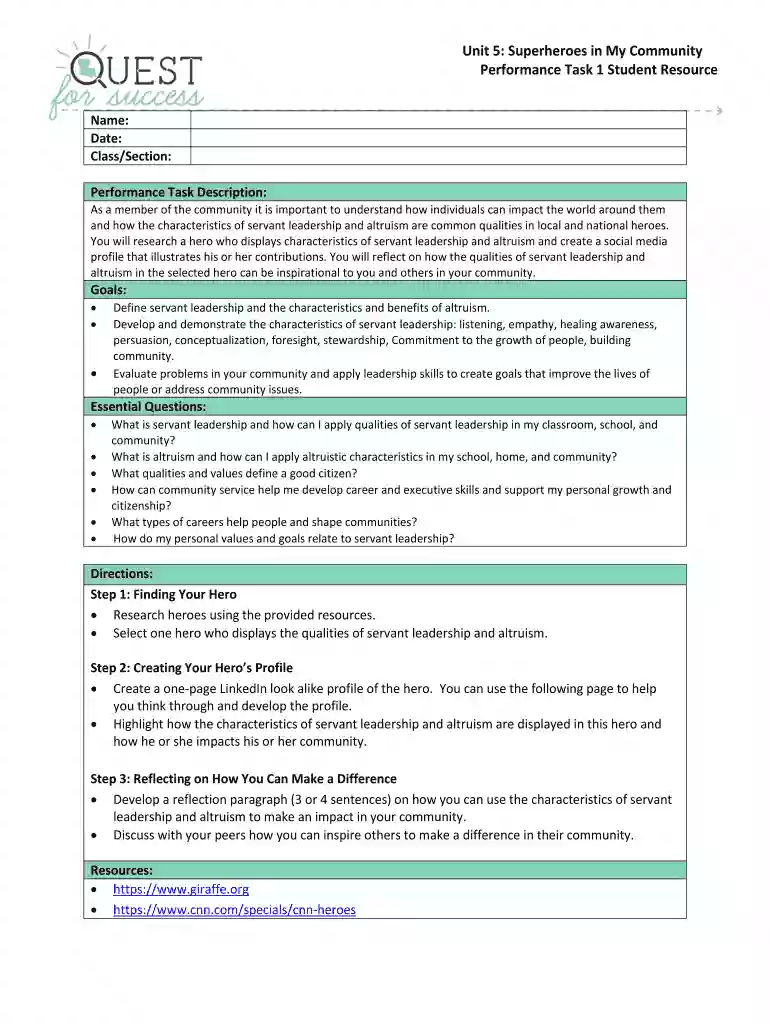
The "Unit 5 2: Leaders in My Community English as a - IntraEdu" is a structured educational task aimed at exploring the principles of servant leadership and altruism through the lens of community engagement. Participants are encouraged to investigate and profile community leaders who exemplify these values, fostering a deeper understanding of leadership qualities beneficial for societal development.
To effectively utilize this educational module, engage in the task of identifying a local leader who displays servant leadership. Research their contributions and create a detailed social media profile that highlights their influence and impact. Reflect on the qualities that make them effective leaders and consider how you can integrate similar characteristics into your personal and community life.
This module is primarily utilized by students in educational settings, particularly those studying leadership, civic responsibility, or social studies. It is also beneficial for educators aiming to instill concepts of community involvement and personal development in their curriculum.


Though primarily educational, when creating profiles, especially in collaborative student projects, legal and ethical considerations should be on the radar. If submissions involve collecting signatures or personal data, ensuring compliance with legal guidelines related to privacy and consent may be necessary.
The module can be completed and submitted via various methods, depending on the educational institution's requirements. Typically, submissions might be digital through an online platform, but physical hand-ins might also be accepted based on the instructor's preference.
The task may be completed either digitally or on paper. Digital versions offer flexibility in incorporating multimedia elements such as links, videos, and graphics, while paper versions might require printed visuals and written content for submission.
We've got more versions of the Unit 5 2: Leaders in My Community English as a - IntraEdu form. Select the right Unit 5 2: Leaders in My Community English as a - IntraEdu version from the list and start editing it straight away!
| Versions | Form popularity | Fillable & printable |
|---|---|---|
| 2019 | 4.3 Satisfied (24 Votes) |
At DocHub, your data security is our priority. We follow HIPAA, SOC2, GDPR, and other standards, so you can work on your documents with confidence.
by RM Rodrguez Astacio 2016 Thomas W. Bean presents several comprehension strategies for including young adult literature in the English Classroom. Relationships, Self-
by ADEMDEC DE Connecting school and community with science learning: real world problems and school-community partnerships as contextual scaffolds.


