




01. Edit your form online
Type text, add images, blackout confidential details, add comments, highlights and more.

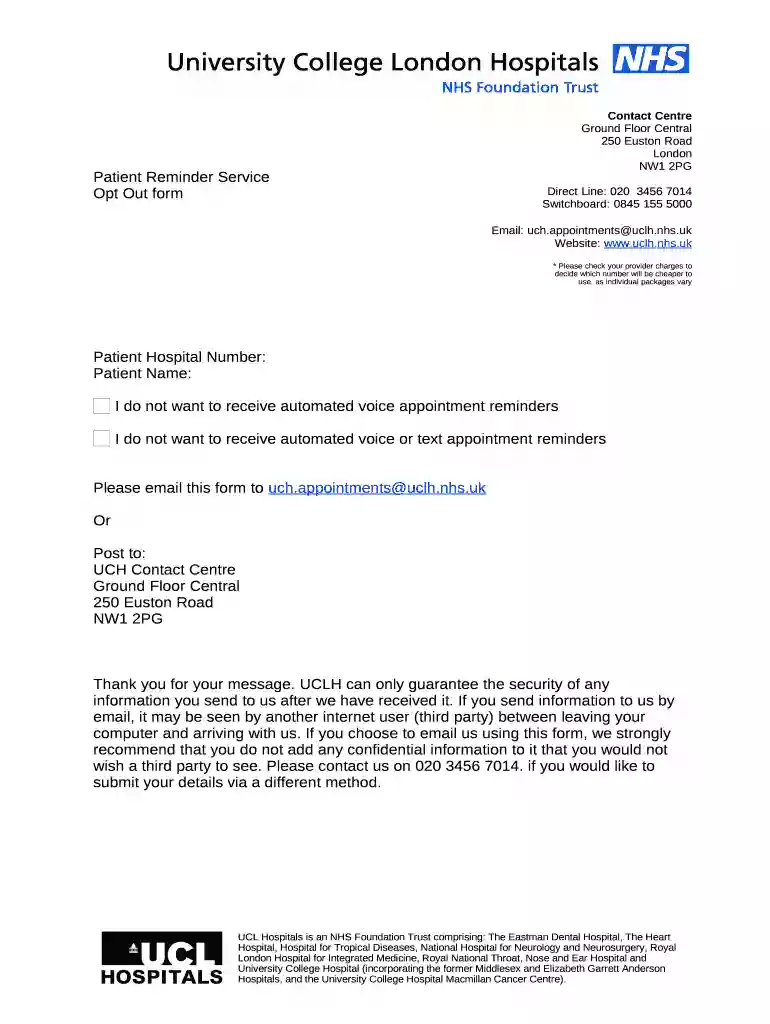
Type text, add images, blackout confidential details, add comments, highlights and more.

Draw your signature, type it, upload its image, or use your mobile device as a signature pad.

Send it via email, link, or fax. You can also download it, export it or print it out.
The "Patient Telephone Reminder Service Opt-Out Form" is designed to allow patients of University College London Hospitals NHS Foundation Trust (UCLH) to opt out of receiving automated appointment reminders via phone or text message. This form grants patients increased control over their communication preferences, ensuring that they only receive notifications in their preferred manner. By formally opting out, patients can manage how they interact with the healthcare system, maintaining privacy and autonomy.
Patients interested in opting out of the telephone reminder service should carefully follow the prescribed steps. Begin by acquiring the form, ensuring all sections are filled out accurately. Once complete, the form must be submitted to the relevant department at UCLH. It is essential to verify that all personal information is correct to avoid issues with processing. Retain a copy for personal records in case verification is needed later.
Patients may choose to use the Opt-Out Form for various reasons, such as privacy concerns, a preference for doctor-initiated contact, or the need to reduce communication overload. By opting out, patients assert control over how they receive medical communications, aligning with personal preferences and privacy considerations.
The form contains crucial segments that must be completed accurately for successful processing:
Each element plays a role in ensuring that the patient's request is processed correctly without delays.
Legally, the form serves as the patient's formal request to decline automated communications. It complies with data protection regulations, ensuring that the patient's decision is respected and confidential. UCLH has a legal obligation to honor the opt-out request once submitted.
The form can be submitted through several channels, depending on the patient's preference and the hospital's available options:
Each method provides flexibility to accommodate the patient's convenience while ensuring the form reaches the appropriate department.
The form is available in both digital and paper formats to cater to diverse patient needs. While the digital version allows for quick submission and reduced paper waste, the paper version may be preferred by those who are less comfortable with digital tools. Both formats require the same information and are equally valid.
This form is utilized by UCLH patients who want to manage their appointment reminders more personally. It caters to diverse demographics, including older adults who may prefer fewer automated communications and young patients who want tailored communication settings.


At DocHub, your data security is our priority. We follow HIPAA, SOC2, GDPR, and other standards, so you can work on your documents with confidence.
by Y Chen 2024 Cited by 4 No data will leave the UCLH NHS system. Patients who opt out or withdraw from the trial will have their decision documented on the eCRF andRead more
by M McClellan 2018 Cited by 1 University conducted a study to review progress of and identify steps to advance integrated care models in the National Health Service (NHS) in England.


