




01. Edit your affiliation letter business card online
Type text, add images, blackout confidential details, add comments, highlights and more.

Type text, add images, blackout confidential details, add comments, highlights and more.

Draw your signature, type it, upload its image, or use your mobile device as a signature pad.

Send affiliation letter via email, link, or fax. You can also download it, export it or print it out.
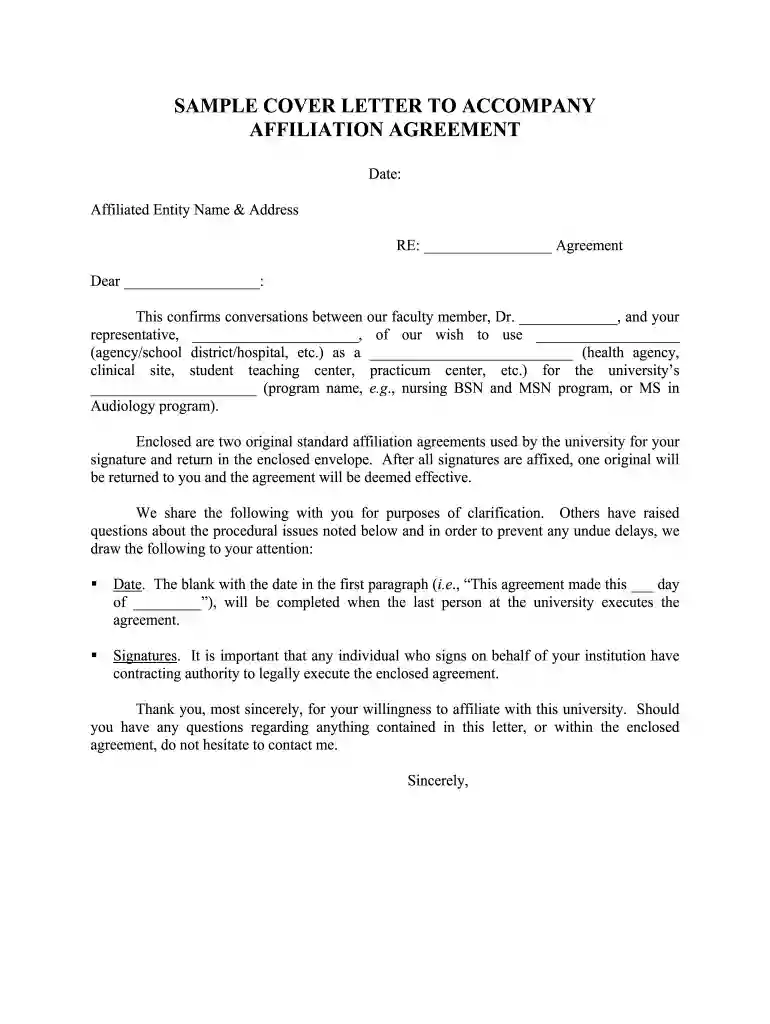
A letter of affiliation between companies serves as a formal document that outlines the relationship between two or more businesses. This type of letter typically confirms the intent to collaborate, share resources, or pursue mutual goals. Such letters are important as they clarify roles and responsibilities, helping to avoid misunderstandings.
The structure of a letter of affiliation follows a professional format to convey its importance and seriousness.
[Insert Date]
[Your Name]
[Your Title]
[Your Company]
[Your Address]
[Recipient's Name]
[Recipient's Title]
[Recipient's Company]
[Recipient's Address]
Subject: Letter of Affiliation
Dear [Recipient's Name],
This letter confirms the affiliation between [Your Company] and [Recipient's Company]. We are excited to collaborate on [specific projects or objectives]. This partnership will [state the mutual benefits and goals].
Our affiliates will share resources, knowledge, and expertise specifically regarding [specific areas of collaboration]. We anticipate that our joint efforts will lead to [expected outcomes].
The affiliation will commence on [start date] and is expected to continue until [end date]. We are eager to work closely with your team to ensure a successful partnership.
Thank you for considering this unique opportunity. Please do not hesitate to reach out for any further clarification.
Sincerely,
[Your Name]
[Your Title]
[Your Company]
In some cases, a shorter version or a more informal email format may be appropriate. Ensure that all essential elements are still present.
It is vital that a letter of affiliation includes legal considerations to protect all parties involved. Clarity around expectations can prevent disputes down the line.
A variety of industries utilize letters of affiliation to formalize relationships:


Many organizations may benefit from utilizing existing templates or software tools to draft these letters. Document management systems like DocHub can facilitate the creation of professional-looking letters of affiliation by providing customizable templates and formatting options.
By systematically addressing these components, a well-crafted letter of affiliation between companies can foster stronger working relationships and guide collaborations effectively.
At DocHub, your data security is our priority. We follow HIPAA, SOC2, GDPR, and other standards, so you can work on your documents with confidence.
The letter must be printed on official company letterhead and/or sent from the company email account of the designee writing the letter. Date
The American Broadcasting Company (ABC) is an American commercial television network owned by Disney General Entertainment, a division of Disney EntertainmentRead more


