Province releases new Standard Lease FormLandlord's Self 2026

Get Form
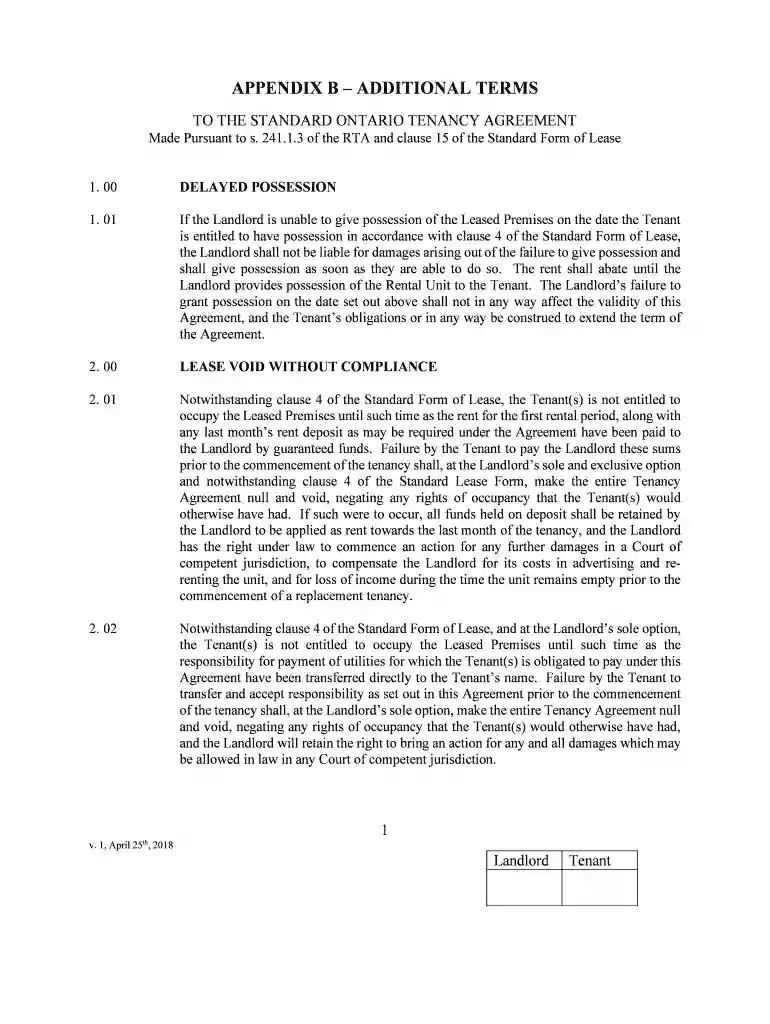
additional terms tenancy agreement Preview on Page 1

Here's how it works

01. Edit your additional terms tenancy agreement online
Type text, add images, blackout confidential details, add comments, highlights and more.

02. Sign it in a few clicks
Draw your signature, type it, upload its image, or use your mobile device as a signature pad.

03. Share your form with others
Send it via email, link, or fax. You can also download it, export it or print it out.

Definition and Meaning

The "Province releases new Standard Lease FormLandlord's Self" is designed to streamline the leasing process within Ontario, providing a clear and standardized framework for both landlords and tenants. This document outlines fundamental terms and conditions that govern residential tenancies, ensuring that both parties are aware of their rights and obligations. The form aims to reduce disputes by providing explicit guidelines on various aspects of the landlord-tenant relationship, such as rent payments, maintenance responsibilities, and termination procedures. By solidifying these terms, the lease form increases transparency and promotes fair practice in the rental market.

How to Use the Standard Lease Form

Using the Standard Lease Form requires landlords to complete specific sections with relevant information about the rental agreement. Here is a structured approach:

  1. Identify Details: Begin by filling in the details of both parties, including names and contact information.
  2. Specify Rental Terms: Clearly outline the terms of the rental, including the duration of the lease and the amount of rent.
  3. Define Responsibilities: Specify the responsibilities of both parties concerning maintenance, repairs, and utilities.
  4. Include Special Conditions: Add any additional conditions or terms that have been mutually agreed upon, such as pet policies or modifications to the premises.
  5. Ensure Signatures: Both landlord and tenant must sign the form to make the agreement legally binding.

This structured approach ensures all critical aspects of the lease are clearly defined and agreed upon.

Steps to Complete the Standard Lease Form

Completing the Standard Lease Form involves several key steps:

  1. Gather Information: Before filling out the form, collect necessary information from both parties, including identification and property details.
  2. Fill Out Core Sections: Input specific information in the required fields, ensuring accuracy and completeness.
  3. Review Terms and Clauses: Go through each term and clause with the tenant, clarifying any doubts or questions they may have.
  4. Make Necessary Amendments: If any additional clauses are required, such as unique payment arrangements or property use clauses, add these to the relevant sections.
  5. Review and Sign: Once completed, both parties should review the document thoroughly, ensuring all information is accurate before signing.

Completing the form carefully ensures a clear and enforceable lease agreement.

Key Elements of the Standard Lease Form

The key elements of the Standard Lease Form include:

  • Identification of Parties: Clearly identifies the landlord and tenant, providing names and contact information.
  • Premises Description: Detailed description of the rental property, including address and type of dwelling.
  • Term of Lease: Specifies the fixed-term duration and any renewal options.
  • Rent Details: Includes the amount of rent, due dates, and accepted payment methods.
  • Responsibilities: Outlines both landlord and tenant responsibilities, focusing on maintenance and repair duties.
  • Additional Clauses: Details any additional agreements, like pet rules or specific property modifications, tailored to the specific lease agreement.

These elements ensure a comprehensive understanding of the lease agreement.

Legal Use of the Standard Lease Form

The Standard Lease Form holds legal weight and provides a framework that aligns with Ontario's Residential Tenancies Act. It ensures compliance with provincial regulations, including stipulations on rent control, tenant rights, and eviction procedures. The legal use of this form requires:

  • Adherence to Provincial Laws: Ensures compliance with relevant housing laws and tenant protections.
  • Clear Articulation of Terms: Precise language to avoid ambiguities that could result in legal disputes.
  • Right to Amend: Allows for amendments if both parties agree and signatures are provided.

This legal framework protects both landlords and tenants under Ontario law.

State-Specific Rules for Using the Lease Form

While this form is rooted in Ontario legislation, similar principles may apply in other regions with differences in regulatory frameworks. Key considerations include:

  • Local Regulations: Ensure alignment with local housing laws by consulting region-specific guidelines before using.
  • Provincial Amendments: Stay informed about any amendments in provincial laws affecting lease terms.
  • Municipal Policies: Incorporate any municipal regulations that may impact housing, such as zoning laws or property taxes.

Understanding state-specific rules supports effective and lawful lease execution.

Who Typically Uses the Standard Lease Form?

The Standard Lease Form is typically used by residential landlords and tenants in Ontario. It is particularly beneficial for:

  • Individual Landlords: Those who own and manage single or multifamily rental properties.
  • Property Management Companies: Entities overseeing multiple rental units, ensuring consistency across agreements.
  • Tenants: Individuals or families entering a residential rental agreement, ensuring their rights and responsibilities are clearly defined.

This form provides a balanced framework advantageous for all parties involved in a residential leasing transaction.


decoration image ratings of Dochub

Important Terms Related to the Standard Lease Form

Understanding the important terms related to the lease form ensures clarity in the agreement:

  • Tenancy Agreement: A legally binding contract stating the terms of rental between landlord and tenant.
  • Fixed-Term Lease: A rental agreement set for a specific duration.
  • Security Deposit: A sum of money held by the landlord as assurance for tenant adherence to lease terms.
  • Rent Control: Regulations limiting the amount of rent increase permissible by landlords.

Awareness and understanding of these terms prevent potential misunderstandings and disputes.

be ready to get more

Complete this form in 5 minutes or less

Get form

Got questions?

We have answers to the most popular questions from our customers. If you can't find an answer to your question, please contact us.
Contact us
A standard lease also is not required for sublets or for landlords who share a kitchen or bathroom with a tenant. But most rental housing must use the standard lease. If you started renting on or after April 30, 2018, and you did not get a standard lease, you can write to the landlord and ask them for one.
The general answer is that verbal agreements are legally binding (meaning you cant back out) as long as: They dont violate the State of Frauds, and. You can prove the existence of the agreement and certain basic facts with reasonable certainty.
There is no way that it is enforceable. Contracts for lease and sale must be reduced to writing. It is an old legal requirement called the statute of frauds. Verbal agreements are only as enforceable as the parties can agree, a court will never enforce them as they are legally invalid.
A verbal contract can become void for several reasons, such as : (1) one or more of the parties was placed under duress, (2) one or more of the parties lacked the capacity to contract, (3) there is evidence of fraud, (4) the contract violates the statute of frauds, or (5) the contract is illegal.
Yes, verbal contracts can hold up in court, if a court determines there is sufficient evidence to prove the existence and terms of a binding agreement.

Security and compliance

At DocHub, your data security is our priority. We follow HIPAA, SOC2, GDPR, and other standards, so you can work on your documents with confidence.

Learn more
ccpa2
pci-dss
gdpr-compliance
hipaa
soc-compliance

People also ask

Verbal agreements can be difficult to enforce, so you may be able to rescind your acceptance in writing. The agreement might not be legally binding until you sign it.
If a landlord fails to provide a standard lease within 21 days of a tenants request, the tenant may withhold one months rent. Additionally, the tenant has the right to terminate the tenancy early if the landlord does not provide the lease within 21 days after the rent withholding.
The OREA form 420 is also known as the Amendment to Agreement to Lease Residential version. It was created by the Ontario Real Estate Association and accepted by Toronto Real Estate Board. You can use this form only for the property based in the Province of Ontario.