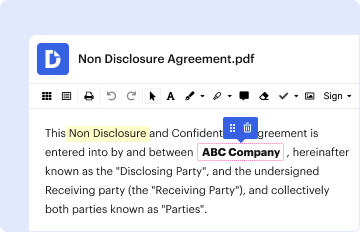
Type text, add images, blackout confidential details, add comments, highlights and more.
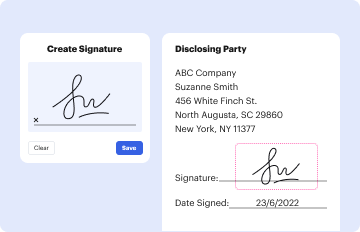
02. Sign it in a few clicks
Draw your signature, type it, upload its image, or use your mobile device as a signature pad.
03. Share your form with others
Send it via email, link, or fax. You can also download it, export it or print it out.
How to use or fill out U S TREAS Form treas-irs-1041-t-2002 Free download with our platform
Ease of Setup
DocHub User Ratings on G2
Ease of Use
DocHub User Ratings on G2
Click ‘Get Form’ to open it in the editor.
Begin by filling in the trust or decedent’s estate name and employer identification number at the top of the form. Ensure accuracy as this information is crucial for processing.
In section 1, enter the total amount of estimated taxes to be allocated to beneficiaries. This figure should match what you will report on Form 1041, line 24b.
For each beneficiary, complete columns (a) through (e). Include their identifying numbers, names, addresses, allocated amounts, and proration percentages. This ensures proper allocation of tax payments.
If there are more than ten beneficiaries, list additional ones on a separate sheet and summarize the total on line 3.
Finally, sign and date the form only if filing separately from Form 1041. Review all entries for accuracy before submission.
Start using our platform today to easily fill out your U S TREAS Form treas-irs-1041-t-2002 for free!
Fill out U S TREAS Form treas-irs-1041-t-2002 Free download online It's free
A trust or, for its final tax year, a decedents estate may elect under section 643(g) to have any part of its estimated tax payments (but not income tax withheld) treated as made by a beneficiary or beneficiaries. The fiduciary files Form 1041-T to make the election.
Do beneficiaries file 1041?
The beneficiary, and not the trust or decedents estate, pays income tax on their distributive share of income. Schedule K-1 (Form 1041) is used to notify the beneficiaries of the amounts to be included on their income tax returns.
How do I download IRS forms?
Downloading from IRS Forms Publications page. Picking up copies at an IRS Taxpayer Assistance Center. Going to the IRS Small Business and Self-Employed Tax Center page. Requesting copies by phone 800-TAX-FORM (800-829-3676).
How do I pay the IRS form 1041?
Payment for Form 1041 e-filed returns can be made in any of these ways: Electronic funds withdrawal (EFW) allows for direct debit payments with balance due returns. Electronic federal tax payment system (EFTPS) Estimated tax payments. You can. You can.
Does everyone need to file an estate tax return?
An estate tax return (Form 706) must be filed if the gross estate of the decedent (who is a U.S. citizen or resident), increased by the decedents adjusted taxable gifts and specific gift tax exemption, is valued at more than the filing threshold for the year of the decedents death, as shown in the table below.
Related Searches
form 1041-tIRS Form 1041 for 20241041-t instructions1041-t instructions 20241041-t due date 2025IRS Form 1041, Schedule DIRS Form 1041 for 2023IRS Form 1041 for 2023 printable
More In File If the estate generates more than $600 in annual gross income, you are required to file Form 1041, U.S. Income Tax Return for Estates and Trusts. An estate may also need to pay quarterly estimated taxes. See Form 1041 instructions for information on when to file quarterly estimated taxes.
Who needs to file IRS Form 1041?
If the estate generates more than $600 in annual gross income, you are required to file Form 1041, U.S. Income Tax Return for Estates and Trusts. An estate may also need to pay quarterly estimated taxes. See Form 1041 instructions for information on when to file quarterly estimated taxes.
What is the minimum income to file form 1041?
The fiduciary (or one of the joint fiduciaries) must file Form 1041 for a domestic trust taxable under section 641 that has: Any taxable income for the tax year, Gross income of $600 or more (regardless of taxable income), or. A beneficiary who is a nonresident alien.
Related links
2016 Publication 575
Jan 4, 2017 This publication contains information that you need to understand the fol- lowing topics. How to figure the tax-free part of periodic payments.
2002 - Instructions for Form 1041 and Schedules A, B, D, G
Form 1041-T, Allocation of Estimated Tax. Line 24gCredit for Federal see the Instructions for Form 1045. Payments to Beneficiaries, which must be. Tax on Fuels.
Cookie consent notice
This site uses cookies to enhance site navigation and personalize your experience.
By using this site you agree to our use of cookies as described in our Privacy Notice.
You can modify your selections by visiting our Cookie and Advertising Notice.