




01. Edit your key return form template online
Type text, add images, blackout confidential details, add comments, highlights and more.

Type text, add images, blackout confidential details, add comments, highlights and more.

Draw your signature, type it, upload its image, or use your mobile device as a signature pad.

Send tenant key return form via email, link, or fax. You can also download it, export it or print it out.
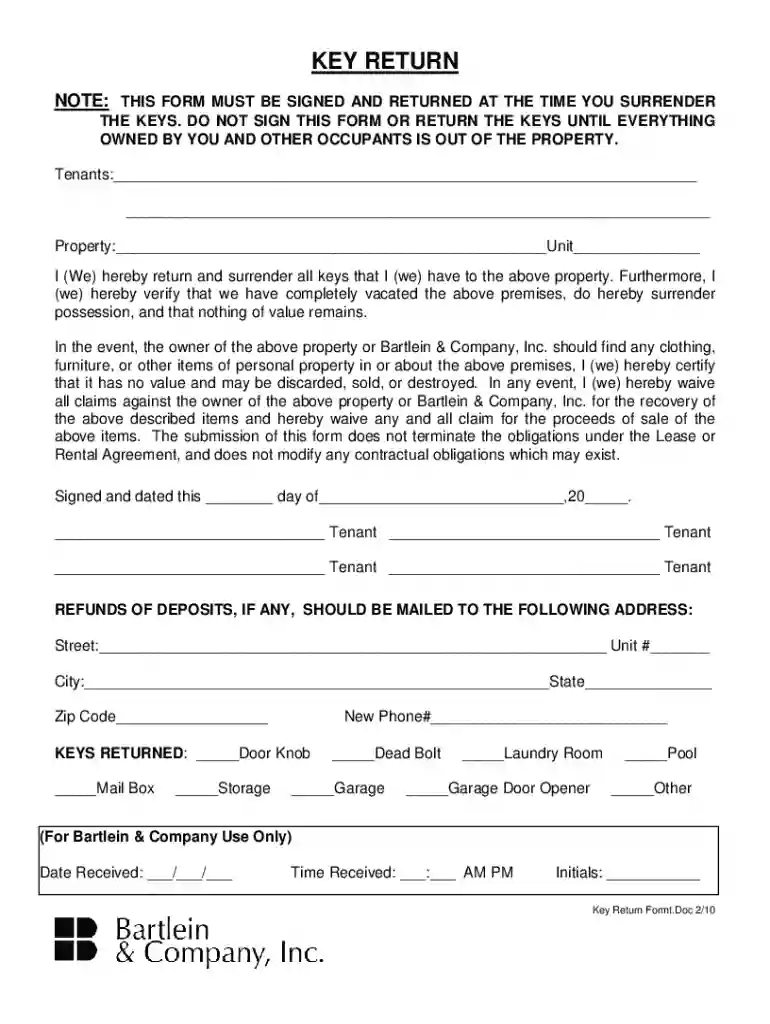
The Tenant Surrender of Property and Key Return Form is a legal document that tenants use to officially notify landlords that they have vacated a rental property and are returning the keys associated with it. This form serves multiple purposes: it confirms that the tenants have surrendered possession of the premises, asserts that no personal items remain within the property, and waives any claims regarding belongings left behind. Importantly, it includes essential clauses that protect both parties involved in the tenancy agreement.
The form typically includes the following key elements:
Using the Tenant Surrender of Property and Key Return Form is straightforward but requires careful attention to detail. The form should be filled out when tenants are ready to move out, and it is best to complete it on the final day of tenancy. Follow these steps for effective use:
This systematic approach ensures that both parties are legally protected, reducing potential disputes later on.
The Tenant Surrender of Property and Key Return Form comprises several crucial components designed to clearly communicate the essential details of a tenant's departure. Understanding these elements is vital for accurate completion:
By including these key elements, the form ensures all relevant information is captured, facilitating a swift process for both parties.
Real-world scenarios can clarify the practical applications of the Tenant Surrender of Property and Key Return Form. Here are examples showcasing how the form operates in different contexts:
Example 1: A family moving out of a rented apartment fills out the form on their final day of occupancy. They list that all keys are returned, including garage keys. After signing, both family representatives and the landlord sign the form, which confirms the conclusion of the rental agreement and finalizes the process for the return of their security deposit.
Example 2: A tenant who subleased an apartment prepares for their departure. The tenant ensures that the original leaseholder is present to sign the form along with them, verifying that they are authorized to return the keys. This mutual acknowledgment helps prevent disputes regarding responsibility for damages or lost items.
Example 3: A college student moves out of campus housing at the end of the semester and uses the form to return their room keys. The housing administration signs it in receipt, which also serves to start the process of deposit return after the final inspections.
These scenarios illustrate the utility of the Tenant Surrender of Property and Key Return Form in various housing situations, ensuring clear communication and verification of agreements.
Knowledge of specific terms associated with the Tenant Surrender of Property and Key Return Form enhances comprehension of its context and legal significance. Key terms include:
Understanding these terms facilitates a clearer perspective on legal obligations and rights involved in the tenant-landlord relationship.
The Tenant Surrender of Property and Key Return Form has legal implications that protect both parties during the transition from tenancy. Its use is governed by several important legal considerations:
Legality of Electronic Signatures: In many jurisdictions, electronic signatures can be used on this form, provided they comply with local laws. This can simplify the process, particularly in a digital-first environment.
Record Keeping: The form serves as a legal record of the tenant’s decision to vacate, which can be vital if disputes arise regarding deposit returns or property conditions. A signed form significantly bolsters a tenant's case if the landlord attempts to claim damages without evidence of a breach.
State-Specific Laws: Different states may have particular requirements governing key returns and property surrender. For example, some states may mandate additional paperwork or notifications during the move-out process, and it’s advisable to familiarize oneself with such regulations.
Waiver of Claims: The form often includes clauses that help tenants waive any current or future claims regarding items left behind, meaning tenants must ensure they have taken all personal belongings before signing.
Understanding the legal landscape surrounding the form enhances its effectiveness and serves to shield both tenants and landlords from misunderstandings.
We've got more versions of the key return form template form. Select the right key return form template version from the list and start editing it straight away!
| Versions | Form popularity | Fillable & printable |
|---|---|---|
| 2010 | 4.4 Satisfied (58 Votes) |
At DocHub, your data security is our priority. We follow HIPAA, SOC2, GDPR, and other standards, so you can work on your documents with confidence.
In general, the tenant must return the commercial property, such as an office space, to a broom-clean state.
the tenant will have seven days to surrender the premises. The landlord must serve the tenant a written notice allowing three days, excluding weekends the


