




01. Edit your form online
Type text, add images, blackout confidential details, add comments, highlights and more.

Type text, add images, blackout confidential details, add comments, highlights and more.

Draw your signature, type it, upload its image, or use your mobile device as a signature pad.

Send it via email, link, or fax. You can also download it, export it or print it out.
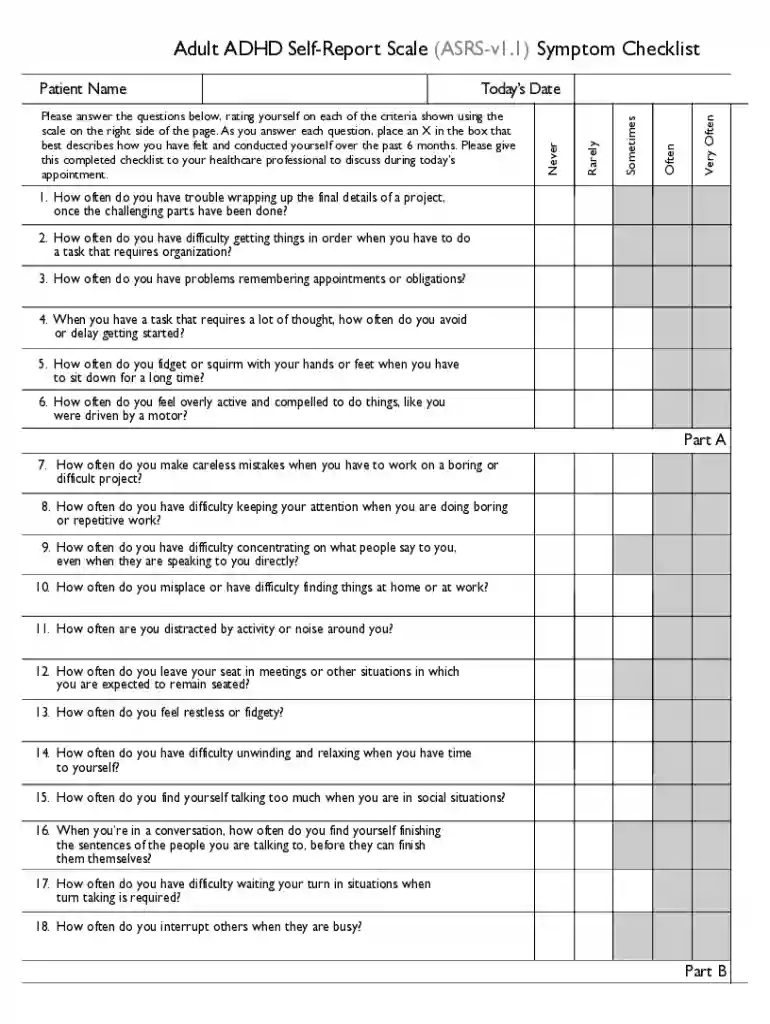
The Adult ADHD Self-Report Scale (ASRS-v1.1) Symptom Checklist is a standardized tool developed to help individuals self-assess symptoms associated with Attention Deficit Hyperactivity Disorder (ADHD) in adults. Developed with the input of the World Health Organization, this checklist allows adults to rate the frequency of various behaviors over the past six months. This assessment provides insight into one's behavioral tendencies that align with ADHD symptoms and helps determine the need for professional evaluation.
Using the ASRS-v1.1 involves completing a series of questions pertaining to typical ADHD-related behaviors. Participants rate each behavior from 'never' to 'very often,' based on their experiences over the past six months. It's crucial to respond honestly to obtain an accurate assessment of potential ADHD symptoms. Upon completion, the checklist can help individuals identify whether their symptoms may warrant further evaluation by a healthcare professional.
To effectively complete the ASRS-v1.1, follow these steps:
The ASRS-v1.1 checklist comprises a specific set of questions designed to identify characteristic ADHD symptoms in adults.
Understanding these elements ensures accurate self-assessment and prepares individuals for subsequent professional consultations if needed.
Familiarity with the terminology is vital for effectively using and interpreting the checklist:
Understanding these terms enhances the interpretation and utility of the checklist results.
This checklist provides an accessible means for adults to assess ADHD symptoms using validated indicators. It empowers individuals to identify challenges that might be impacting their quality of life and facilitates a structured approach to discussing symptoms with healthcare providers. The checklist serves as a preliminary step towards diagnosing ADHD, potentially leading to interventions that improve day-to-day functioning.
This tool is used across various settings to support accurate identification and understanding of ADHD symptoms.


The ASRS-v1.1 is employed within clinical settings as an initial screening tool. It is important that users adhere to ethical guidelines, ensuring that results are interpreted by qualified professionals. While it aids in identifying symptoms, the checklist does not serve as a diagnostic instrument, and results should be confirmed by clinical evaluation following standard diagnostic criteria.
Understanding these legal and ethical boundaries ensures that the checklist is used responsibly and effectively in aiding diagnosis and treatment planning.
At DocHub, your data security is our priority. We follow HIPAA, SOC2, GDPR, and other standards, so you can work on your documents with confidence.


