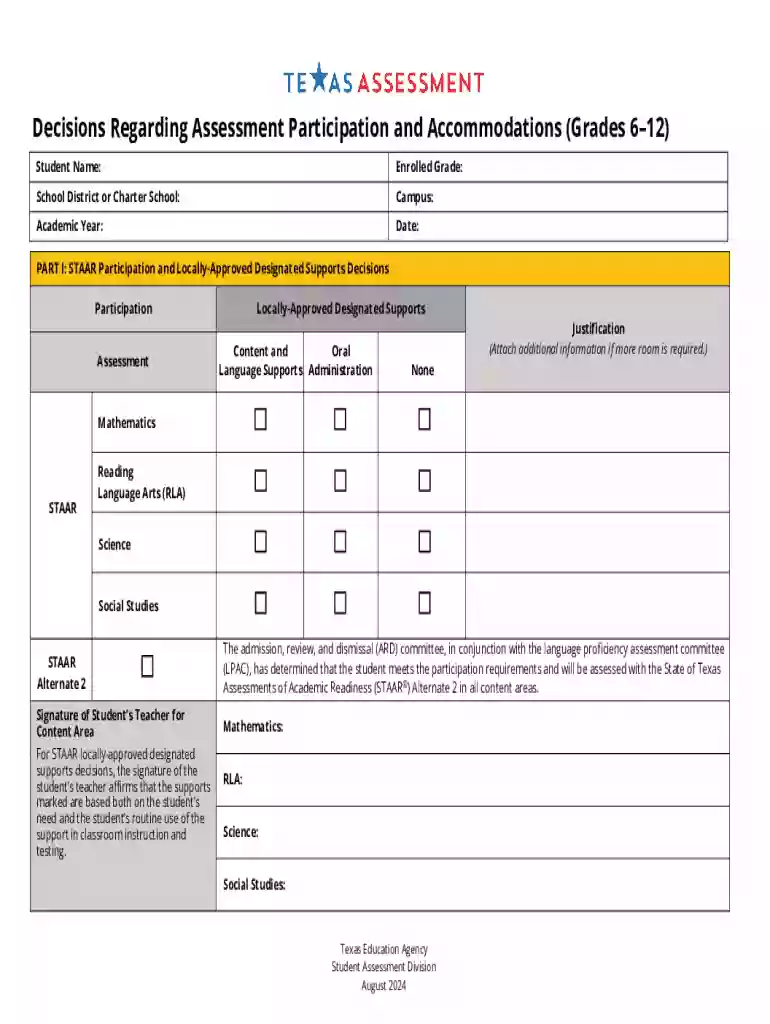
Decisions Regarding Assessment Participation and Accommodations (KindergartenGrade 5) Decisions Rega 2026

Get Form
Decisions Regarding Assessment Participation and Accommodations (KindergartenGrade 5) Decisions Rega Preview on Page 1

Here's how it works

01. Edit your form online
Type text, add images, blackout confidential details, add comments, highlights and more.

02. Sign it in a few clicks
Draw your signature, type it, upload its image, or use your mobile device as a signature pad.

03. Share your form with others
Send it via email, link, or fax. You can also download it, export it or print it out.

Definition & Meaning

The "Decisions Regarding Assessment Participation and Accommodations (Kindergarten to Grade 5)" form is crucial for outlining individualized education plans that detail students' involvement in assessments and the accommodations they require. This form is typically used by educational professionals to ensure that young learners with unique needs receive appropriate support during assessments. The document serves as a formal record of decisions agreed upon by educators and other stakeholders involved in the child's education, focusing on ensuring equitable access for all students.

Key Elements of the Form

The form consists of several key sections that detail the necessary accommodations for each student:

  • Student Information: Includes name, grade, and school details.
  • Assessment Participation: Specifies which assessments the student will participate in and any associated criteria.
  • Accommodation Details: Lists specific accommodations such as additional time, use of technology, or alternative assessment formats.
  • Stakeholder Signatures: Documents signatures from educators, family members, and any relevant committee members to confirm agreement and compliance with the decisions.

These parts ensure that all necessary information is captured to support the student's educational journey effectively.

How to Use the Form

Educators and parents should collectively review the form to determine the best assessment strategies for the student:

  1. Planning Meeting: Organize a meeting with all stakeholders involved in the student's education to discuss needs.
  2. Documenting Decisions: Fill in the form with detailed plans for assessment participation and accommodations.
  3. Reviewing and Signing: Ensure all participants agree and understand the decisions, then collect signatures.
  4. Regular Updates: Revisit the form regularly to make updates as the student's needs or educational standards evolve.

Using this strategic approach helps in creating a tailored assessment plan for each student.

Steps to Complete the Form

To complete the "Decisions Regarding Assessment Participation and Accommodations" form, follow these steps:

  1. Gather Information: Collect all pertinent student details, including existing assessment data and any prior accommodations.
  2. Consult with Experts: Engage with specialists, such as special education professionals, to understand the accommodations necessary for each student.
  3. Fill Out Sections: Complete each section of the form, detailing the student’s specific needs and the planned accommodations.
  4. Review for Accuracy: Double-check all entries for accuracy and completeness.
  5. Stakeholder Signings: Obtain signatures from all required parties to validate the decisions.

This thorough process ensures all necessary accommodations are documented and agreed upon.

Important Terms Related to the Form

  • Accommodations: Adjustments made to assessments to support students' needs without altering the test’s content or criteria.
  • Assessment Participation: The involvement of a student in standardized testing, considering their educational requirements.
  • Individualized Education Program (IEP): A documented plan tailored to the educational needs of students eligible for special education.

Understanding these terms is essential for comprehensively filling out and using the form.

Legal Use of the Form

The form must be used in compliance with federal and state regulations governing education and disability accommodations. It should conform to the Individuals with Disabilities Education Act (IDEA), ensuring that all students receive the legally mandated support. Schools must adhere to privacy laws, such as the Family Educational Rights and Privacy Act (FERPA), when handling student information.

  • FERPA Compliance: Protects the privacy of students' education records.
  • IDEA Provisions: Mandates individualized education plans for students with disabilities.

These legal frameworks ensure that using the form is aligned with student rights and educational standards.

Who Typically Uses the Form

The form is generally used by professionals involved in elementary education, such as:

  • Teachers and Special Educators: To identify and document necessary accommodations.
  • School Administrators: For oversight of compliance with educational standards.
  • Parents and Guardians: To collaborate on and consent to decisions regarding their child’s assessment participation.

Each of these stakeholders plays a crucial role in ensuring the successful implementation of the accommodations.


decoration image ratings of Dochub

State-Specific Rules for the Form

While the form may hold standard elements, its application can vary by state due to differing education laws and standards:

  • State Regulations: Each state may have unique guidelines on how assessments and accommodations should be managed.
  • Policy Variations: Ensure the form aligns with the specific state’s educational policies.

Checking state-specific regulations ensures compliance and relevance of the assessment and accommodation decisions.

Examples of Using the Form

Real-world applications of the form might look like:

  • A student with dyslexia receiving extra time on reading assessments.
  • An English language learner receiving translated instructions or glossary assistance during tests.
  • A student with ADHD using noise-canceling headphones to minimize distractions.

These scenarios demonstrate the form's application in providing tailored supports to students based on individual needs.

be ready to get more

Complete this form in 5 minutes or less

Get form

Got questions?

We have answers to the most popular questions from our customers. If you can't find an answer to your question, please contact us.
Contact us
Assessment accommodation is a change made to an assessment procedure, format or content. It is designed to remove barriers to a fair assessment and allow candidates to fully demonstrate their competency. Most of the people who request assessment accommodation do it on the basis of a disability.
Accommodations are typically grouped into four categories: presentation, response, setting, and timing and scheduling.
For EB students taking STAAR Spanish, the LPAC does not have sole authority to make designated supports decisions for content and language supports and oral administration. Decisions for content and language supports must be made by the ARD committee or Section 504 committee, in conjunction with the LPAC.
A Guide to Types of Assessment: Diagnostic, Formative, Interim, and Summative. Assessments come in many shapes and sizes. For those who are new to assessment or just starting out, the terms can be hard to sort out or simply unfamiliar.

Security and compliance

At DocHub, your data security is our priority. We follow HIPAA, SOC2, GDPR, and other standards, so you can work on your documents with confidence.

Learn more
ccpa2
pci-dss
gdpr-compliance
hipaa
soc-compliance