




01. Edit your 433f online
Type text, add images, blackout confidential details, add comments, highlights and more.

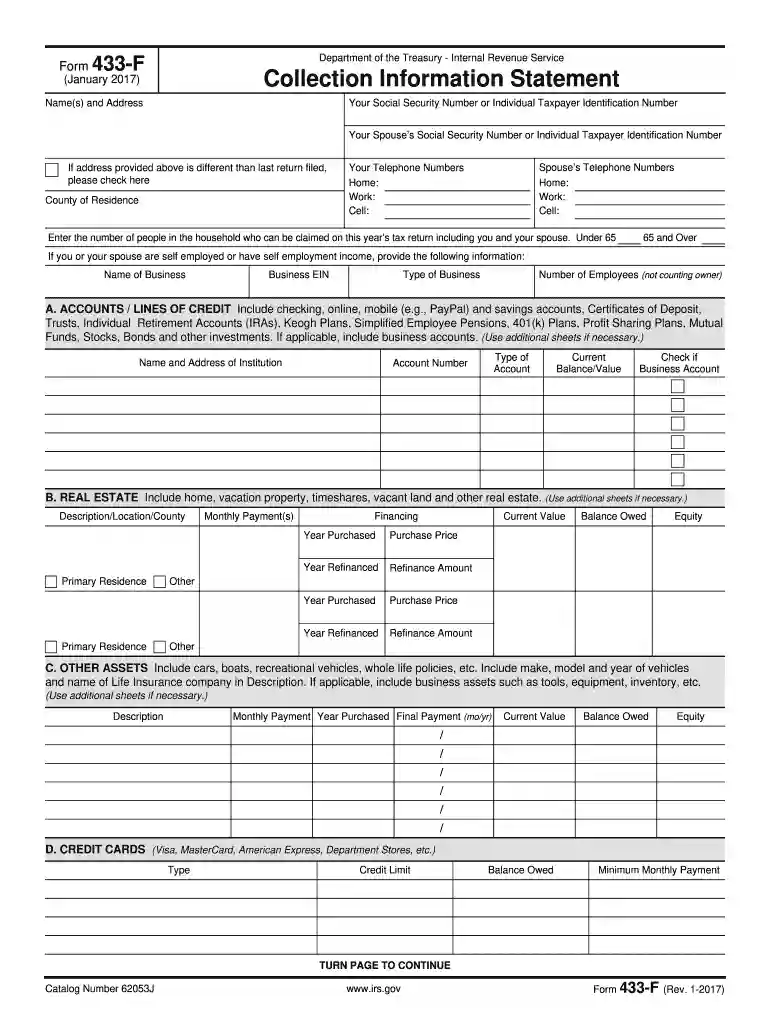
Type text, add images, blackout confidential details, add comments, highlights and more.

Draw your signature, type it, upload its image, or use your mobile device as a signature pad.

Send 433f form via email, link, or fax. You can also download it, export it or print it out.
Form 433-F, also known as the Collection Information Statement, is used by the IRS to collect detailed financial information from individuals and self-employed persons. This form helps the IRS understand a taxpayer's financial situation, allowing them to determine the taxpayer's ability to pay outstanding tax liabilities. The form requires personal information, including asset and liability details, income sources, and monthly living expenses, serving as a foundation for potential payment arrangements with the IRS.
Personal Information: Begin by entering your personal and contact details, including your name, social security number, and address.
Financial Information: Provide comprehensive information about your financial status. This includes:
Verification and Submission: After completing the form, review all entries for accuracy. The final step involves signing the document to verify the information provided before submitting it to the IRS.
Each section of the form must be filled out truthfully to provide the IRS with a clear picture of the individual's financial standing.
The IRS has established specific guidelines to follow when completing Form 433-F. It is crucial to adhere to these guidelines to avoid delays or complications in processing. Key points include the necessity of full financial disclosure, the importance of honest and accurate data entry, and the requirement to respond to any IRS follow-up inquiries promptly.
While Form 433-F does not have a fixed deadline, it is typically used in response to IRS communications. If the IRS requests the form, it is vital to submit it within the timeframe specified in their letter to avoid penalties or further collection actions.
Supporting documents may be required to accompany the form, providing evidence of financial claims. These can include:
Gathering these documents before starting can streamline the completion process.
Failing to submit Form 433-F when requested by the IRS can lead to significant penalties. This might include increased collection efforts, additional interest or penalties on outstanding taxes, and potentially the garnishment of wages or other legal actions to recover owed taxes.
Form 433-F is generally used by taxpayers experiencing difficulty in meeting their tax liabilities. This includes individuals facing temporary financial hardships or those needing to negotiate payment plans with the IRS. Furthermore, it is applicable to self-employed individuals who must provide comprehensive financial disclosures to manage their tax obligations efficiently.


Form 433-F is used in a legal context as it forms a critical component of negotiations between a taxpayer and the IRS. The information provided via this form can be used to establish payment plans or to grant temporary relief from tax obligations based on documented financial hardships. This legally binding document must be completed accurately to reflect the individual's current financial state, preventing potential legal repercussions and aiding in resolving tax issues with the IRS.
We've got more versions of the 433f form. Select the right 433f version from the list and start editing it straight away!
At DocHub, your data security is our priority. We follow HIPAA, SOC2, GDPR, and other standards, so you can work on your documents with confidence.

2017-2019 - Process Line 13 as follows: Note: All Line references refer to Form 943 revision 2017 - 2019. IF, THEN. Line 13 has an amount for a tax year notRead more
Feb 28, 2022 Business Address: University of California, Davis. Phone: 530-752-1970. School of Veterinary Medicine. Fax: 530-752-7690.Read more
2017-2019 Budget by Category of Expenditure and Location f) At 2.5% annual compounded inflation rate, the proposal includes during the trienniumRead more


