







Definition and Meaning
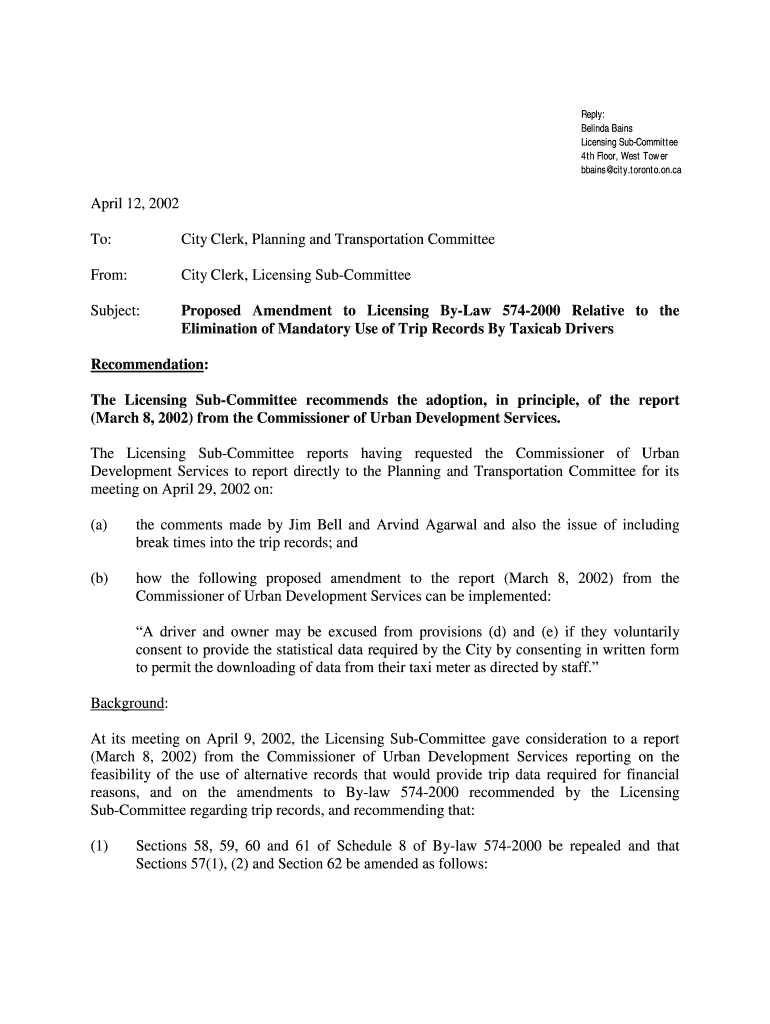
The form titled "April 12, 2002 To: City Clerk, Planning and - City of Toronto - Toronto" likely serves as a formal communication or submission to the City Clerk's office in Toronto, specifically addressing planning concerns. This type of document often includes key information regarding urban development, zoning changes, or proposed amendments to municipal regulations. Understanding its purpose involves recognizing its role in facilitating official city business and ensuring that pertinent data and requests are directed to the appropriate municipal body.
How to Use the April 12, 2002 To: City Clerk, Planning and - City of Toronto - Toronto Form
Utilizing this form effectively requires attention to detail and an understanding of the submission process. Individuals or entities involved in development projects or urban planning initiatives typically fill out this form. It is crucial to provide accurate and comprehensive information, including the nature of the request or proposal, the affected areas, and any relevant legal or environmental considerations. Submission may involve attaching supplementary documents, such as maps or reports, to justify and support the statements made.
Steps to Complete the Form
Completing the form "April 12, 2002 To: City Clerk, Planning and - City of Toronto - Toronto" involves several key steps:
- Gather Required Information: Collect all essential details needed for submission, including names, addresses, and project specifics.
- Fill Out the Form: Provide clear and concise responses to each section, ensuring that all mandatory fields are completed.
- Attach Supporting Documents: Include any supplementary materials, such as zoning maps or technical reports, that provide context and support for the form's content.
- Review for Accuracy: Double-check all entries for correctness and completeness, as errors could delay processing.
- Submit the Form: Follow the designated submission method, which may involve online submission, mailing, or hand-delivery to the City Clerk's office.
- Follow Up if Necessary: Track the progress of your submission, especially if a response or decision is required.
Key Elements of the Form
The form includes several pivotal components that must be addressed to ensure successful submission:
- Identification Information: Clearly state the name of the applicant or organization and provide contact details for correspondence.
- Purpose of Submission: Clearly articulate the objective or request, such as seeking permission for zoning changes or development approvals.
- Associated Documents: List and attach all relevant documentation that supports the submission, ensuring they are correctly labeled and referenced.
- Signature and Date: The form should be duly signed and dated by the responsible party to validate its authenticity.
Legal Use of the Form
The form bears legal significance; it represents a formal interaction with municipal authorities within Toronto. Thus, it is essential to ensure compliance with all relevant regulations and ordinances and to obtain necessary approvals for development projects or planning changes. Misstatements or omissions on the form could lead to legal repercussions or project delays. Therefore, engaging with legal or professional advisors during form preparation helps mitigate potential risks.
Important Terms Related to the Form
A comprehension of related terminology is essential for accurately completing the form:
- Zoning: Refers to municipal plans that prescribe the permitted uses of land within particular areas.
- By-Law: A regulation that may be relevant depending on the form's context, particularly concerning licensing and mandatory record-keeping changes.
- City Clerk: The official responsible for managing municipal records and documents.
Form Submission Methods
There are typically several methods for submitting the form to the City Clerk, each with distinct processes and considerations:
- Online Submission: Utilizing a digital platform for immediate delivery, providing convenience and efficiency.
- Mail: Sending physical copies through postal services, which may involve longer processing times.
- In-Person: Delivering directly to the City Clerk’s office, ensuring immediate receipt acknowledgement.
Examples of Using the Form
Examples illustrate practical applications of the form:
- Small Business Expansion: A local business owner may use this form to request a zoning amendment to expand operations or modify the land use.
- Community Development Plan: A nonprofit organization could submit this form to propose a new community center, focusing on areas needing revitalization.
- Residential Project: A property developer may present plans for a new residential complex, including requests for necessary planning approvals.




