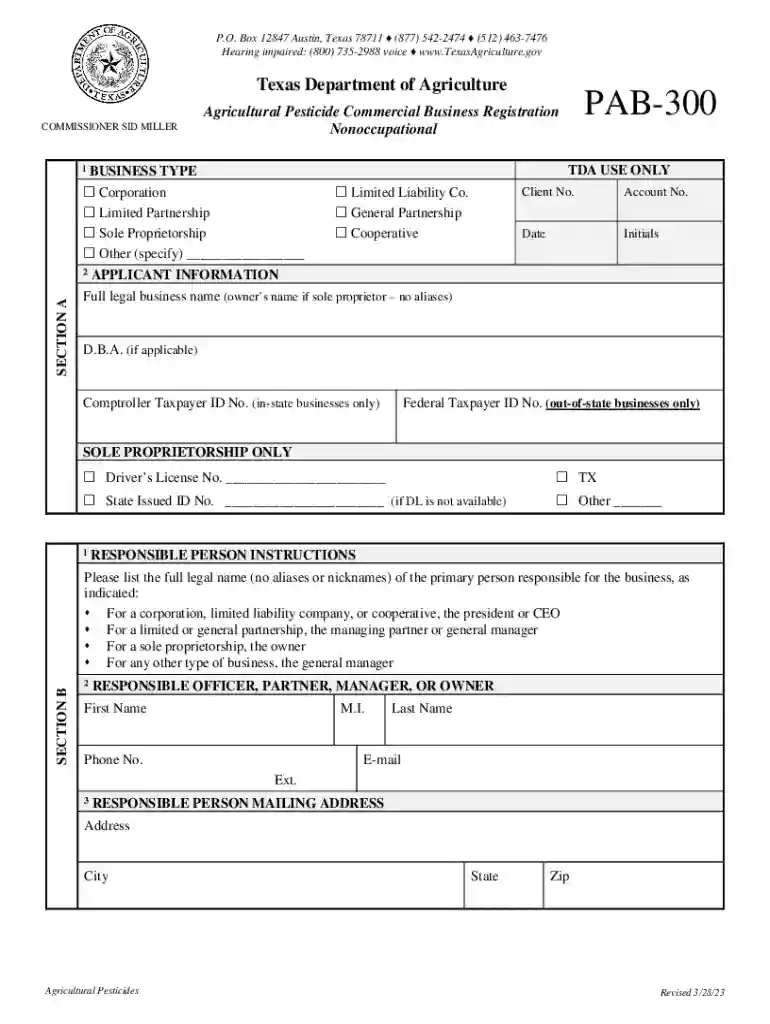
PAB-300 form revision 2026

Get Form
pab 300 Preview on Page 1

Here's how it works

01. Edit your pab 300 online
Type text, add images, blackout confidential details, add comments, highlights and more.

02. Sign it in a few clicks
Draw your signature, type it, upload its image, or use your mobile device as a signature pad.

03. Share your form with others
Send it via email, link, or fax. You can also download it, export it or print it out.

Definition and Purpose of the PAB-300 Form Revision

The PAB-300 form revision is a document used for the Agricultural Pesticide Commercial Business Registration, governed by the Texas Department of Agriculture. It serves to ensure that commercial pesticide applicators are properly registered, providing essential information about their business operations. This form collects detailed data on business type, applicant details, licensed applicators, and other relevant aspects necessary for regulatory compliance.

Key Elements of the PAB-300 Form Revision

The form encompasses various critical elements that need attention:

  • Business Type: Classify the business under the correct category whether it be a sole proprietorship, partnership, corporation, or other entity types.
  • Applicant Details: Comprehensive information about the applicant, including contact information and role within the entity.
  • Responsible Personnel: Identification of key individuals responsible for pesticide application, including their qualifications and certifications.
  • Facility Information: Detail the physical addresses of the business locations where pesticide-related activities are conducted.

How to Use the PAB-300 Form Revision

Completing the PAB-300 form revision involves several structured steps that must be followed precisely:

  1. Gather Required Information: Collect all necessary business, personnel, and facility information beforehand.
  2. Fill Out the Form: Carefully enter data into each specified section.
  3. Certification and Declaration: Ensure the applicant certifies the accuracy of the information provided.
  4. Review and Verify: Double-check for any data entry errors or missing information.

Step-by-Step Completion Process

  • Step 1: Access the form, typically available from the Texas Department of Agriculture's official website.
  • Step 2: Fill in each segment accurately, starting with business type and moving down through each section systematically.
  • Step 3: Review the entire form to catch any mistakes.
  • Step 4: Submit the completed form by mail or email as specified.

Importance and Benefits of Using the PAB-300 Form Revision

The PAB-300 form revision is crucial for maintaining compliance with state agricultural regulations. It ensures that pesticide applications are conducted safely and legally, thereby protecting public health and the environment.

Advantages for Businesses

  • Legal Compliance: Meets the mandatory requirements set by the Texas Department of Agriculture.
  • Risk Mitigation: Helps prevent legal issues related to improper pesticide application.
  • Operational Clarity: Clearly defines and organizes business operations concerning pesticide use.

Legal Use and Compliance

The legal framework surrounding the PAB-300 form revision is grounded in robust agricultural laws intended to safeguard health and environmental standards. Businesses must adhere to these legal stipulations:

  • Certification: All information must be truthful and accurate as false reporting can lead to penalties.
  • Regulatory Adherence: Stay updated with changes in regulatory requirements to ensure persistent compliance.
  • Submit on Time: Adhere to filing deadlines to avoid fines or legal repercussions.

Who Typically Uses the PAB-300 Form Revision

The primary users of this form include commercial pesticide businesses operating within Texas. These entities range from large agricultural companies to smaller independent operators who need to register their pesticide-related activities.


decoration image ratings of Dochub

Eligible Business Types

  • Agricultural Corporations: Firms heavily involved in crop production needing frequent pesticide applications.
  • Independent Applicators: Small businesses specializing in specific pesticide treatments for local farms.
  • Co-operatives: Grouped agricultural operations pooling resources for shared pesticide use.

State-Specific Rules for the PAB-300 Form Revision

Given the state's distinct regulations, businesses must be aware of Texas-specific requirements when completing the PAB-300 form revision. State laws may impose unique rules that differ from general federal guidelines, often reflecting local agricultural needs and environmental conditions.

Important Considerations

  • Regional Variations: Understand the local context and mandatory practices specific to Texas.
  • Updates and Amendments: Regularly consult the Texas Department of Agriculture for any legislative changes influencing the form.

Form Submission Methods

The PAB-300 form revision allows for multiple submission methods:

  • Email Submission: A digital file in the specified format can be sent directly to the Texas Department of Agriculture's email.
  • Postal Mail: Paper copies can be mailed to the official addresses provided by the department.

Processing Time and Confirmation

  • Acknowledge Submission: Confirm receipt through official channels to ensure that the form has been filed correctly.
  • Timeline for Approval: Follow up to understand the processing timeline and anticipate any further requirements.

Disclosure Requirements and Penalties for Non-Compliance

A fundamental aspect of the PAB-300 form revision is the necessity to fully disclose all required information. Incomplete or inaccurate disclosure can lead to severe penalties:

  • Fines and Penalties: Incorrect information can result in direct financial penalties.
  • Operational Consequences: Continued non-compliance could lead to a suspension of pesticide application privileges.

Maintaining Compliance

  • Regular Updates: Keep documented evidence of compliance standards and complete revisions promptly.
  • Seek Legal Guidance: When in doubt, consult with legal experts to navigate complex regulatory landscapes effectively.
be ready to get more

Complete this form in 5 minutes or less

Get form

Got questions?

We have answers to the most popular questions from our customers. If you can't find an answer to your question, please contact us.
Contact us
Of the 5 CEUs required, at least one CEU must be from each of two (2) of the following three categories; Laws and Regulations, IPM or Drift. The remaining 3 CEUs may come from the above categories or from the general category. The state requires you to attend a live CEU class every other year.
Applicants for a license will complete an application and submit license fees to TDA. After they receive an account number from TDA, they will be able to go to Metros website and register for an exam at one of their conveniently located testing locations in Texas.
Certified Private and Private Applicators must maintain records of each application of a restricted-use pesticide, state-limited-use pesticide, or regulated herbicide.
Recertification Requirements Licensed private applicators are required to redocHub every five years by obtaining 15 continuing education credits, including two (2) credits in laws and regulations and two (2) credits in integrated pest management (IPM), prior to expiration of the license.

Security and compliance

At DocHub, your data security is our priority. We follow HIPAA, SOC2, GDPR, and other standards, so you can work on your documents with confidence.

Learn more
ccpa2
pci-dss
gdpr-compliance
hipaa
soc-compliance