What If? The High School Policy Debate Topics That 2026

Get Form
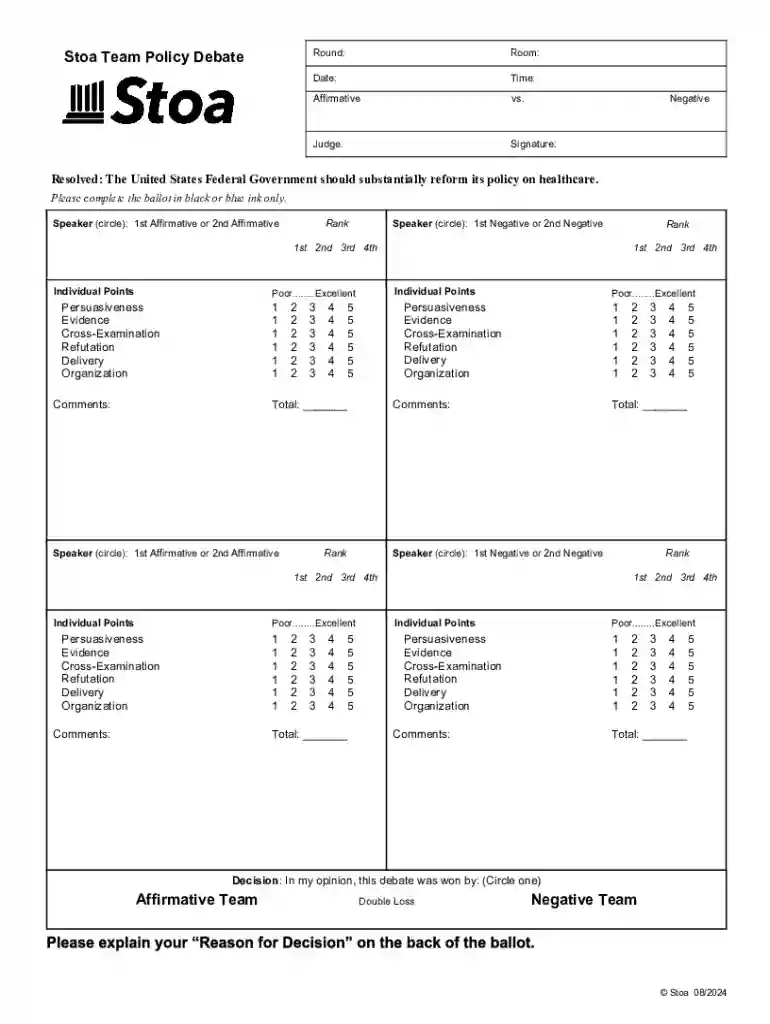
team policy debate affirmative Preview on Page 1

Here's how it works

01. Edit your team policy debate affirmative online
Type text, add images, blackout confidential details, add comments, highlights and more.

02. Sign it in a few clicks
Draw your signature, type it, upload its image, or use your mobile device as a signature pad.

03. Share your form with others
Send it via email, link, or fax. You can also download it, export it or print it out.

Definition and Meaning

High school policy debate topics like "What If? The High School Policy Debate Topics That" serve as foundational aspects for high school debate teams across the United States. These topics are carefully selected to stimulate in-depth research, critical thinking, and structured argumentation among students. Generally, a policy debate topic poses a resolution that challenges debaters to consider hypothetical changes to the status quo, evaluate potential impacts, and develop persuasive arguments for or against the proposed policy shift.

Key Elements of High School Policy Debate Topics

High school debate topics typically consist of several key elements that guide the focus of the debate. These elements include:

  • Resolution Statement: A clear, concise statement that presents the issue to be debated, usually framed as a policy change.
  • Parameters: Specific guidelines that define the scope of the debate, such as geographic boundaries, the time frame of the policy change, or specific stakeholders involved.
  • Provision for Evidence: Emphasis on the use of credible evidence and logical reasoning to support arguments, often requiring debaters to research current laws, expert opinions, and statistical data.

How to Use High School Policy Debate Topics

Understanding how to effectively use high school policy debate topics is essential for participants and educators. Here are actionable steps to maximize their potential in an educational setting:

  1. Research and Preparation: Teams should begin by thoroughly researching the topic to understand the nuances and context of the issue.
  2. Developing Arguments: Construct well-organized arguments, focusing on the affirmative and negative sides of the resolution.
  3. Practice Sessions: Engage in regular practice debates to refine speaking skills, rebuttal strategies, and time management.
  4. Use of Evidence: Learn to integrate evidence seamlessly into arguments to strengthen credibility.
  5. Feedback and Revision: Post-debate feedback sessions can help identify strengths and areas for improvement.

Important Terms Related to Policy Debate Topics

Understanding the following terms will enhance comprehension and performance in policy debates:

  • Affirmative Case: The case presented by the team in support of the resolution, detailing the benefits of the proposed policy.
  • Negative Case: The opposing case that challenges the resolution, often by defending the status quo or presenting disadvantages of the proposed change.
  • Cross-Examination: An opportunity for teams to question their opponents to clarify or undermine their arguments.
  • Constructive Speeches: Initial presentations by each side laying out their main arguments and evidence.
  • Rebuttal: The phase of the debate where teams refute their opponents’ arguments and reinforce their own positions.

Steps to Complete a Debate on Policy Topics

Successfully completing a debate on high school policy topics involves several structured steps:

  1. Preparation and Research: Gather evidence and develop arguments based on the policy topic.
  2. Constructive Speeches: Present detailed arguments for and against the resolution.
  3. Cross-Examination: Critically question opponents to identify weaknesses in their case.
  4. Rebuttal and Defense: Respond to counterarguments, strengthening your team's position.
  5. Closing Summations: Provide a cohesive summary of the debate, articulating why your team’s arguments prevail.

Who Typically Uses High School Policy Debate Topics

High school policy debate topics are primarily used by:

  • Students: Who participate in debate clubs or competitions as a way to improve public speaking, research, and critical thinking skills.
  • Teachers and Coaches: Who guide students in developing their argumentation skills and provide feedback to improve performance.
  • Judges and Adjudicators: Who evaluate the effectiveness, persuasiveness, and evidence used during debates and provide constructive criticism.

Examples of Using Policy Debate Topics

Illustrating how these topics are used:

  • Educational Curriculum: Incorporating debate topics into social studies or government classes to encourage analytical thinking.
  • Extracurricular Competitions: Participation in local and national debate tournaments where these topics are central to competition.
  • Mock Debates: Classroom or club-based simulations that mimic formal debate settings for learning and practice.

Legal Use and Ethical Considerations

While engaging in debates on policy topics, participants must remain ethically grounded:

  • Avoiding Plagiarism: Give proper credit to sources used in research.
  • Respectful Discourse: Maintain civility and respect throughout discussions, focusing on ideas rather than personal attacks.
  • Transparency of Evidence: Ensure all evidence cited during debates is authentic and verifiable.

Required Documents and Preparation Materials

Preparation is crucial and involves compiling documents such as:

  • Case Outlines: Summarizing arguments and supporting evidence.
  • Evidence Packets: Complete collections of research materials categorized by theme or argument.
  • Flow Charts: Visual aids to track the debate’s progression and the relationship between different arguments and counterarguments.

Appropriate preparation for using high school policy debate topics encourages a fair, informative, and engaging debate environment.

be ready to get more

Complete this form in 5 minutes or less

Get form

Got questions?

We have answers to the most popular questions from our customers. If you can't find an answer to your question, please contact us.
Contact us
This is the Second Negative Rebuttal, or 2NR. The 2NR is the single hardest speech in debate. The Negative has to be technical here, covering the 1AR and extending offense from the Negative Block. But at the same time, this is the Negatives final speech! Policy (CX) Debate Second Negative Rebuttal | Introduction Debate Drills policy second-negative- Debate Drills policy second-negative-
One of the most difficult aspects of policy is the inconsistency and massive topic area to cover. Winning consistently is difficult in policy because of the vast range of arguments, opponents, and judges available. What to Expect Competing in Policy Debate National Speech Debate Association wp-content uploads National Speech Debate Association wp-content uploads
Policy debate is a two-on-two debate where an affirmative team proposes a plan and the negative team argues why that plan should not be adopted. The topic for policy debate changes annually, so debaters throughout the course of the year will debate the same topic. An Introduction to Policy Debate (PD) National Speech Debate Association uploads MS- National Speech Debate Association uploads MS- PDF
Policy debate is a two-on-two debate where an affirmative team proposes a plan and the negative team argues why that plan should not be adopted. The topic for policy debate changes annually, so debaters throughout the course of the year will debate the same topic.
The 20232024 high school debate topic is: Resolved: The United States federal government should substantially increase fiscal redistribution in the United States by adopting a federal jobs guarantee, expanding Social Security, and/or providing a basic income. The topic is selected annually by ballot of the delegates

Security and compliance

At DocHub, your data security is our priority. We follow HIPAA, SOC2, GDPR, and other standards, so you can work on your documents with confidence.

Learn more
ccpa2
pci-dss
gdpr-compliance
hipaa
soc-compliance

People also ask

School and education debate topics Religion has no place in schools. Life skills like cooking or personal finance should be taught in schools. Book smarts are better than street smarts. Students who fail a test should be given a chance to take it again. Discipline is the biggest problem facing schools today.

Related links