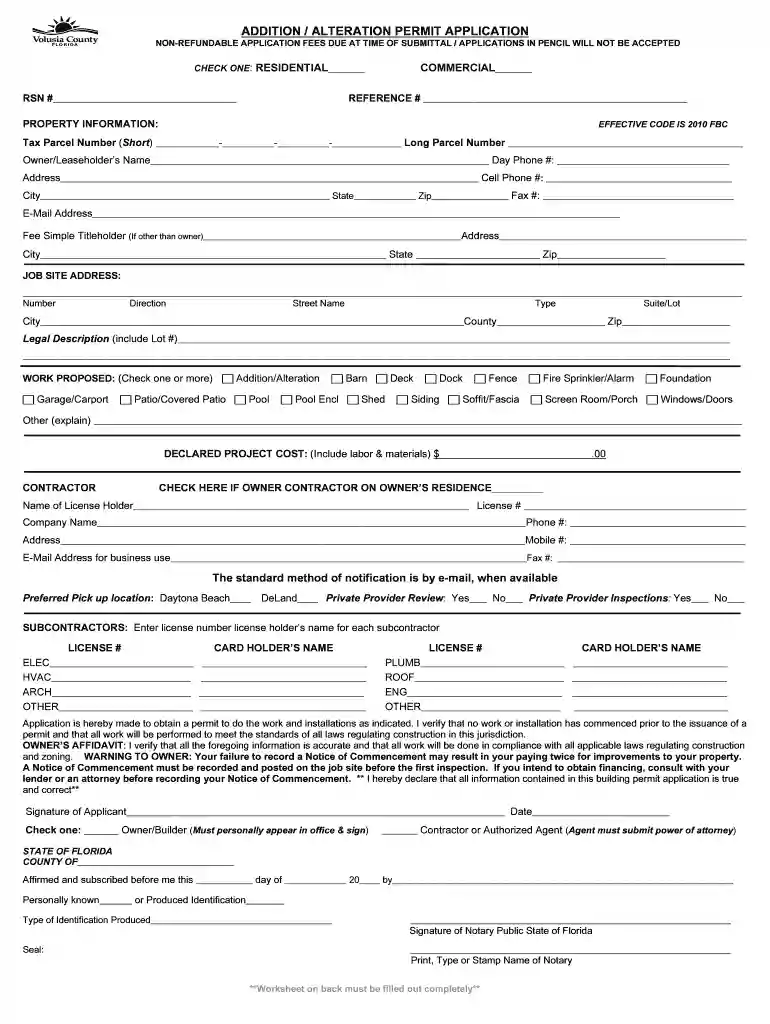
ADDITION ALTERATION PERMIT APPLICATION 2026

Get Form
ADDITION ALTERATION PERMIT APPLICATION Preview on Page 1

Here's how it works

01. Edit your form online
Type text, add images, blackout confidential details, add comments, highlights and more.

02. Sign it in a few clicks
Draw your signature, type it, upload its image, or use your mobile device as a signature pad.

03. Share your form with others
Send it via email, link, or fax. You can also download it, export it or print it out.

Definition and Meaning of Addition Alteration Permit Application

The Addition Alteration Permit Application is a crucial document typically required for those planning to make modifications or additions to existing structures in compliance with local construction laws. This application ensures that any proposed structural changes, whether residential or commercial, meet safety and regulatory standards set by relevant authorities. It encompasses specifics about the type of work being proposed, including changes to electrical systems, plumbing, heating, ventilation, and air conditioning (HVAC) systems, as well as any other structural modifications.

How to Use the Addition Alteration Permit Application

To effectively utilize the Addition Alteration Permit Application, applicants must fill out various sections detailing the proposed work. It starts with providing basic information about the property and the owner. Following this, applicants need to describe the scope of the alteration or addition, specifying any changes to the building's footprint, structural integrity, or internal systems. This form is an essential communication tool with local permitting authorities, designed to capture all aspects of the project, facilitating an efficient review process by convey inspectors and officials.

Steps to Complete the Addition Alteration Permit Application

  1. Gather Necessary Information:
    • Identify the property details, including the address and current owner.
    • Obtain contractor information, including licenses and contact details.
  2. Describe Proposed Work:
    • Clearly outline the scope of alterations or additions, including structural, electrical, and mechanical modifications.
    • Attach detailed plans or diagrams, if required.
  3. Compliance Acknowledgment:
    • Acknowledge understanding of local construction laws and regulations.
    • Ensure plans comply with zoning laws and environmental regulations.
  4. Submit Required Fees:
    • Calculate and submit any applicable fees associated with the permit.
  5. Submit the Application:
    • Provide completed forms along with all supporting documents to the local building or planning department.
    • Opt for submission methods such as online submission, mailing, or in-person, as per the department's availability.

Key Elements of the Addition Alteration Permit Application

  • Property Information:
    • Address and legal description of the property.
  • Proposed Work Description:
    • Detailed outline of the work to be undertaken.
  • Contractor Information:
    • Names, license numbers, and contact information of contractors involved.
  • Compliance and Regulations:
    • Verification that the project adheres to zoning laws, building codes, and safety standards.
  • Notice of Commencement:
    • A formal declaration to begin work, contingent upon permit approval.

Who Typically Uses the Addition Alteration Permit Application

The Addition Alteration Permit Application is used by property owners, architects, contractors, and developers intending to modify existing structures. These stakeholders often require approval from local authorities to ensure projects adhere to applicable codes and safety standards. Whether expanding a home, renovating a commercial property, or altering internal structures, these parties must obtain the necessary permissions through this application process.


decoration image ratings of Dochub

Legal Use of the Addition Alteration Permit Application

Compliance with the Addition Alteration Permit Application safeguards against legal repercussions and ensures structures are safe and habitable. Entities are legally required to submit this application before commencing any significant alterations. Failure to obtain the appropriate permits may result in fines or legal mandates to cease construction, rectify unauthorized work, or dismantle unapproved modifications.

Important Terms Related to the Addition Alteration Permit Application

  • Notice of Commencement: The formal announcement required before any construction work begins.
  • Zoning Laws: Regulations dictating how properties in certain geographical areas can be used, impacting projects that require permits.
  • Building Codes: Safety standards stipulated to ensure building quality and occupant safety.
  • Structural Alterations: Modifications that affect a building's framework or main elements.

State-Specific Rules for the Addition Alteration Permit Application

In the United States, while federal laws provide a general framework, state-specific regulations dictate additional criteria for the Addition Alteration Permit Application. This includes differences in building codes, environmental impact assessments, and specific zoning requirements. Applicants must verify with local government offices or building departments for state-specific rules and amendments to ensure comprehensive compliance.

Examples of Using the Addition Alteration Permit Application

Consider a homeowner planning to add an extra room to their house in California. The application would involve submitting the Addition Alteration Permit Application, outlining the scope of the proposed addition, assessing its impact on existing structures, and ensuring compliance with state-specific earthquake safety codes. Similarly, a business owner in New York hoping to convert a warehouse into office spaces must fulfill local fire safety and occupancy regulations before their application is approved.

See more ADDITION ALTERATION PERMIT APPLICATION versions

We've got more versions of the ADDITION ALTERATION PERMIT APPLICATION form. Select the right ADDITION ALTERATION PERMIT APPLICATION version from the list and start editing it straight away!
Versions Form popularity Fillable & printable
2017 4.8 Satisfied (101 Votes)
2015 4 Satisfied (45 Votes)
2014 4 Satisfied (45 Votes)
be ready to get more

Complete this form in 5 minutes or less

Get form

Got questions?

We have answers to the most popular questions from our customers. If you can't find an answer to your question, please contact us.
Contact us
Permits are required for construction of all new buildings/structures, additions to buildings/structures, interior remodels/alterations that include structural modifications, structural repairs to buildings, storm shelters, decks, covered patios, storage buildings, carports, fences over 7ft tall, swimming pools,
If you own the property and it is your main place of residence, then you can do any building, plumbing, electrical or mechanical work yourself. You are still required to pull permits as that work will have to be inspected and the work must be completed by you.
Homeowners and/or contractors are responsible for ensuring that design and construction meet the appropriate code. Code compliance is verified during inspections. Permits are required for kits, packages and pre-assembled structures larger than 10 square meters (108 square feet).
Cosmetic work such as painting, tiling, carpeting and replacing cabinets do not require a permit. However, you are encouraged to contact the Building Inspection office at (479)-621-1100 before beginning any work to determine whether or not permits are required.
Fines are one of the most common penalties for constructing without a permit. Most local governments have a set schedule of fines based on the size and nature of the project. The fines can be substantial, escalating with the duration of non-compliance or the severity of the offense.

Security and compliance

At DocHub, your data security is our priority. We follow HIPAA, SOC2, GDPR, and other standards, so you can work on your documents with confidence.

Learn more
ccpa2
pci-dss
gdpr-compliance
hipaa
soc-compliance

People also ask

Per the California Residential Code detached accessory structure not exceeding 120 square feet does not require a building permit if there is no plumbing, electrical, and or mechanical equipment. Please note, Sheds and/or Structures under 120 square feet do require a Planning Permit.
Permit amendment means any revisions to the original permit such as addition or reduction of repair fees.

Related links