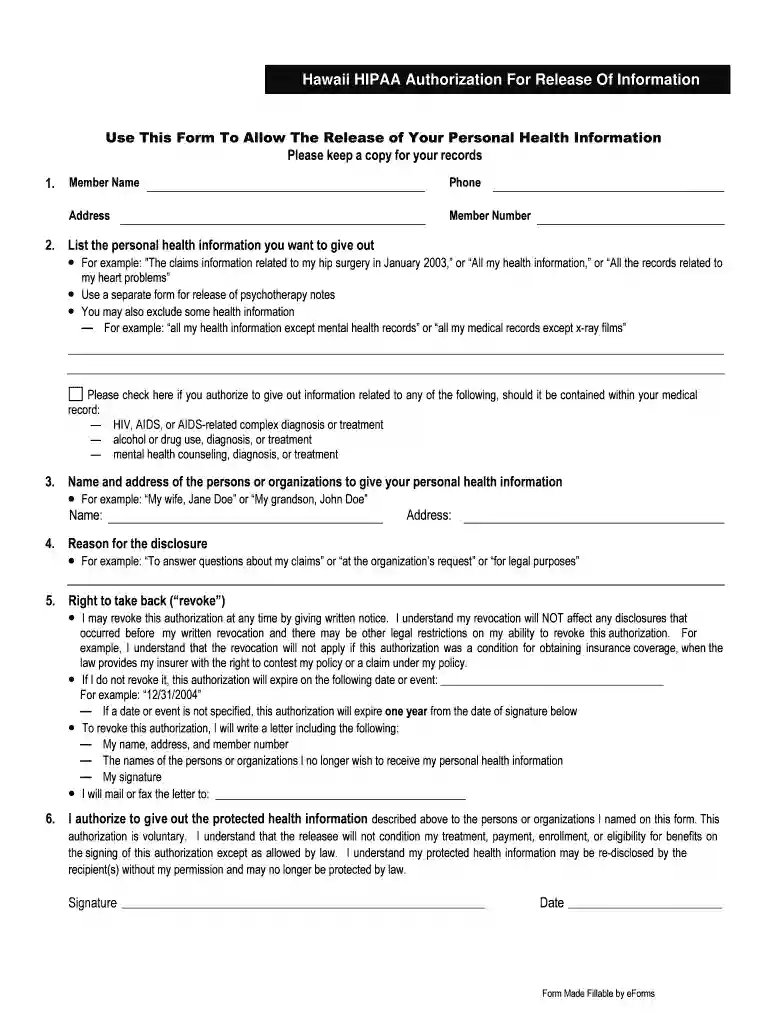
Hawaii HIPAA Medical Release Form 2026

Get Form
Hawaii HIPAA Medical Release Form Preview on Page 1

Here's how it works

01. Edit your form online
Type text, add images, blackout confidential details, add comments, highlights and more.

02. Sign it in a few clicks
Draw your signature, type it, upload its image, or use your mobile device as a signature pad.

03. Share your form with others
Send it via email, link, or fax. You can also download it, export it or print it out.

Definition and Purpose of the Hawaii HIPAA Medical Release Form

The Hawaii HIPAA Medical Release Form is a legal document allowing individuals to authorize the disclosure of their personal health information. This document is critical for ensuring that healthcare providers and other entities comply with the Health Insurance Portability and Accountability Act (HIPAA), which mandates the protection of sensitive patient data. The form specifies which pieces of health information can be shared, the entities authorized to receive the information, and the purpose for sharing such details. This empowerment allows individuals to maintain control over their personal health information while facilitating necessary communication between authorized parties.

Important Components

  • Specification of Information: Individuals must detail the specific health information they wish to disclose.
  • Authorization Recipients: The form identifies who will receive the disclosed information.
  • Purpose of Disclosure: The reason for sharing the information must be clearly stated.

Obtaining the Hawaii HIPAA Medical Release Form

Securing the Hawaii HIPAA Medical Release Form is a straightforward process. Individuals can typically obtain this form from their healthcare provider's office, hospitals, or medical facilities that handle patient records. Additionally, these forms might be available on the websites of health organizations or state health departments.

Key Steps

  1. Inquire at Medical Facilities: Ask for the form at your doctor's office or any medical facility managing your records.
  2. Online Resources: Some healthcare providers offer downloadable forms on their websites.
  3. State Health Departments: Forms may also be available through government health department websites.

Steps to Complete the Hawaii HIPAA Medical Release Form

Filling out the Hawaii HIPAA Medical Release Form requires attention to detail to ensure compliance and proper authorization.

Step-by-Step Process

  1. Personal Information: Enter your full name, date of birth, and contact information.
  2. Specify Information: Clearly outline the health information to be released.
  3. Designate Recipients: List individuals or organizations authorized to receive the information.
  4. Purpose: State the reason for the release of your medical information.
  5. Signature and Date: Sign and date the form to validate the authorization.
  6. Witness or Notarization: Some forms might require a witness signature or notarization for added security.

Usage Scenarios for the Hawaii HIPAA Medical Release Form

The Hawaii HIPAA Medical Release Form is widely used in various scenarios where the disclosure of medical information is necessary.

Practical Use Cases

  • Continuity of Care: Sharing information with new healthcare providers for ongoing treatment.
  • Legal and Financial Situations: When medical information is needed for legal matters or insurance purposes.
  • Family Access: Granting access to family members managing your health care when you are unable.

Legal Implications and Obligations

Understanding the legal ramifications of the Hawaii HIPAA Medical Release Form is crucial for compliance with federal and state laws.

Legal Considerations

  • Revocation Rights: Individuals have the right to revoke the authorization at any time, though this must be done in writing.
  • Voluntary Nature: Signing the form is voluntary, but necessary for information disclosure.
  • Re-disclosure Risks: Released information might be subject to re-disclosure, which the individual must understand before signing.

Key Elements of the Hawaii HIPAA Medical Release Form

Several key elements make up the Hawaii HIPAA Medical Release Form, ensuring it meets legal standards while protecting individual rights.

Essential Elements

  • Clear Identification: Accurate personal details to avoid identity confusion.
  • Precise Scope: Detailed specification of what information will be released and for what purpose.
  • Duration: The authorization's validity period or expiration date must be clearly defined.

Important Terminology Related to the Hawaii HIPAA Medical Release Form

Familiarity with the terminology used in the Hawaii HIPAA Medical Release Form is essential for proper understanding and completion of the form.

Glossary of Terms

  • Protected Health Information (PHI): Any information about health status, provision of health care, or payment for health care that is linked to an individual.
  • Authorization: Formal approval for disclosure of personal information.
  • Covered Entity: Organizations, such as healthcare providers and insurers, who handle health information and must comply with HIPAA regulations.

State-Specific Rules and Differences

While the Hawaii HIPAA Medical Release Form follows federal HIPAA regulations, there may be state-specific nuances to consider.

Hawaii-Specific Rules

  • State Compliance: Hawaii may have additional privacy laws that complement federal HIPAA rules, ensuring even stricter information protection.
  • Additional Requirements: Some state regulations might dictate additional steps or forms needed in conjunction with the HIPAA release.

By providing comprehensive insights into the Hawaii HIPAA Medical Release Form, including its purpose, usage, and legal implications, individuals can navigate the complexities of medical information disclosure with confidence.

be ready to get more

Complete this form in 5 minutes or less

Get form

Got questions?

We have answers to the most popular questions from our customers. If you can't find an answer to your question, please contact us.
Contact us
Hawaii Data BdocHub Notification Law The HIPAA BdocHub Notification Rule requires healthcare organizations to report bdocHubes that compromise the confidentiality, integrity, or availability of protected health information. Incidents that are considered reportable bdocHubes include: Hacking or IT incidents.
A: No. The HIPAA Privacy Rule does not require you to docHub authorization forms or have a witness. Though taking the time to fill out an authorization form and get a patients signature is an extra step, its an important one that you cant afford to overlook.
In Hawaii, an employer can elect to pay the entire premium amount or share the cost with the employee. The employer must pay for at least one-half of the (single) premium cost, however, the employees contribution cannot exceed 1.5% of the employees monthly wages.
Complaint Requirements Your complaint must: Be filed in writing by mail, fax, e-mail, or via the OCR Complaint Portal. Name the covered entity or business associate involved, and describe the acts or omissions, you believed violated the requirements of the Privacy, Security, or BdocHub Notification Rules.
A covered entity must obtain the individuals written authorization for any use or disclosure of protected health information that is not for treatment, payment or health care operations or otherwise permitted or required by the Privacy Rule.

Security and compliance

At DocHub, your data security is our priority. We follow HIPAA, SOC2, GDPR, and other standards, so you can work on your documents with confidence.

Learn more
ccpa2
pci-dss
gdpr-compliance
hipaa
soc-compliance

People also ask

A HIPAA violation is any failure to comply with the HIPAA regulations which can include the unauthorized access, use, or disclosure of Protected Health Information (PHI), the failure to provide patients with access to their PHI, a lack of safeguards to protect PHI, the failure to conduct regular risk assessments, or
Persons at least 14 years old and less than 16 years old can consent to sexual activity with a person who is less than five years older. For example, a person who just turned 14 years old cannot consent to sexual activity with a person who is about to turn 20 years old.

Related links