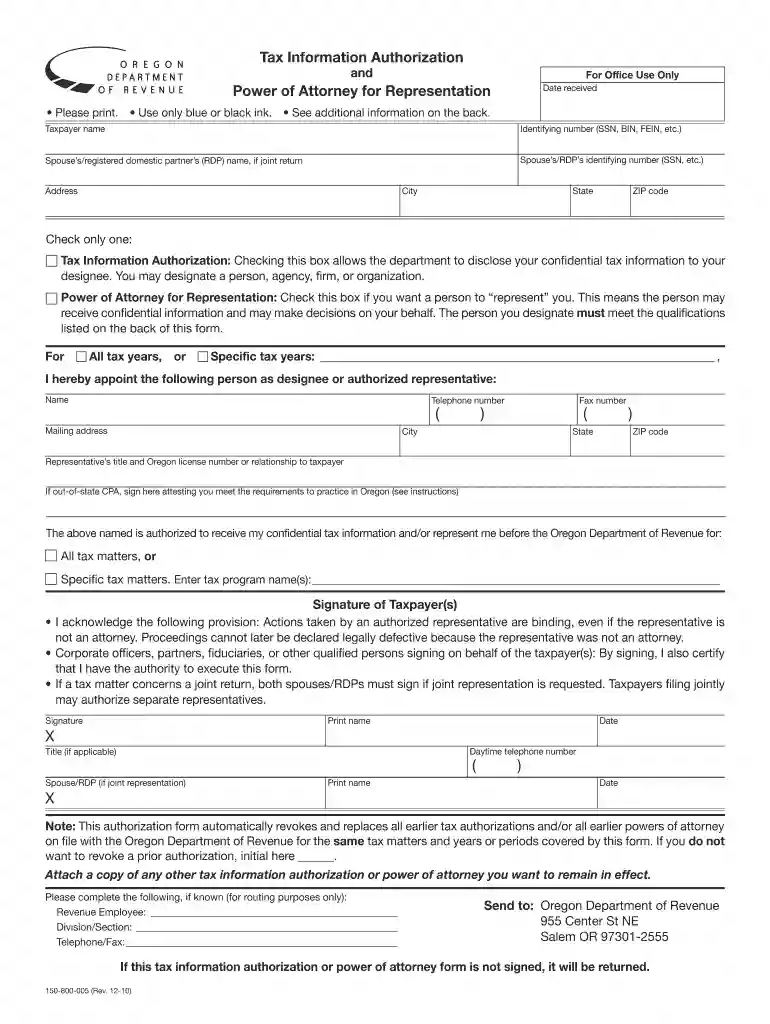
Tax Information Authorization: Checking this box allows the department to disclose your confidential 2026

Get Form
Tax Information Authorization: Checking this box allows the department to disclose your confidential Preview on Page 1

Here's how it works

01. Edit your form online
Type text, add images, blackout confidential details, add comments, highlights and more.

02. Sign it in a few clicks
Draw your signature, type it, upload its image, or use your mobile device as a signature pad.

03. Share your form with others
Send it via email, link, or fax. You can also download it, export it or print it out.

Definition and Meaning

The Tax Information Authorization form is a critical document that enables taxpayers to authorize specific individuals or organizations to access their confidential tax information. This permission extends to receiving sensitive data and, in certain cases, acting on behalf of the taxpayer in dealings with tax authorities. Understanding this form's purpose is essential, as it governs how and with whom your tax-related information can be shared. Key elements typically include the types of information that can be disclosed and the duration of the authorization.

Key Elements of the Tax Information Authorization Form

The form contains several essential components to ensure the taxpayer's intentions are clear and legally binding:

  • Personal Information: Includes the taxpayer's full name, address, and Social Security Number (SSN). This identifies who is granting the authorization.
  • Authorized Party Details: Requires the name and contact information of the individual or organization being authorized to receive confidential information.
  • Scope of Authorization: Specifies the type of tax information that can be disclosed. It may define particular tax years or documents.
  • Duration: Indicates how long the authorization is valid, which could be indefinite or for a specific period.

How to Use the Tax Information Authorization Form

Using the Tax Information Authorization form involves several steps to ensure it is completed accurately:

  1. Enter Personal and Contact Information: Accurately fill in the taxpayer's and the authorized party's details.
  2. Define the Scope: Clearly specify the types of tax information to be disclosed, ensuring it aligns with your intent.
  3. Establish the Timeframe: Determine the validity period of the authorization, which may be vital for periodic reviews.
  4. Signature and Date: Both the taxpayer and the authorized representative must sign and date the form to validate it.

Steps to Complete the Tax Information Authorization Form

Completing the form requires attention to detail to ensure that all necessary information is correctly provided:

  1. Gather Required Information: Collect all personal identification information, including tax identification numbers.
  2. Complete All Sections: Fill out each part of the form with accuracy, paying special attention to the scope and duration of the authorization.
  3. Review for Accuracy: Double-check the entire form to ensure there are no errors or omissions.
  4. Sign and Date: Ensure both the taxpayer and representative signatures are present and correctly dated.
  5. Submit to the Relevant Tax Authority: Depending on the instructions provided, submission can be done through specified channels like mailing to the IRS or submitting online.

Legal Use of the Authorization Form

The legal framework surrounding this form ensures confidentiality and follows specific guidelines to protect taxpayer information. Adhering to legal requirements when using the form guarantees compliance with tax laws and regulations:

  • Legal Intent: The form must reflect the taxpayer's legitimate intent to disclose information.
  • Compliance with Regulations: Align with regulations such as the Internal Revenue Code, ensuring that all disclosures are lawful.
  • Revocation Process: Taxpayers retain the right to revoke the authorization at any time by providing a written notice to the relevant tax authority.

Who Typically Uses This Form

Various individuals and organizations might find this form necessary:

  • Taxpayers: Both individuals and businesses who need to authorize accountants, tax professionals, or attorneys to access their tax information.
  • Tax Professionals: Certified Public Accountants (CPAs) and tax preparers who represent clients.
  • Businesses: Companies that need to facilitate operations involving tax matters by designating representatives.

Examples of Using the Tax Information Authorization Form

Several scenarios illustrate the practical use of this form:

  • Tax Audit Assistance: A taxpayer facing an IRS audit grants their CPA authority to access relevant tax documents.
  • Estate Planning: An individual gives their attorney permission to access their tax information to prepare for estate management.
  • Business Representation: A corporation authorizes a tax consultant to handle yearly tax submissions on its behalf.

IRS Guidelines

Understanding IRS guidelines related to the form is vital:

  • Official Instructions: Follow specific instructions provided by the IRS for completing and submitting the form.
  • Eligible Information: Determine what type of tax information can be disclosed according to IRS standards.
  • Revocation Procedures: Comply with IRS guidelines on how to revoke authorization if needed.

Disclosure Requirements

Adhering to disclosure requirements ensures information security and taxpayer rights:

  • Confidentiality Assurance: All parties must adhere to confidentiality agreements.
  • Accuracy of Disclosure: Authorized parties must ensure the correct information is exchanged.
  • Limitations: The release of information should not exceed what is explicitly authorized within the form.

This comprehensive overview of the Tax Information Authorization form serves to guide through its completion, use, and legal context, directly aligning with the needs and standards expected by the U.S. tax system.

See more Tax Information Authorization: Checking this box allows the department to disclose your confidential versions

We've got more versions of the Tax Information Authorization: Checking this box allows the department to disclose your confidential form. Select the right Tax Information Authorization: Checking this box allows the department to disclose your confidential version from the list and start editing it straight away!
Versions Form popularity Fillable & printable
2015 4.8 Satisfied (49 Votes)
2010 4.5 Satisfied (36 Votes)
be ready to get more

Complete this form in 5 minutes or less

Get form

Got questions?

We have answers to the most popular questions from our customers. If you can't find an answer to your question, please contact us.
Contact us
File Form 8821 to: Authorize any individual, corporation, firm, organization, or partnership you designate to inspect and/or receive your confidential information verbally or in writing for the type of tax and the years or periods listed on the form. Delete or revoke prior tax information authorizations.
A Tax Information Authorization gives that person the legal right to review some confidential taxpayer information. A TIA relationship does not allow the representative to act on a taxpayers behalf to resolve their tax issues with FTB.
Tax information authorization You can use Form 8821 to allow the IRS to discuss your tax matters with designated third parties and, where necessary, to disclose your confidential tax return information to those designated third parties on matters other than just the processing of your current tax return.
Tax returns and return information are broadly defined Section 6103 includes broad protections preventing disclosure of taxpayer returns or return information. Specifically, it provides a baseline rule that tax returns and return information shall be confidential unless otherwise authorized by the statute.
Form 8821 authorizes the IRS to disclose your confidential tax information to the person you appoint. This form is provided for your convenience and its use is voluntary. The information is used by the IRS to determine what confidential tax information your appointee can inspect and/or receive.

Security and compliance

At DocHub, your data security is our priority. We follow HIPAA, SOC2, GDPR, and other standards, so you can work on your documents with confidence.

Learn more
ccpa2
pci-dss
gdpr-compliance
hipaa
soc-compliance

People also ask

Common triggers for audits include docHub discrepancies between reported income and third-party information, large charitable deductions, or unusually high business expenses compared to income. Being aware of these factors can help you maintain accurate records and avoid potential pitfalls.
Power of attorney and other authorizations You can submit Power of Attorney (POA) or Tax Information Authorization (TIA) for a taxpayer with these options: Tax Pro Account. Submit Forms 2848 and 8821 online. Mail or fax Form 2848 (POA) PDF or Form 8821 (TIA) PDF.

Related links