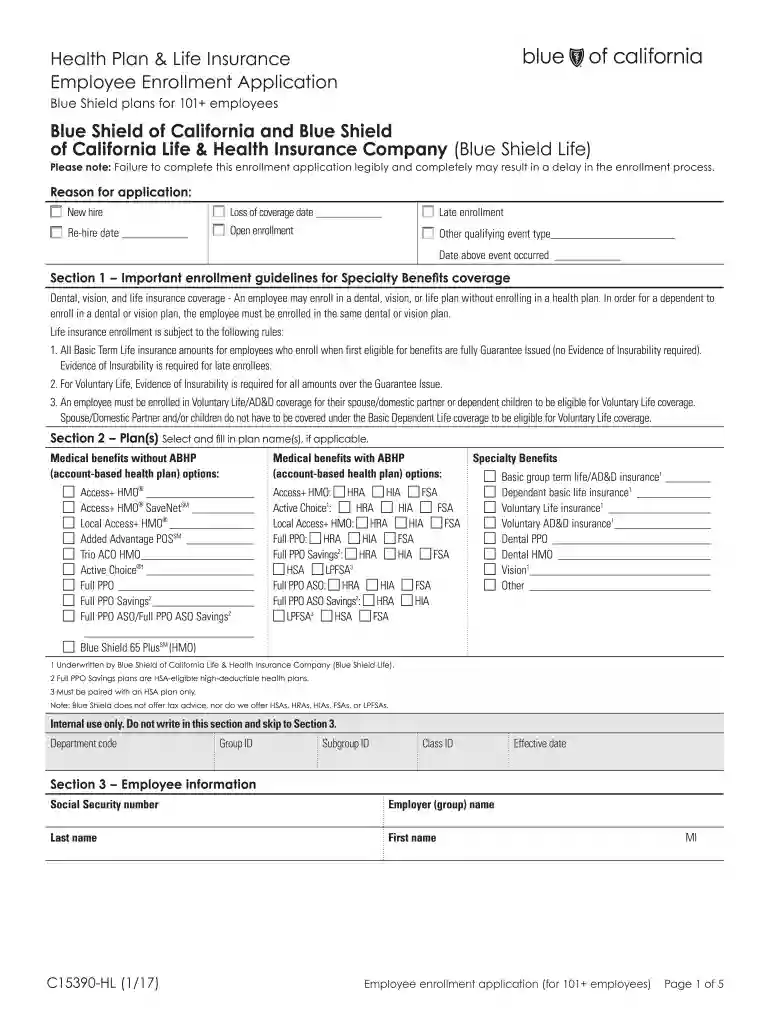
Definition and Purpose of the Life Insurance Plan Employee Enrollment Application
The Life Insurance Plan Employee Enrollment Application, specifically designed for Blue Shield of California, serves as a formal document through which employees enroll in various insurance coverages offered by their employer. This application is used by companies with 101 or more employees and provides comprehensive coverage options, including health, dental, vision, and life insurance. The document ensures the capture of detailed personal and dependent information for accurate insurance enrollment and beneficiary designation.
Key Purposes
- Insurance Enrollment: Facilitates the enrollment process for multiple insurance plans provided by the employer, like medical and life insurance.
- Information Collection: Collects essential employee and dependent information to process insurance coverage accurately.
- Beneficiary Designation: Allows employees to specify beneficiaries for life insurance policies, ensuring clarity in benefit distribution.
Steps to Complete the Life Insurance Plan Employee Enrollment Application
Completing the Life Insurance Plan Employee Enrollment Application involves several important steps to ensure all necessary data is captured and processed correctly.
- Gather Required Information: Collect all personal details, including social security number, contact information, and employment details.
- Complete Dependent Information: Provide accurate information about any dependents, including names, dates of birth, and social security numbers.
- Choose Coverage Options: Select the desired insurance coverages, considering factors like premiums, coverage limits, and included benefits.
- Designate a Beneficiary: Identify a beneficiary for life insurance if applicable, including the percentage of benefits they should receive.
- Specific Sections to Attention:
- Personal Information: Ensure accuracy to avoid processing delays.
- Coverage Selection: Assess each plan's benefits versus its costs.
- Beneficiary Information: Double-check the designated beneficiaries and their details.
Eligibility Criteria for the Life Insurance Plan Employee Enrollment Application
Eligibility for using the Life Insurance Plan Employee Enrollment Application typically includes several key criteria prospective applicants must meet.

Employee Eligibility
- Must be actively employed by a company affiliated with Blue Shield of California and have an employment size of at least 101 employees.
- Generally requires full-time employment status.
Dependent Eligibility
- Legally recognized dependents, such as spouses, children, or domestic partners, can be included in the application.
Important Terms Related to the Application
Grasping the key terms associated with the Life Insurance Plan Employee Enrollment Application is essential for clear understanding and accurate completion.
- Premium: The amount paid periodically to keep the insurance plan active.
- Beneficiary: A person designated to receive benefits under an insurance policy.
- Coverage Limit: The maximum amount an insurance company will pay for a covered loss.
Legal Use and Compliance
Making sure the application complies with all legal standards is critical. The application aligns with federal and state laws governing employee benefits and life insurance.
Relevant Regulations
- ESIGN Act Compliance: Ensures electronic signatures on enrollment forms are legally binding.
- HIPAA Regulations: Protects sensitive health information provided in the application.
Required Documents for Submission
The Life Insurance Plan Employee Enrollment Application mandates the submission of several documents to authenticate and process the enrollment accurately.
- Proof of Employment: A letter or document verifying your employment status.
- Dependent Documents: Birth certificates or marriage licenses for each dependent listed.
- Identification: A government-issued ID to confirm the applicant's identity.
Application Process and Approval Time
Understanding the timeline from submission to approval helps applicants set realistic expectations regarding the enrollment process.
Process Overview
- Submission: Submit the completed application form along with all required documents.
- Review Period: Typical review time is two to four weeks, during which the employer and insurer evaluate the application.
- Approval: Once approved, coverage begins as per the terms outlined in the selected insurance plan.
State-Specific Rules and Variances
Some states may have unique guidelines or regulations influencing the application process for insurance coverage.
Examples
- California Specifics: May include additional forms or disclosures due to state-specific insurance mandates.
- Variations by State: Certain benefits or coverage requirements might differ, affecting how the application needs to be completed or what additional documentation is necessary.
Digital vs. Paper Versions
Choosing between digital and paper versions of the application can depend on user preference and convenience.
-
Digital: Offers faster processing times and easier integration with online systems for real-time tracking.
-
Paper: Preferred by those who favor physical documentation; requires mailing or in-person delivery.
-
Considerations:
- Digital offers seamless integration with platforms like DocHub for ease of use and efficiency.
- Paper is often considered more tangible but may involve greater logistical challenges for submission and tracking.
Software Compatibility
Leveraging the application with compatible software can enhance efficiency and accuracy during the completion process.
Supported Platforms
- DocHub: Provides tools for editing, signing, and annotating the application efficiently.
- Google Workspace Integration: Ensures documents can be easily handled within integrated Google services for straightforward form management.
Choosing between digital and paper versions or integrating with software can significantly impact the time taken, ease, and overall experience of completing the application.