Caregiver Monthly Mileage - A Place Called Hope 2026

Get Form
Caregiver Monthly Mileage - A Place Called Hope Preview on Page 1

Here's how it works

01. Edit your form online
Type text, add images, blackout confidential details, add comments, highlights and more.

02. Sign it in a few clicks
Draw your signature, type it, upload its image, or use your mobile device as a signature pad.

03. Share your form with others
Send it via email, link, or fax. You can also download it, export it or print it out.

Definition and Meaning

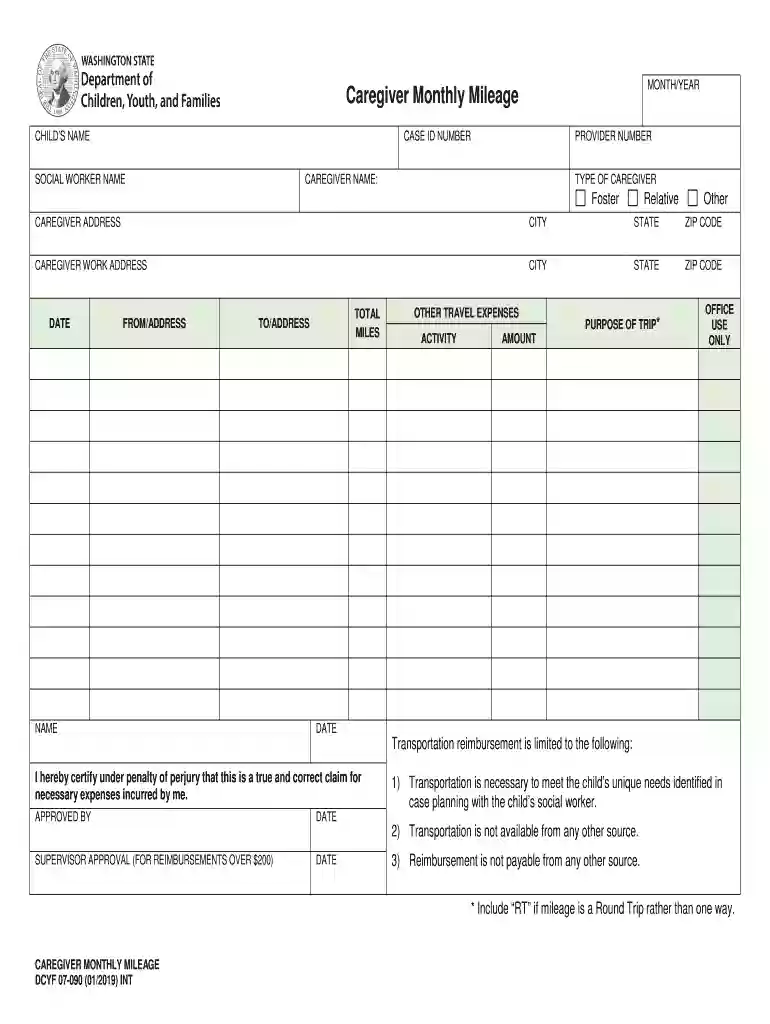
The "Caregiver Monthly Mileage - A Place Called Hope" form is a vital document for caregivers involved in the foster care system. It serves as a record of mileage incurred while performing duties related to foster care responsibilities. Such duties may include transporting children to medical appointments, educational institutions, court hearings, or family visits. The primary objective of this form is to ensure that caregivers receive financial reimbursement for the transportation costs they incur. Understanding its purpose is crucial for caregivers to efficiently manage their travel expenses and receive the appropriate compensation.

How to Use the Caregiver Monthly Mileage - A Place Called Hope

Using the form involves documenting each journey made in the capacity of a caregiver. Caregivers need to record the date, starting location, destination, purpose of the trip, and the total mileage for each trip. This meticulous documentation process ensures that every mile driven in service of the child's welfare is accounted for. Accurate record-keeping on the form is essential for validating the reimbursements and for auditing purposes if required. Regular updates to the form, ideally in real-time or soon after each trip, will help maintain accuracy and reduce the burden at the month's end.

Steps to Complete the Caregiver Monthly Mileage Form

  1. Gather Required Information: Collect all necessary trip details such as dates, destinations, and purposes of travel.
  2. Record Details: Enter each trip's information into the form accurately. Ensure to capture the exact mileage using a reliable method, like a vehicle's odometer reading.
  3. Calculate and Summarize Mileage: At the end of the month, add up all recorded mileage to get the total monthly mileage.
  4. Attach Supporting Documentation: Include any required receipts or documentation that supports the mileage claim.
  5. Submit the Form: After completion, submit the form to the designated authority by the specified deadline. This could be through mail, online submission, or in-person delivery, depending on the organization's preferences.

Key Elements of the Caregiver Monthly Mileage Form

  • Trip Details: Sections for date of travel, start and endpoint, purpose of the trip, and odometer readings.
  • Mileage Calculation: Spaces to record start and end mileage for accurate calculations.
  • Reimbursable Categories: Lists of trip categories that qualify for reimbursement, such as medical appointments or court-related travel.
  • Non-Reimbursable Activities: Items that do not qualify for mileage reimbursement, such as personal errands unrelated to foster care duties.
  • Summary Section: A cumulative overview of total miles traveled for quick reference and submission.

Important Terms Related to the Form

  • Reimbursable Mileage: The distance driven that qualifies for reimbursement under foster care guidelines.
  • Non-Reimbursable Activities: Personal or recreational trips that cannot be claimed.
  • Case Plans: Documents detailing the specific needs and schedules of each foster child that influence travel requirements.
  • Mileage Rate: The rate per mile set by the relevant authority for calculating reimbursement.

Who Typically Uses this Form

This form is predominantly used by caregivers in the foster care system. These individuals transport children in their care to various mandatory appointments and meetings. In addition to primary caregivers, foster care administrators and financial officers may also interact with the form to handle reimbursement processes and audits.

Legal Use of the Caregiver Monthly Mileage Form

Compliance with legal standards is crucial when using this form. All entries should be honest and accurate, reflecting actual travel conducted for foster care duties. Misrepresenting information could lead to audits, denial of reimbursement claims, and legal repercussions. Adhering to ethical guidelines and maintaining transparency protects caregivers and supports the trustworthiness of the foster care system.

State-Specific Rules for the Form

Each state may have unique regulations and mileage reimbursement rates applicable to caregivers. It is important to familiarize oneself with state-specific guidelines to ensure proper completion and submission of the form. Variations may include differences in allowable mileage categories, rates, and documentation requirements. Checking with local foster care agencies for updates ensures compliance and correct reimbursement.

Examples of Using the Caregiver Monthly Mileage Form

  • Medical Appointments: Documenting trips to doctor visits for regular check-ups and emergency care.
  • Educational Transportation: Mileage incurred when driving children to and from school or educational programs.
  • Court Hearings: Travel related to attending mandated court sessions concerning the child's welfare or custody.
  • Family Visits: Trips needed for children to visit biological family members as outlined in their case plans.

These practical applications illustrate the range and type of transportation that the form covers, highlighting its relevance and necessity for caregivers in the foster care system.

See more Caregiver Monthly Mileage - A Place Called Hope versions

We've got more versions of the Caregiver Monthly Mileage - A Place Called Hope form. Select the right Caregiver Monthly Mileage - A Place Called Hope version from the list and start editing it straight away!
Versions Form popularity Fillable & printable
2021 4.9 Satisfied (37 Votes)
2019 4.3 Satisfied (56 Votes)
be ready to get more

Complete this form in 5 minutes or less

Get form

Got questions?

We have answers to the most popular questions from our customers. If you can't find an answer to your question, please contact us.
Contact us
Yes, caregivers typically expect to be compensated for travel time and mileage, especially when they need to travel between multiple clients. Clear communication about these policies is essential to avoid misunderstandings.
Helping from miles away: Strategies for long-distance caregiving Understanding their health and care. Keeping track of important documents. Planning meaningful visits. Creating a local care network. Staying connected and informed. Adapting as their needs evolve.
Caregiving often involves travel between client homes, appointments, or training locations. The IRS standard mileage rate allows you to deduct costs based on business-related driving, even if you use your personal vehicle. Examples of deductible trips: Driving to and from a clients home.
Care Worker Travel Expenses Reimbursement The approved rates are 45p per mile for the first 10,000 miles and 25p per mile thereafter. If an employer provides a mileage allowance between these rates, employers can claim tax relief on the difference.
Can a caregiver deduct mileage? Yes, like taxes for a small business, caregivers can deduct mileage, but only for the costs incurred within the scope of the job itself.

Security and compliance

At DocHub, your data security is our priority. We follow HIPAA, SOC2, GDPR, and other standards, so you can work on your documents with confidence.

Learn more
ccpa2
pci-dss
gdpr-compliance
hipaa
soc-compliance