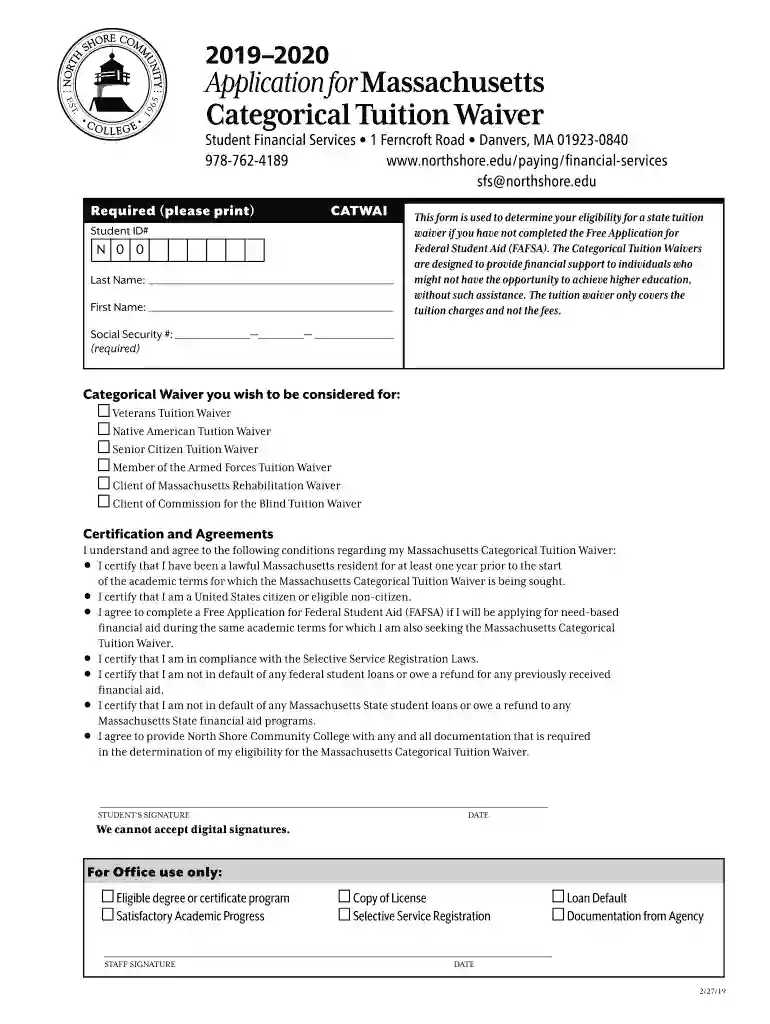
This form is used to determine your eligibility for a state tuition 2026

Get Form
This form is used to determine your eligibility for a state tuition Preview on Page 1

Here's how it works

01. Edit your form online
Type text, add images, blackout confidential details, add comments, highlights and more.

02. Sign it in a few clicks
Draw your signature, type it, upload its image, or use your mobile device as a signature pad.

03. Share your form with others
Send it via email, link, or fax. You can also download it, export it or print it out.

Understanding the Purpose and Meaning

The "This form is used to determine your eligibility for a state tuition" is a crucial document intended to help individuals ascertain their qualification for state-funded educational financial aid. Its primary focus is to help applicants understand and meet specific criteria necessary for obtaining tuition assistance offered by state governments. This form plays a significant role in facilitating access to educational opportunities by ensuring that financial aid is extended to eligible individuals.

Eligibility Criteria Explanation

Eligibility for state tuition programs often involves meeting various personal and financial criteria. Some common factors considered include:


  • Residency Status: Applicants are usually required to prove they have been residents of the state for a specified period.
  • Income Levels: Information about the applicant’s income is often necessary to determine need-based eligibility.
  • Educational History: Previous educational achievements and current enrollment status might impact eligibility.
  • Specific Categories: Some states offer unique waivers for veterans, Native Americans, or other specific groups.
decoration image ratings of Dochub

Steps to Complete the Form

  1. Gather Required Information: Before starting, collect personal identification, previous educational records, and proof of residency.
  2. Complete Personal Details: Fill in name, contact information, and Social Security number.
  3. Provide Educational Information: Include details of current educational institution and intended program of study.
  4. Declare Financial Status: Report income, dependents, and any existing financial aid.
  5. Review and Sign: Carefully check all information provided and sign to certify accuracy.
  6. Submit the Form: Depending on state requirements, submit online, by mail, or in-person.

How to Obtain the Form

The form is typically available through:

  • State Education Department Websites: Access and download directly.
  • Educational Institutions: Universities and colleges often have copies.
  • Mail Requests: Some states allow citizens to request mailed copies from government agencies.

Key Elements of the Form

  • Identification Section: Includes fields for personal information and signature.
  • Eligibility Criteria Checklist: Allows applicants to see which conditions they meet.
  • Financial Disclosure: Requires income proof and any current financial aids report.
  • Certification: Includes statements that the applicant meets residency and educational criteria.

Legal and Compliance Aspects

Applicants must provide truthful and accurate information to avoid penalties for falsification. States may prosecute fraudulent claims, emphasizing the importance of honesty in completing the form. Legal definitions of terms and conditions related to state-funded tuition waivers must be read and understood by the applicant.

Submission Methods and Deadlines

  • Online Submission: Often preferred for speed and efficiency.
  • Mail Submission: Must be postmarked by a specific deadline.
  • In-Person Submission: Might be required for certain states or situations like document verification.

Important dates vary by state but failing to meet submission deadlines can disqualify applicants from receiving state tuition benefits.

State-Specific Guidelines

Each state has its own set of rules and deadlines for the form. For example, in Massachusetts, the Categorical Tuition Waiver form may differ in its application procedure compared to California or Texas. Checking specific requirements from applicable state education authorities is necessary.

Real-World Application Examples

  • Veterans: Benefit from waivers by demonstrating service records and residency.
  • Senior Citizens: Might qualify if they enroll in courses towards personal enrichment or degree completion.
  • Low-Income Families: Use income-related criteria to access financial relief for educational purposes.

Required Documentation

Necessary documentation often includes but is not limited to:

  • Proof of residency
  • Previous year's tax returns
  • High school or college transcripts
  • Financial aid award letters

Form Variants and Alternatives

Different states might have alternative forms or associated documents, such as financial aid forms that could be relevant for cross-checking or supplementary purposes.

Implications for Non-Compliance

Failure to comply with form submission rules can result in denial of tuition aid or the need to repay previously granted funds. Non-compliance might include incorrect information, late submission, or failing to provide all necessary documents.

See more This form is used to determine your eligibility for a state tuition versions

We've got more versions of the This form is used to determine your eligibility for a state tuition form. Select the right This form is used to determine your eligibility for a state tuition version from the list and start editing it straight away!
Versions Form popularity Fillable & printable
2020 4.8 Satisfied (32 Votes)
2019 4.3 Satisfied (55 Votes)
be ready to get more

Complete this form in 5 minutes or less

Get form

Got questions?

We have answers to the most popular questions from our customers. If you can't find an answer to your question, please contact us.
Contact us
Even though the 1099-Q is going on the students return, the 1098-T should go on the parents return, so you can claim the education credit. You can do this because he is your dependent. You can and should claim the tuition credit before claiming the 529 plan earnings exclusion.
Your eligibility depends on your Student Aid Index (SAI), your year in school, your enrollment status, and the cost of attendance at the school you will be attending. This is how they do it: The financial aid staff starts by determining your cost of attendance (COA) at that school. They then review your SAI.
The 1098-T, Tuition Statement form reports tuition expenses you paid for college tuition that might entitle you to an adjustment to income or a tax credit.
1098-T Tuition Statement.
The 1098-T, Tuition Statement form reports tuition expenses you paid for college tuition that might entitle you to an adjustment to income or a tax credit. Information on the 1098-T is available from the IRS at Form 1098-T, Tuition Statement.

Security and compliance

At DocHub, your data security is our priority. We follow HIPAA, SOC2, GDPR, and other standards, so you can work on your documents with confidence.

Learn more
ccpa2
pci-dss
gdpr-compliance
hipaa
soc-compliance
be ready to get more

Complete this form in 5 minutes or less

Get form

People also ask

The main difference between Form 1098-E and 1098-T is what they record. Form 1098-T records the tuition payments made within a given tax year. On the other hand, Form 1098-E records the interest paid on student loans once the taxpayer begins repaying them.
Tuition waivers provide another form of financial assistance. Learners may qualify for a waiver for various reasons, such as military service or nontraditional learner status. Adopted degree-seekers are also eligible for tuition waivers. Schools, state governments, and the federal government fund waiver programs.

Related links