Science Fair Project Planning - Free Horizon Montessori 2025

Get Form
science fair planning packet Preview on Page 1

Here's how it works

01. Edit your science fair planning packet online
Type text, add images, blackout confidential details, add comments, highlights and more.
02. Sign it in a few clicks
Draw your signature, type it, upload its image, or use your mobile device as a signature pad.
03. Share your form with others
Send science fair planning template via email, link, or fax. You can also download it, export it or print it out.

How to use or fill out Science Fair Project Planning - Free Horizon Montessori with our platform

Form edit decoration
9.5
Ease of Setup
DocHub User Ratings on G2
9.0
Ease of Use
DocHub User Ratings on G2
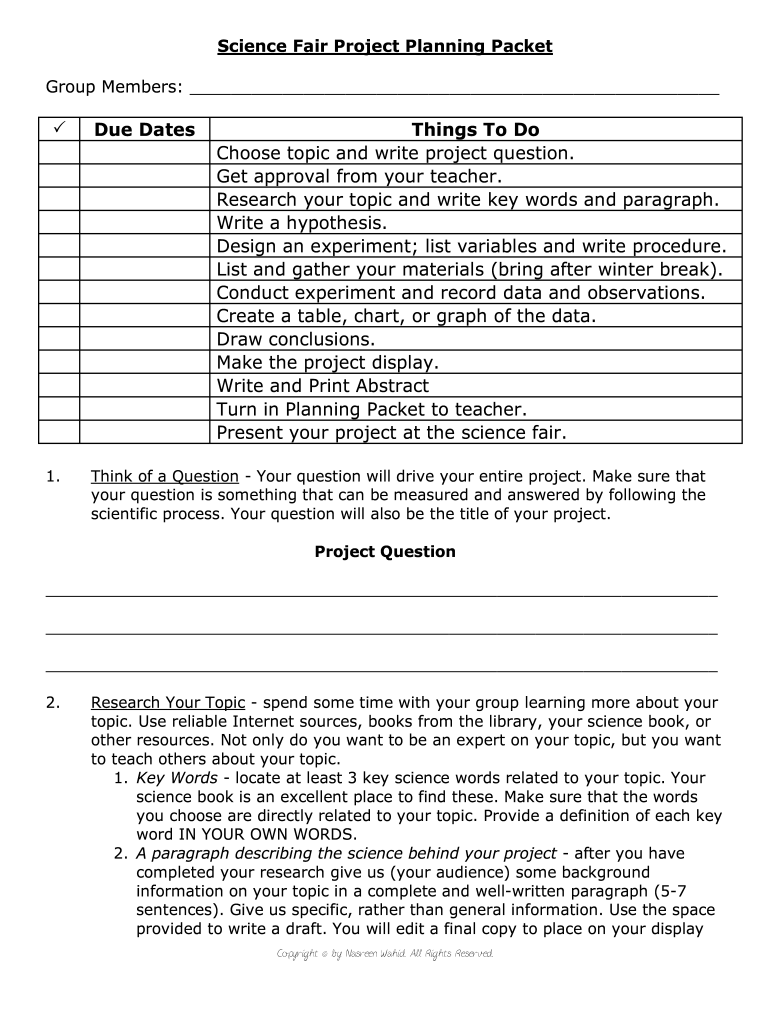
  1. Click ‘Get Form’ to open the Science Fair Project Planning document in the editor.
  2. Begin by entering your group members' names in the designated field at the top of the form.
  3. In the 'Due Dates' section, outline all important deadlines for your project tasks, ensuring you stay organized.
  4. For 'Project Question', formulate a clear and measurable question that will guide your research and experimentation.
  5. In 'Research Your Topic', list at least three key science words related to your project along with their definitions in your own words.
  6. Draft a paragraph summarizing your research findings, providing background information on your topic.
  7. State your hypothesis clearly, explaining what you expect to find and why.
  8. Design your experiment by detailing the procedure and listing variables, ensuring clarity in each step.
  9. Gather all necessary materials needed for conducting your experiment and list them accordingly.
  10. Conduct your experiment, recording data and observations meticulously in the provided sections.
  11. Analyze results by creating graphs or charts based on collected data, then summarize findings in written form.
  12. Draw conclusions about your original question and evaluate whether your hypothesis was correct or not.
  13. Prepare a display board following guidelines provided, ensuring all required components are included.
  14. Finally, write an abstract summarizing your project’s purpose, procedures, results, and conclusions before printing it out for submission.

Start using our platform today to streamline your Science Fair Project Planning process for free!

be ready to get more

Complete this form in 5 minutes or less

Get form

Got questions?

We have answers to the most popular questions from our customers. If you can't find an answer to your question, please contact us.
Contact us
Project Steps Step 1: Introduction. Step 2: Get your idea and do some research. Step 3: Ask a testable question. Step 4: Design and conduct your experiment. Step 5: Examine your results. Step 6: Communicate your experiment and results.
The five-second rule states that food dropped on the ground will be safe to eat and not covered in germs as long as it is picked up within 5 seconds of being dropped. This experiment will evaluate whether there is any truth to this theory.
How to organize your first Science Fair 3 Months Before. Meet with the Principal. Set Dates Confirm Building Use. Build your Dream Team. Plan Essential Activities Budget. Lay Down the Rules. 2 Months Before. Create Effective Signups. Communication is Key. Plan Supporting Activities. Create a Support Structure for Students.
The Short Answer Steps in a science fair project are: pick a topic, research, hypothesis, experiment, construct an exhibit for results, write a report, and practice presenting. Some science fair projects are experiments to test a hypothesis.
Write the experimental procedure like a step-by-step recipe for your science experiment. A good procedure is so detailed and complete that it lets someone else duplicate your experiment exactly! Repeating a science experiment is an important step to verify that your results are consistent and not just an accident.
be ready to get more

Complete this form in 5 minutes or less

Get form

People also ask

Its a review of the relevant publications (books, magazines, websites) discussing the topic you want to investigate. The long answer is that the research paper summarizes the theory behind your experiment. Science fair judges like to see that you understand why your experiment turns out the way it does.

Related links