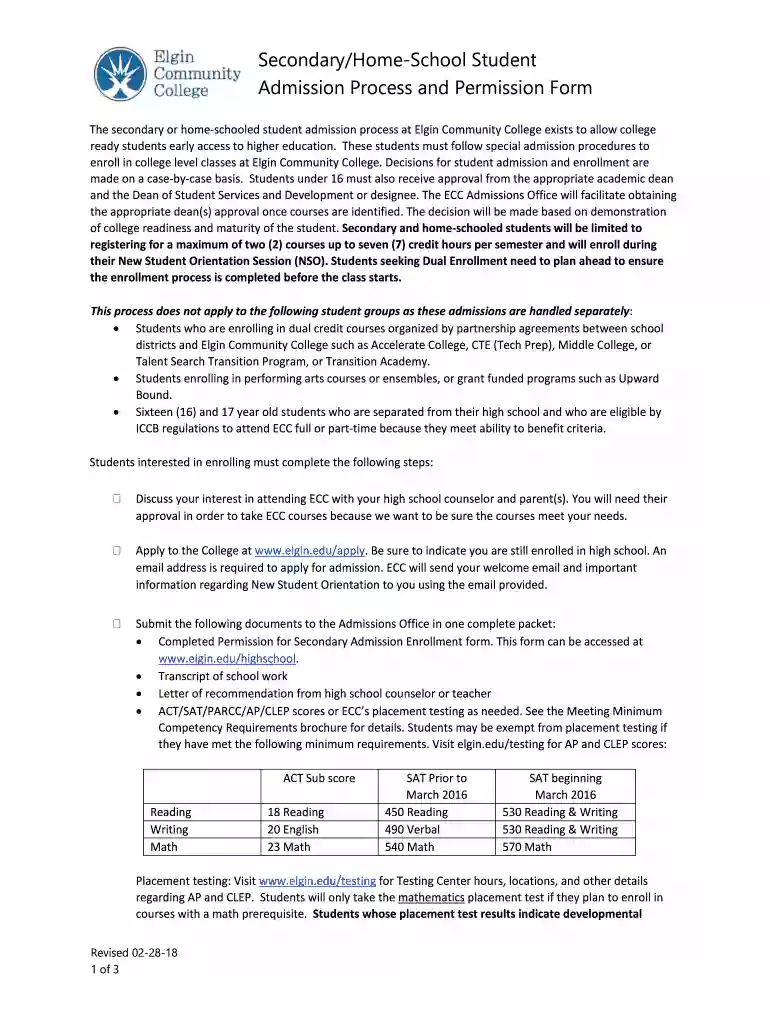
Secondary or Home School Student Admission 2026

Get Form
Secondary or Home School Student Admission Preview on Page 1

Here's how it works

01. Edit your form online
Type text, add images, blackout confidential details, add comments, highlights and more.

02. Sign it in a few clicks
Draw your signature, type it, upload its image, or use your mobile device as a signature pad.

03. Share your form with others
Send it via email, link, or fax. You can also download it, export it or print it out.

Definition & Importance of Secondary or Home School Student Admission

Secondary or Home School Student Admission refers to the process by which students, either attending secondary schools or those being homeschooled, gain entry into higher educational institutions, such as community colleges. This form is essential for transitioning from high school or a homeschooling environment to college-level coursework. Understanding this form's purpose helps both students and educators prepare effectively for higher education.

Key Elements

  • Eligibility Criteria: Establishes who can apply based on age, educational background, or home school accreditation.
  • Documentation: Outlines required materials such as transcripts, standardized test scores, and proof of education for homeschooled students.

Relevance

  • Exemptions and Conditions: Certain student groups may be exempt from this process, highlighting the need for awareness of applicable categories and conditions.

How to Use the Form

Understanding the steps to use this form is crucial for a smooth application process. Here is what you need to know:

Initial Steps

  1. Consultation: Meet with a high school counselor to discuss eligibility and obtain necessary approvals.
  2. Research: Review the college’s specific admission requirements and the form instructions.

Form Completion

  • Application Details: Fill out the form with personal details, educational background, and intended college programs.
  • Permissions and Signatures: Obtain signatures from required parties, such as guardians or academic deans.

Steps to Complete the Secondary or Home School Student Admission

Completing this form involves several precise steps to ensure proper submission and acceptance.

Step-by-Step Instructions

  1. Collect Required Documents: Gather all necessary academic records, test scores, and additional forms, such as approval letters.
  2. Fill Out the Form: Provide accurate information in each section, ensuring clarity and completion of all fields.
  3. Review and Revise: Check for errors or omissions. Double-check the eligibility requirements and documentation needs before submission.

Final Submission

  • Submit the Application: Depending on the institution’s guidelines, submit via online portals, mail, or in-person drop-off.
  • Follow-Up: After submission, monitor your application status, and prepare for additional steps like orientation or interviews.

Who Typically Uses the Secondary or Home School Student Admission

Understanding the typical users of this form can inform applicants about the process.

decoration image ratings of Dochub

Target Audience

  • Secondary Students: Students currently enrolled in high school seeking dual enrollment or early college admission.
  • Home Schooled Students: Those educated at home needing formal assessment for college entry.

Specialized Cases

  • Transfer Students: Students moving from other educational systems or out-of-state schools.
  • International Applicants: Those needing to align their foreign education with U.S. educational standards.

Important Terms Related to the Admission Process

Knowing the terminology helps applicants navigate the process smoothly.

Key Terminology

  • Dual Enrollment: Allows students to enroll in college courses while still attending high school.
  • Accreditation: Recognizes the validity of home school programs and determines eligibility.
  • Transcripts: Official records of academic performance required for application.

Legal Use of the Secondary or Home School Student Admission

Using the form within legal boundaries ensures compliance with educational policies and standards.

Compliance and Legal Framework

  • ESIGN Act Compliance: Allows for legally binding electronic submissions, which may be relevant for institutions accepting digital forms.
  • FERPA Regulations: Protect students' privacy concerning educational records, crucial when handling sensitive information.

Ethical Considerations

Ensuring transparency in how the information is used, and maintaining integrity throughout the application process, is mandatory.

Required Documentation for Admission Process

Preparing the correct documents upfront can expedite the admission process significantly.

Essential Documents

  • High School Transcripts: Official records showing completed coursework and grades.
  • Standardized Test Scores: Such as SAT, ACT, or others as required by the institution.
  • Recommendation Letters: Written attestations from educators or community leaders.

Exceptions and Alternatives

Some colleges may request additional documentation or waive requirements based on special conditions.

Form Submission Methods and Tools

Understanding submission methods can aid in avoiding delays and ensuring timely application processing.

Digital vs. Paper Submissions

  • Online Portals: Simplify the submission process through platforms that support direct uploads and electronic signatures.
  • Mail or In-Person: For institutions requiring physical forms, understanding postal deadlines or office hours is essential.

Integration with Document Platforms

Utilizing document management tools like DocHub can streamline the process by allowing for efficient editing, signing, and submission of electronic forms.

See more Secondary or Home School Student Admission versions

We've got more versions of the Secondary or Home School Student Admission form. Select the right Secondary or Home School Student Admission version from the list and start editing it straight away!
Versions Form popularity Fillable & printable
2019 4.9 Satisfied (25 Votes)
2018 4.1 Satisfied (62 Votes)
be ready to get more

Complete this form in 5 minutes or less

Get form

Got questions?

We have answers to the most popular questions from our customers. If you can't find an answer to your question, please contact us.
Contact us
Common disadvantages of homeschooling include a lack of real-life socialization, limited access to resources and facilities, the demanding load on parents, and potential legal challenges.
Each applicant to Harvard College is considered with great care and homeschooled applicants are treated the same as all other applicants. There is no special process, but all relevant information about your educational and personal background is welcome.
A majority of survey participants 60.9 percent said they attended a non-charter public high school, 34 percent indicated they went to a parochial or non-religious private school, and 0.5 percent reported being homeschooled.
With homeschooled applicants typically making up less than 1% of Harvards freshman class and facing similarly competitive odds at other top institutions like Stanford and Yale, standing out is crucial. But dont let the statistics deter youyour unique educational path can be a powerful asset.
Yale requires letters of recommendation for home-schooled applicants, including two from academic teachers and one from the school counselor. Please do not present letters written only by your parents.

Security and compliance

At DocHub, your data security is our priority. We follow HIPAA, SOC2, GDPR, and other standards, so you can work on your documents with confidence.

Learn more
ccpa2
pci-dss
gdpr-compliance
hipaa
soc-compliance

People also ask

Home educated young people aged 14-16 in England are able to attend college and the Government (currently the Education Skills Funding Agency) will pay for the course. It is up to the colleges whether or not to admit under-16s. These students can do any course agreed by the college, not just a designated 14-16 course.
MIT has a long history of admitting homeschooled students, and these students are successful and vibrant members of our community. We do not have separate requirements for homeschooled applicants.

Related links