
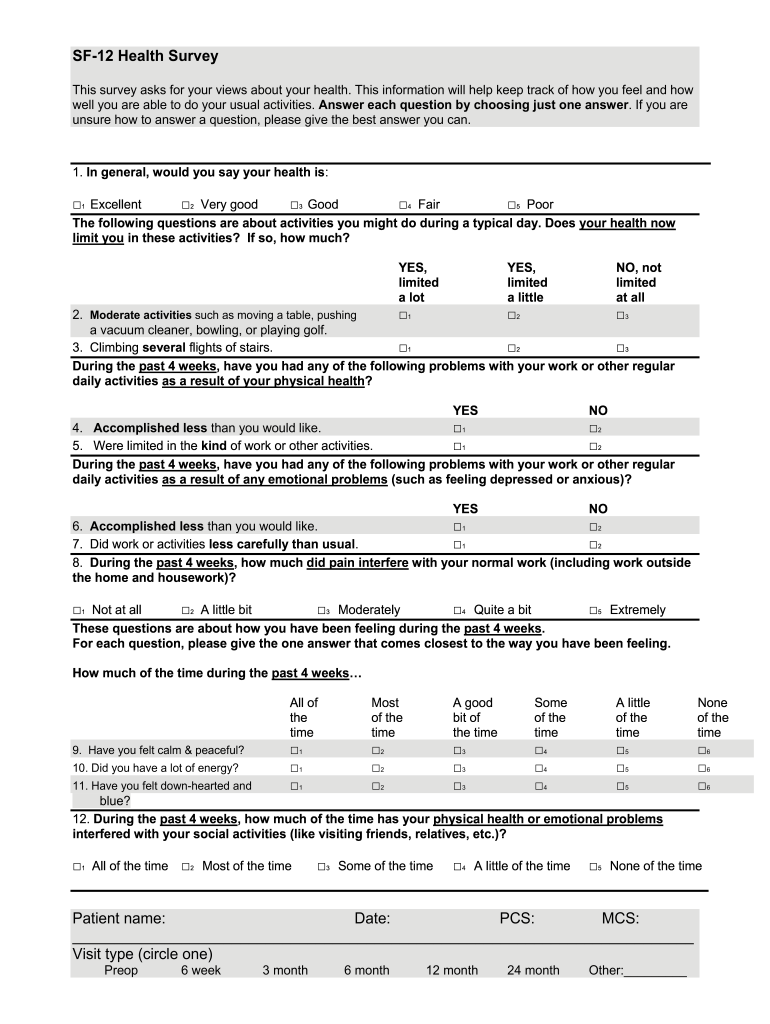







Overview of the SF-12 Health Survey
The SF-12 Health Survey is a concise questionnaire that assesses an individual's overall health status, focusing on the impact of physical and mental health on daily life. It serves as a useful tool for organizations aiming to monitor health outcomes, evaluate patient care, and conduct research. This survey is particularly advantageous because it can produce summary scores that reflect the quality of life of respondents.
Structure and Content of the SF-12
The SF-12 is derived from the broader SF-36 Health Survey and encompasses twelve essential questions. These questions are categorized into two primary components: physical health and mental health.
- Physical Health: Questions in this category assess physical functioning, role limitations due to physical health, pain, and general health perceptions.
- Mental Health: This component evaluates emotional well-being, social functioning, and role limitations associated with mental health issues.
The responses are usually scored on a Likert scale, providing numerical data that can quantify an individual's health status.
How to Administer the SF-12
Distributing the SF-12 Health Survey can be achieved through various methods to accommodate different populations, including:
- Digital Formats: The survey can be administered online using tools designed for healthcare assessments. This method allows for real-time data collection and analysis.
- Paper-Based Administration: For settings where technology may not be accessible, paper versions of the SF-12 can be provided.
- Telephonic Surveys: This approach can be valuable for reaching individuals who may have difficulty engaging with digital formats.
Scoring and Interpretation of Results
The SF-12 yields two summary scores: the Physical Component Summary (PCS) and the Mental Component Summary (MCS). These scores can range from zero to one hundred, where higher scores indicate better health status.
- Scoring Guidelines:
- The PCS score is primarily affected by responses related to physical health limitations and pain, while the MCS score is influenced by mental health-related questions.
- Scoring procedures involve standard algorithms, which can be accessed in the SF-12 scoring manual.
Understanding the interpretation of these scores is critical. For example, a person with a PCS score below fifty may be experiencing significant physical health challenges, possibly indicating a need for intervention.
Applications of the SF-12 Health Survey
The versatility of the SF-12 Health Survey allows it to be utilized across various fields, including:
- Clinical Settings: Healthcare providers use the survey to assess patient outcomes over time and evaluate the effectiveness of treatments.
- Research: Scholars apply the SF-12 in studies to explore correlations between health variables and quality of life, as well as population health trends.
- Public Health: Organizations monitor community health by aggregating data from the SF-12 to identify areas needing improved health services.
Legal and Ethical Considerations
When administering the SF-12, it is essential to adhere to ethical considerations and protect respondents' confidentiality. Compliance with regulations such as HIPAA in the United States is crucial to ensure that personal health information remains secure.
Accessing the SF-12 Health Survey
The SF-12 Health Survey is available in different formats, including PDFs and digital tools that facilitate the survey process. Professionals can download the survey for free or utilize resources from organizations that specialize in health assessments.
Conclusion
The SF-12 Health Survey is an effective tool for capturing the health status of individuals through a simple, user-friendly format. Its applicability across diverse disciplines, coupled with robust scoring and interpretation guidelines, makes it invaluable for clinicians, researchers, and public health officials.




