




01. Edit your form online
Type text, add images, blackout confidential details, add comments, highlights and more.

Type text, add images, blackout confidential details, add comments, highlights and more.

Draw your signature, type it, upload its image, or use your mobile device as a signature pad.

Send it via email, link, or fax. You can also download it, export it or print it out.
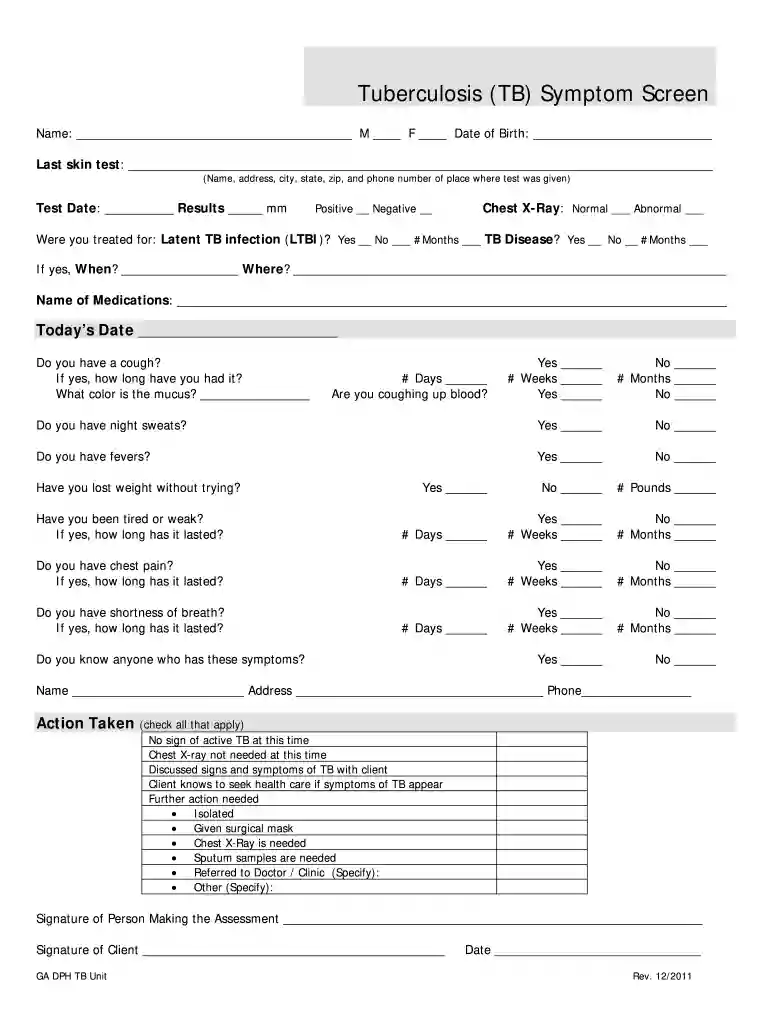
The Tuberculosis (TB) Symptom Screen is a medical document used to evaluate individuals for potential TB symptoms and their history. This screening form collects personal data, previous test results, and current symptoms, like persistent cough, night sweats, and chest pain. Its purpose is to identify those who may need further medical evaluation or intervention for TB, thus playing a crucial role in public health management and individual care strategies.
Completing the TB Symptom Screen requires attention to detail to ensure all pertinent information is accurate and comprehensive.
The TB Symptom Screen is essential for both individual and public health reasons. By identifying potential TB cases early, the form helps prevent the spread of TB within communities. Additionally, early detection can lead to more effective treatment, reducing the likelihood of severe health complications associated with the disease.
Each section of the TB Symptom Screen is designed to gather essential health data that aids in diagnosing potential TB infections.
The TB Symptom Screen is commonly utilized by healthcare professionals, public health entities, and institutions that require TB screening, such as schools and workplaces.


Using the TB Symptom Screen responsibly involves understanding legal and privacy requirements.
While the TB Symptom Screen is generally standardized, specific states may have unique requirements or additional elements specific to their public health strategies.
Consider a scenario where a public school in a high-risk area conducts yearly TB screenings for all new employees. The screening form serves as an initial assessment tool preemptively identifying those who may need a formal diagnostic test.
By providing detailed insights into each of these aspects, the TB Symptom Screen not only plays a critical role in managing the spread of tuberculosis but also ensures individual health and community well-being are prioritized effectively.
We've got more versions of the Tuberculosis (TB) Symptom Screen form. Select the right Tuberculosis (TB) Symptom Screen version from the list and start editing it straight away!
At DocHub, your data security is our priority. We follow HIPAA, SOC2, GDPR, and other standards, so you can work on your documents with confidence.
Dec 19, 2023 TB Symptom Evaluation A cough that lasts three weeks or longer Chest pain Coughing up blood or sputum (phlegm from deep inside the lungs).
May 7, 2025 Form H is NOT a TB clearance. Please complete Form F to issue a TB clearance. 1. How long have you been coughing in the past 12 months?
Prolonged direct contact is generally understood as having been within six feet of a person with a bad continuous cough for at least 8 consecutive hours on a


