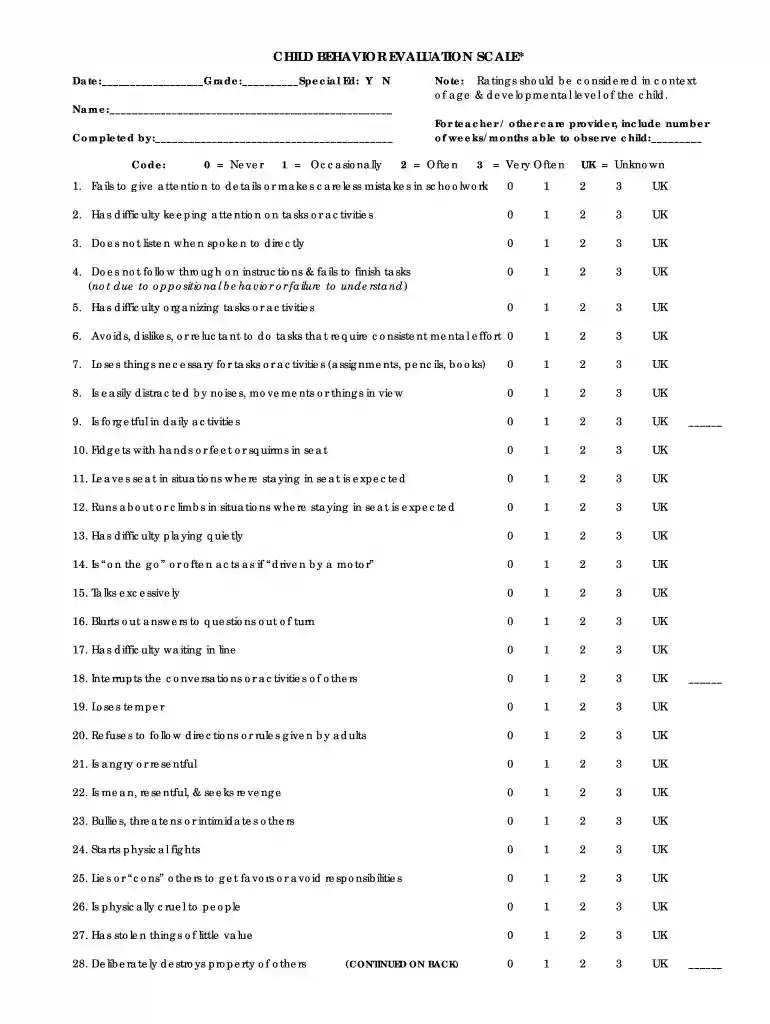
Student behavior evaluation form 2026

Get Form
behavior improvement form doc Preview on Page 1

Here's how it works

01. Edit your behavior improvement form doc online
Type text, add images, blackout confidential details, add comments, highlights and more.

02. Sign it in a few clicks
Draw your signature, type it, upload its image, or use your mobile device as a signature pad.

03. Share your form with others
Send behavior assessment form doc via email, link, or fax. You can also download it, export it or print it out.

How to use or fill out student behavior evaluation form with our platform

Form edit decoration
9.5
Ease of Setup
DocHub User Ratings on G2
9.0
Ease of Use
DocHub User Ratings on G2
  1. Click ‘Get Form’ to open the student behavior evaluation form in the editor.
  2. Begin by filling in the date, grade, and whether the child is in special education. This information sets the context for your evaluation.
  3. Enter the child's name and specify how long you have observed them. This helps provide a comprehensive view of their behavior.
  4. For each behavior listed, select a rating from 0 (Never) to 3 (Very Often) or UK (Unknown). Be mindful of the child's age and developmental level when making your assessments.
  5. In the academic performance section, rate subjects like reading and mathematics on a scale of 1 to 5. This will help identify areas needing support.
  6. Describe three recent events that reflect typical interactions for this child. Provide detailed observations to enrich your evaluation.
  7. Finally, add any additional comments or concerns regarding treatment strategies at the end of the form.

Start using our platform today to easily complete your student behavior evaluation form online for free!

See more student behavior evaluation form versions

We've got more versions of the student behavior evaluation form form. Select the right student behavior evaluation form version from the list and start editing it straight away!
Versions Form popularity Fillable & printable
2012 4.9 Satisfied (46 Votes)
be ready to get more

Complete this form in 5 minutes or less

Get form

Got questions?

We have answers to the most popular questions from our customers. If you can't find an answer to your question, please contact us.
Contact us
The five phases of behavioral assessment in Applied Behavior Analysis (ABA) are essential for understanding and addressing behavior effectively: Screening and General Disposition. Defining and Quantifying Problems. Pinpointing Target Behaviors. Monitoring Progress. Follow-Up Evaluations.
Observe the changes in the students when they are in the classroom and interacting with others. Also, talk to parents about what behaviour changes they are seeing in their child at home. Based on the observations and conversation make a list of the students where they need support or need to pay attention.
The seven steps from FBA to PBS are: Identify the behaviour of concern. Gather Information (data collection) Analyse the Information. Formulate a Hypothesis. Develop a Positive Behaviour Support Plan (or Behaviour Intervention Plan) Implement the Plan / Intervention. Monitor and Evaluate.
10 Positive Ways to Assess and Support Students with Behavior Challenges Focus on Connection and Relationships. If Possible, Get the Students Perspective. Prioritize Prevention. Talk to the Students Family. Use the School Community. Assess and Adapt the Environment. Teach New Skills.
How to Assess Students Learning and Performance Alternative Grading Methods. Creating assignments. Creating exams. Using classroom assessment techniques. Using concept maps. Using concept tests. Assessing group work. Creating and using rubrics.

Security and compliance

At DocHub, your data security is our priority. We follow HIPAA, SOC2, GDPR, and other standards, so you can work on your documents with confidence.

Learn more
ccpa2
pci-dss
gdpr-compliance
hipaa
soc-compliance