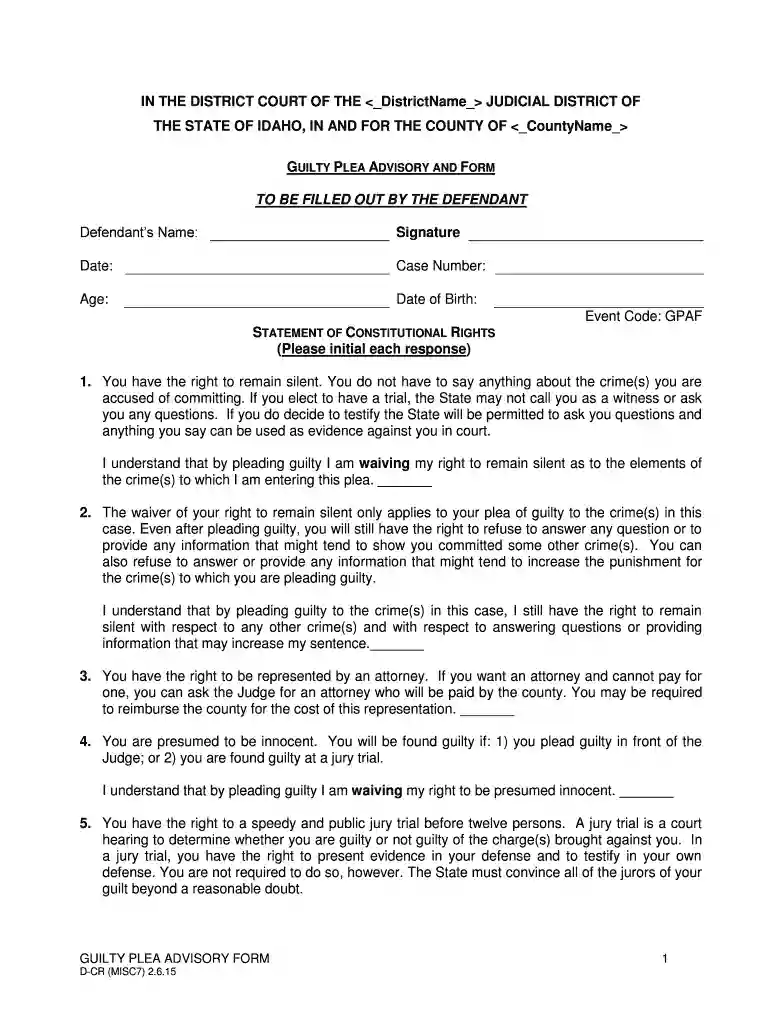
IN THE DISTRICT COURT OF THE JUDICIAL - isc idaho 2026

Get Form
IN THE DISTRICT COURT OF THE JUDICIAL - isc idaho Preview on Page 1

Here's how it works

01. Edit your form online
Type text, add images, blackout confidential details, add comments, highlights and more.

02. Sign it in a few clicks
Draw your signature, type it, upload its image, or use your mobile device as a signature pad.

03. Share your form with others
Send it via email, link, or fax. You can also download it, export it or print it out.

Definition & Meaning

The document titled "IN THE DISTRICT COURT OF THE JUDICIAL - isc idaho" is a formal legal form used in the District Court of Idaho. It is commonly associated with the procedures involving a guilty plea advisory, which outlines the rights and consequences for defendants choosing to plead guilty. This form is essential for ensuring that defendants fully understand their constitutional rights and the implications of their plea decision. The form serves to provide a comprehensive overview of what a guilty plea entails, including potential sentences, additional consequences, and post-plea rights.

How to Use the Form

When utilizing the "IN THE DISTRICT COURT OF THE JUDICIAL - isc idaho" form, defendants should meticulously follow the outlined sections to ensure complete comprehension of their rights and responsibilities. Typically, the form will include areas where the defendant must acknowledge particular elements, such as an understanding of the constitutional rights they are waiving by pleading guilty. It's crucial for defendants to read each section carefully, answer all required questions, and provide accurate personal information. This form serves as part of the plea agreement process, requiring detailed attention to convey informed consent comprehensively.

Steps to Complete the IN THE DISTRICT COURT OF THE JUDICIAL - isc idaho

  1. Read the Form Thoroughly: Start by carefully reviewing each section of the form to understand what information is required and the implications of submitting the form.
  2. Fill Out Personal Information: Include your full name, case details, and other identifying information as requested.
  3. Acknowledge Constitutional Rights: Check the boxes that confirm you understand the constitutional rights you're waiving, such as the right to a trial.
  4. Answer Additional Questions: Respond to inquiries regarding your capacity to make informed decisions and understand the plea’s legal consequences.
  5. Understand Potential Sentences: Review the listed potential sentences that might result from pleading guilty.
  6. Consider Additional Consequences: Be aware of any non-criminal consequences, such as impacts on immigration status or civil rights, noted on the form.
  7. Post-Plea Rights: Acknowledge your awareness of rights retained post-plea, like the right to appeal under certain conditions.
  8. Sign and Date the Form: Provide your signature to affirm that all information is correct and that you have understood the form in its entirety.

Key Elements of the Form

  • Defendant's Information: Includes personal and case-specific details that identify the user of the form.
  • Constitutional Rights: Sections that detail rights the defendant is waiving by pleading guilty, such as the right to a jury trial.
  • Questions on Competency: A set of questions verifying the defendant's mental and physical ability to make legal decisions.
  • Sentencing Information: Provides potential punishments and sentencing possibilities upon pleading guilty.
  • Additional Consequences: Covers other consequences, including but not limited to civil rights impacts and future legal implications.
  • Post-Plea Rights: Outlines rights that the defendant retains even after accepting the plea, such as limited appeal rights.

Who Typically Uses the Form

The primary users of the "IN THE DISTRICT COURT OF THE JUDICIAL - isc idaho" form are defendants in Idaho's judicial system considering entering a guilty plea. Legal professionals, including defense attorneys, might also use the form to guide their clients through the plea process. Additionally, court officials may provide this form as part of the procedural requirements in plea bargain negotiations.


decoration image ratings of Dochub

Legal Use of the Form

The form is employed specifically within Idaho’s legal framework to facilitate the plea bargaining process. It legally documents the defendant's informed decision to plead guilty while ensuring that all the legal consequences and rights have been communicated effectively. This documentation protects both the court and the defendant by providing a clear record of understanding and consent.

Important Terms Related to the Form

  • Guilty Plea: An admission of wrongdoing whereby the defendant accepts the charges brought against them, often in exchange for a more lenient sentence.
  • Constitutional Rights: The rights guaranteed to individuals under the U.S. Constitution, which might be waived during a guilty plea.
  • Sentencing: The judicial determination of a punishment for a crime committed, agreed upon during the plea.
  • Waiver: The voluntary relinquishment of specified legal rights by the defendant as a condition of the plea.

State-Specific Rules for Idaho

Idaho has specific rules governing the usage of the guilty plea advisory form. These rules mandate that defendants are made fully aware of their rights and the potential consequences of pleading guilty. The judicial system in Idaho requires that these forms be completed accurately to uphold the integrity of the criminal justice process. Specific nuances, such as local sentencing guidelines and the role of plea negotiations, are particular to Idaho’s judicial procedures.

See more IN THE DISTRICT COURT OF THE JUDICIAL - isc idaho versions

We've got more versions of the IN THE DISTRICT COURT OF THE JUDICIAL - isc idaho form. Select the right IN THE DISTRICT COURT OF THE JUDICIAL - isc idaho version from the list and start editing it straight away!
Versions Form popularity Fillable & printable
2016 4.8 Satisfied (100 Votes)
2015 4 Satisfied (22 Votes)
be ready to get more

Complete this form in 5 minutes or less

Get form

Got questions?

We have answers to the most popular questions from our customers. If you can't find an answer to your question, please contact us.
Contact us
Criminal matters the Circuit Court deals wit The Circuit Court hears criminal matters triable on indictment, except for certain serious crimes which are tried in either the Central Criminal court or the Special Criminal Court. Most indictable offences are dealt with in the Circuit Court.
Types of Cases the Federal Circuit Handles international tradecertain monetary claims against the United States government government contracts federal personnel patents veterans benefits trademarks public safety officers benefits claims
Once the federal district court has decided a case, the case can be appealed to a United States court of appeal. There are twelve federal circuits that divide the country into different regions.
A circuit court has the power to issue death sentences and impanel grand juries. The courts decisions become legal precedents.
District courts are lower and have the responsibility for holding trials, while circuit courts are appellate courts that do not hold trials but only hear appeals for cases decided by the lower court.

Security and compliance

At DocHub, your data security is our priority. We follow HIPAA, SOC2, GDPR, and other standards, so you can work on your documents with confidence.

Learn more
ccpa2
pci-dss
gdpr-compliance
hipaa
soc-compliance

People also ask

Go to the iCourt Portal at: and click on Make Payments. There are several options for looking up a case to make a payment on: Select how you want to look up your case: Citation Number Enter the entire citation number.
Complexity of Cases: The General District Court usually deals with straightforward cases, while the Circuit Court handles more complex and serious legal matters.

Related links